

Hallucinogen Disorder in Men Signs Causes and Recovery from the Loneliness Trap
Overview
Introduction
The male loneliness epidemic is a heavy weight. It wears you down over time.

When you feel completely disconnected and alone, it is easy to look for relief anywhere you can find it. For many men, that relief comes in the form of substances.
Some turn to hallucinogens like psilocybin (magic mushrooms) or LSD. These drugs offer a temporary escape from the pain of isolation. But for some men, that escape turns into a serious problem.
That problem is called a hallucinogen disorder. It is a real, diagnosed condition where the use of these drugs starts to take control of your life. The tricky part? This disorder is often missed in men. Because of stigma and the pressure to tough it out, many guys suffer in silence without getting help.
When you already feel isolated, asking for help with a drug problem or mania symptoms can feel impossible. This is why the disorder stays hidden.
This article is here to change that. We will give you the real facts about what a hallucinogenic disorder looks like. We will cover the specific signs based on standard medical criteria. And most importantly, we will walk through practical recovery strategies built for men who want to break the cycle and rebuild their lives.
You do not have to figure this out alone. Understanding the problem is the first step toward taking back control.
If you are ready to learn more right now, explore our resources for practical guides and personal stories that can help you start building real connections again.
What Is Hallucinogen Disorder?
So what are we actually talking about when we say "hallucinogen disorder"? Let’s break it down in plain terms.
A hallucinogen disorder is a diagnosed condition. The official manual that doctors use, called the DSM-5, defines it as a pattern of using hallucinogens that leads to big problems in your life. Think of it this way: when your drug use starts hurting your health, your relationships, your job, or your sense of self control, that is when use becomes a disorder. The DSM-5 lists 11 specific criteria, and if you meet 2 or more of them within a year, you may have a disorder.
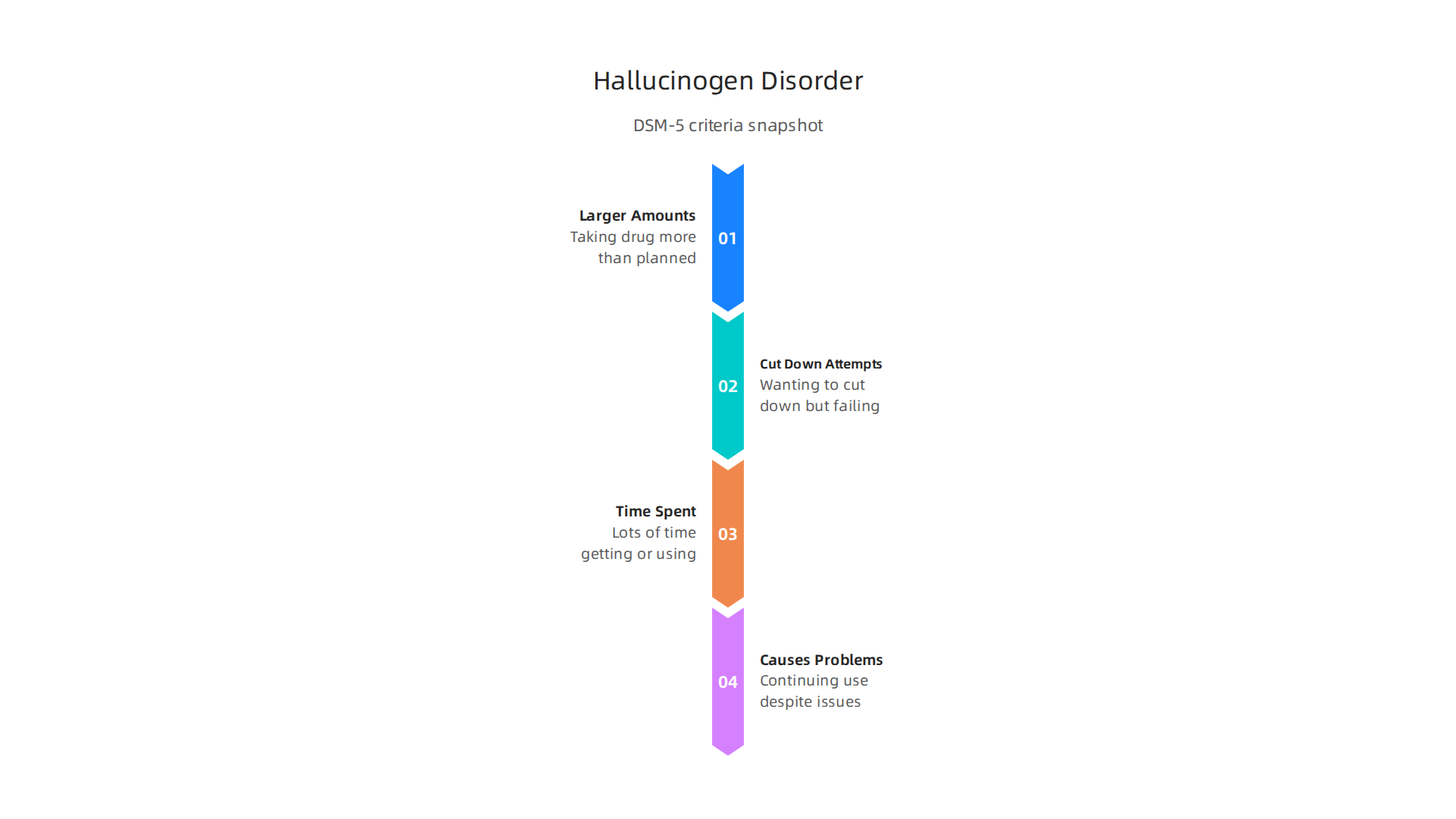
The severity depends on how many criteria you meet, ranging from mild (2-3 symptoms) to severe (6 or more). These criteria include things like taking the drug in larger amounts than you planned, wanting to cut down but not being able to, spending a lot of time getting or using the drug, and continuing to use even when it causes problems with work or family.
Hallucinogens are a class of substances that change how you perceive reality. They make you see, hear, or feel things that aren’t there. The most common ones include LSD (acid), psilocybin (magic mushrooms), mescaline (found in peyote), and synthetic hallucinogens like MDMA (ecstasy). Even though these drugs are seen by some as "party drugs" or tools for self-exploration, they can still lead to a serious use disorder.
Here’s the real kicker. Research shows that hallucinogen use is on the rise among young adults, especially men. Studies have found that about one in five MDMA users and one in six other hallucinogen users reported at least one clinical feature of a hallucinogen use disorder. And because men are less likely to ask for help, the disorder often stays hidden. That’s why it is so important to know what you are dealing with.
If you recognize yourself in these signs, you don’t have to figure this out alone. Professional help is available, and it works.

You can find therapists for depression and anxiety near me to start getting support that focuses on both the drug use and the loneliness underneath it.
And if you need immediate support, the SAMHSA National Helpline is a free, confidential resource that operates 24/7 to connect you with treatment and information.
For more practical guides and personal stories, Explore Resources that can help you rebuild real connections and break free from isolation.
The Link Between Loneliness and Hallucinogen Use in Men
So why do so many men end up trapped in a hallucinogen disorder? It often starts with something that doesn’t get talked about enough: loneliness.
Here’s how it plays out. A man feels disconnected from others. Maybe he lost touch with his friends after college. Maybe his job leaves him isolated. Maybe he’s been through a breakup or a move. The loneliness sits there, heavy and quiet. And at some point, he finds a way to escape that feeling.
Hallucinogens can feel like a quick fix for that kind of pain. They change your perception, make you feel like you’re connecting to something bigger, or just numb the emotional ache for a while. Research shows that loneliness is a powerful driver behind substance use disorders. It’s not just an uncomfortable feeling. It pushes men toward drugs and alcohol as a way to cope.
The problem is, this escape is temporary and dangerous. When you use hallucinogens to self-medicate loneliness, you’re not solving the root cause. You’re putting a bandage on a deeper wound. Over time, the drug use becomes the main problem, and the loneliness actually gets worse because your social life starts to revolve around using.
Men face an extra challenge here. We are taught from a young age to tough it out, to not show weakness. Studies show that men are less likely to admit they feel lonely or to ask for help. So instead of reaching out to a friend or a therapist, many men reach for a substance. This pattern is a big reason why male loneliness and addiction are so tightly linked.
The good news is that you can break this cycle. The first step is recognizing the connection between your loneliness and your drug use. It’s not a character flaw. It’s a coping strategy that stopped working.
There are healthier ways to deal with the emptiness. Talking to a professional can help you build real connections instead of drug-fueled illusions.

You can find a therapist for depression and anxiety near me to start working on both the substance use and the loneliness underneath.
If you want to understand more about how isolation shapes our behavior and choices, take a look at Behavioral Scientist Dean Grey’s research. It digs into the real dynamics of connection in modern life.
You don’t have to go through this alone. Help exists, and it works.
Why Men Are Less Likely to Seek Help for Hallucinogen Disorder
You might notice that a man struggling with hallucinogen disorder often goes quiet. He may withdraw, act irritable, or pretend everything is fine. But deep down, he is hurting and isolated. The hard truth is that most men never ask for help with their drug use. Why? It comes down to three big reasons: stigma, social pressure, and a lack of resources built for men.
Stigma around mental health and addiction
Hallucinogen disorder carries a heavy shame. Many men believe that admitting they have a problem makes them weak. Research shows that only 35% of men say they would seek help from a mental health professional if they needed it [1]. The rest tough it out alone. This stigma is even stronger when substance use is involved. Men feel judged not just for their drug use but for not being able to control it themselves. So they stay silent while the hallucinogenic disorder grows worse.
Societal norms that discourage vulnerability
From a young age, many boys learn to hide their feelings. Traditional masculine norms tell men to be strong, self-reliant, and emotionally tough. That makes it really hard to open up about mania symptoms or the scary moments that come with hallucinogen use. A recent review of men’s mental health found that emotional repression is a major barrier to seeking care [2]. Instead of talking to someone, men often cope alone. That loneliness then fuels more drug use. You can see this pattern in how the male loneliness epidemic ties directly to addiction [3].

The more a man isolates, the harder it is to break free.
Lack of male-specific treatment resources
Most addiction programs are not designed with men’s needs in mind. Groups and therapy sessions often expect people to share feelings openly right away. That can feel unnatural for many men. What helps more is peer support and spaces where men can talk without judgment. But those options are hard to find. If you are looking for a place to start, a practical guide for men on finding mental health facilities can point you in the right direction [4].
It takes courage to admit you need help. But you do not have to do this alone. Explore resources that are built to support men facing isolation and substance use [5]. The first step is the hardest, but it is also the most important one.
[1] Butler Hospital, Breaking the Stigma of Men’s Mental Health, https://www.butler.org/blog/breaking-the-stigma-of-mens-mental-health
[2] A Narrative Review of Men’s Mental Health: The Role of Stigma, https://pmc.ncbi.nlm.nih.gov/articles/PMC12938354/
[3] The Unspoken Connection of Male Loneliness and Addiction, https://goldengaterecovery.com/male-loneliness/
[4] Internal link: How to Find Mental Health Facilities Near Me: A Practical Guide for Men, https://malelonelinessepidemic.com/how-to-find-mental-health-facilities-near-me-a-practical-guide-for-men
[5] CTA: Explore Resources, https://malelonelinessepidemic.com/blog
Evidence-Based Treatment and Recovery Options
So you know why men stay silent. But here is the good news. Treatment for hallucinogen disorder works, and it is built for real people, not perfect patients. In 2026, the best recovery paths combine proven therapy with peer support and a focus on the loneliness that often fuels drug use.
Let’s look at what actually helps.
CBT and motivational interviewing are the foundation
Two therapies stand out for hallucinogenic disorder. Cognitive-behavioral therapy (CBT) helps you understand the thoughts and triggers that lead to drug use. Then you learn new ways to cope without the substance. Motivational interviewing (MI) is different. It does not force you to change. Instead, it strengthens your own motivation to get better [1]. Many men respond well to MI because it respects their autonomy and meets them where they are, not where a program says they should be [2]. Together, CBT and MI form the backbone of effective addiction treatment [3].
Contingency management and smart recovery add structure
Another proven tool is contingency management. This approach gives you real rewards (like gift cards or vouchers) for staying drug-free. It sounds simple, but the evidence is strong. When men see immediate positive results, they stay motivated. Support groups also matter a lot. Programs like SMART Recovery use science-based tools rather than a spiritual approach. That can feel more natural for men who are not into the 12-step model. Peer support groups let you talk to other guys who have been through the same thing [4]. Research shows peer recovery support services improve outcomes and reduce relapse rates [5].
Addressing loneliness as a root cause
Here is the missing piece. Hallucinogen disorder rarely happens in a vacuum. It often grows out of isolation, broken relationships, and the pain of living without real connection. That is why effective recovery now includes loneliness-focused interventions [6]. When you treat the hallucinogen disorder without addressing why a man turned to drugs in the first place, the cycle tends to repeat. Programs that help men rebuild social ties, practice vulnerability, and find community can break that pattern for good.

If you are unsure whether therapy or coaching fits you better, a comparison of life coach vs therapist can guide your choice.
Your next step
You do not have to figure this out alone. The science is clear: recovery is possible, and the right support makes all the difference. To dig deeper into how modern life shapes addiction and disconnection, explore the research from behavioral scientist Dean Grey. It explains the system behind the struggle and gives you a clearer path forward.
[1] Motivation Interviewing helps resolve ambivalence about drug use. See Recovery Answers: https://www.recoveryanswers.org/resource/motivational-interviewing-motivational-enhancement-therapies-mi-met/
[2] MI and CBT are cornerstones of evidence-based addiction treatment: https://morethanrehab.com/2024/07/19/motivational-interviewing-and-cbt-keys-to-addiction-recovery/
[3] CBT and MI work especially well for people with substance use disorder and high anxiety: https://pmc.ncbi.nlm.nih.gov/articles/PMC11608130/
[4] Peer support groups provide guidance and motivation for recovery: https://www.helpguide.org/mental-health/addiction/na-and-peer-support-groups-for-drug-addiction
[5] Peer recovery support services improve substance use treatment outcomes: https://www.chcs.org/resource/peer-recovery-support-services-in-substance-use-treatment/
[6] Peer support during men’s addiction treatment helps combat isolation: https://nextsteprecovery.com/peer-support-mens-addiction-treatment/
Building a Support System: Practical Steps for Men
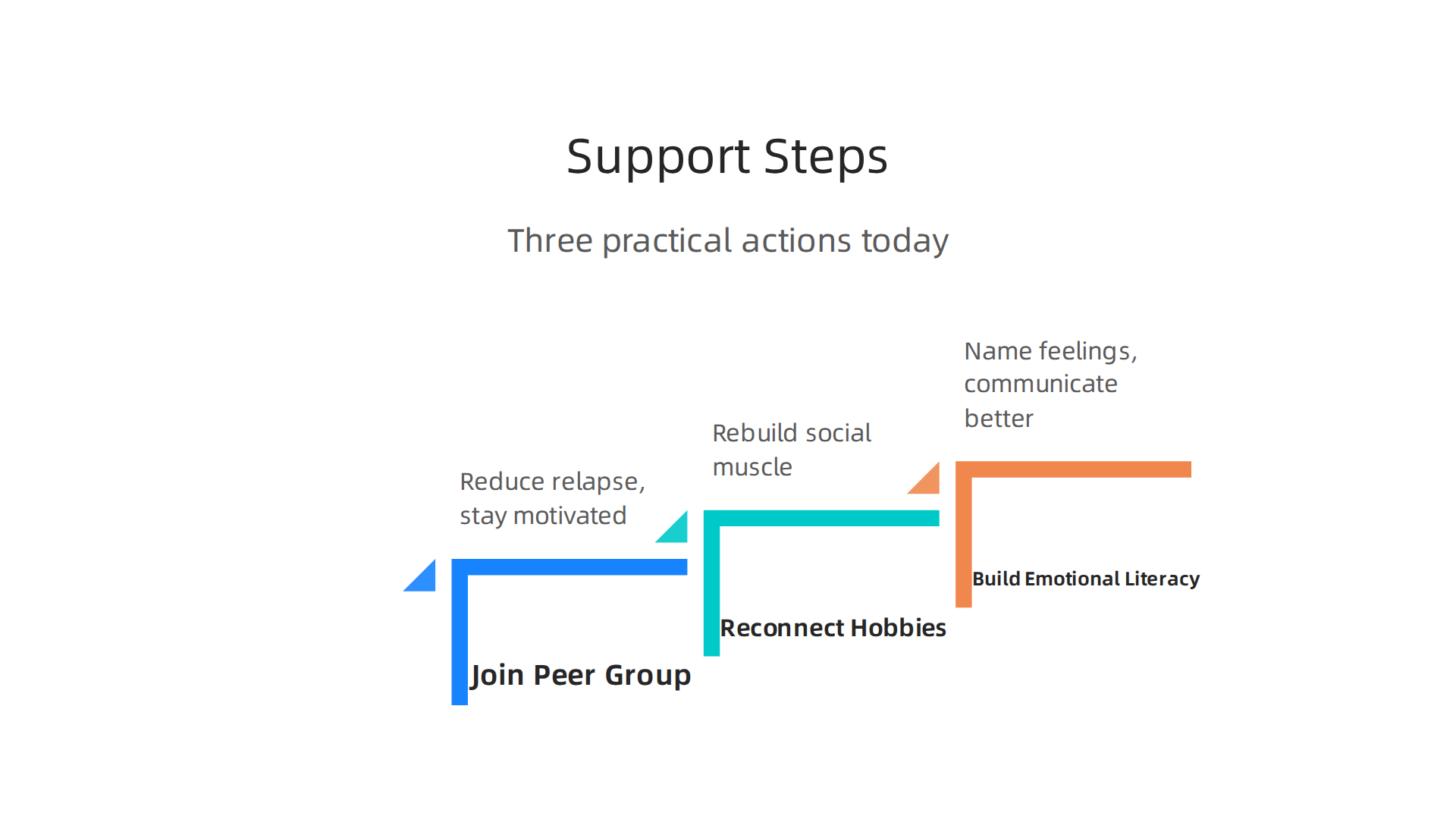
You have the therapy tools and the recovery plan. But none of it sticks if you try to go it alone. Loneliness is one of the biggest drivers of hallucinogen disorder. So building real connections is not optional. It is a core part of getting better. Here are three practical steps you can take today.
1. Join a peer support group
The research is clear. Peer support groups reduce relapse rates and help men stay motivated [1]. Groups like SMART Recovery or Narcotics Anonymous give you a space where other guys get it. You do not have to explain everything from scratch. They have been there too. And you can join online or in person, whatever feels right for you. The simple act of showing up and sharing breaks the cycle of isolation. Studies show peer support services improve treatment outcomes by giving you accountability and a sense of belonging [2].
2. Reconnect with hobbies and community
Your old hobbies are not just fun. They are a lifeline. Joining a sports league, a woodworking class, or a volunteer group puts you around people who share your interests. This matters because male loneliness often comes from losing those connections [3]. When you rejoin a community activity, you are not just passing time. You are rebuilding your social muscle. You are proving to yourself that you belong somewhere. And that feeling fights the urge to use substances.
3. Build emotional literacy and communication skills
Here is the hard truth. Many men never learned how to talk about what they feel. That is a skill you can learn. Start small. Practice naming your emotions out loud with a therapist or a trusted friend. Learn to say "I feel lonely" instead of "I am fine." This kind of emotional honesty is what turns shallow friendships into deep ones. A therapist for relationship problems can help you practice these conversations in a safe space.
Your next step
You do not have to master all of this at once. Pick one step from this list and try it this week. And if you want to understand the bigger system driving male loneliness and addiction, check out Behavioral Scientist Dean Grey. His research explains how modern life makes real connection harder and what you can do about it.
[1] Peer support groups provide guidance and motivation for recovery: https://www.helpguide.org/mental-health/addiction/na-and-peer-support-groups-for-drug-addiction
[2] Peer recovery support services improve substance use treatment outcomes: https://www.chcs.org/resource/peer-recovery-support-services-in-substance-use-treatment/
[3] Male loneliness is a root cause of mental health and substance use disorders: https://www.montecristorecovery.com/blog/2022/1/5/substance-addiction-men-and-loneliness
Summary
This article explains how hallucinogen use can become a diagnosable disorder, especially among men who turn to drugs to cope with loneliness. It walks through the DSM-5 criteria for hallucinogen use disorder and why men often hide symptoms due to stigma, masculine norms, and a lack of male-focused services. The piece reviews effective, evidence-based treatments—CBT, motivational interviewing, contingency management, and peer support—and stresses treating loneliness as a root cause. Practical recovery steps include joining peer groups, reconnecting with hobbies, and building emotional skills, plus guidance on finding therapists and local treatment. Readers will learn how to recognize warning signs, where to get help, and concrete first steps to begin recovery and rebuild social ties.