

Life Coach vs Therapist for Lonely Men How to Choose the Right Help
Overview
Introduction
Have you ever felt completely alone even when you are surrounded by people?

You are not the only one. The data from 2026 is clear. A recent Gallup study found that 25% of young men in the United States reported feeling lonely a lot of the day. That is one in four men between the ages of 15 and 34. And this problem does not stop at the border. Men across the UK, Australia, and Canada are reporting similar struggles with isolation.
The health effects are serious. Loneliness does not just feel bad. It is linked to higher rates of depression, anxiety, heart problems, and even early death. Men are nearly 50% less likely than women to reach out to friends or family when they feel lonely, according to recent data. So many suffer in silence.
Here is the tricky part. When a man finally decides to get help, he faces a confusing choice. Do you see a life coach? Or a therapist? Both titles sound similar. Both claim to help you feel better. But they are very different in how they work and what they treat.
That confusion stops too many men from taking the first step. And every day of delay makes the loneliness worse.
This article is here to fix that. We will break down the difference between a life coach and a therapist. We will look at what each one actually does. We will cover the evidence behind each approach. And we will help you decide which one is the right starting point for your situation.
No jargon. No fluff. Just a clear path forward for men who want to stop feeling alone.
If you have been wondering about the life coach vs therapist question, you have come to the right place. Let us start by understanding the male loneliness crisis and why it matters so much right now.
Understanding the Male Loneliness Epidemic
You might think loneliness only hits young guys scrolling on their phones. But the truth is more complicated. Men in their 40s, 50s, and beyond feel it just as deeply. They just hide it better.
A recent eight country study on young adult loneliness found that nearly four in 10 adults across eight different countries reported feeling lonely. For people aged 18 to 24, that number jumped to almost one in two. So this is not a small problem. It is widespread and it touches every age group.
Why is this happening? A big reason is the way society teaches men to handle emotions. From a young age, many boys hear messages like "tough it out" or "don’t be so sensitive." These rules stick. By adulthood, many men have built walls around their feelings. They do not know how to let others in. And when loneliness creeps up, they feel ashamed to admit it.
Here is another piece of the puzzle. We are more connected digitally than ever before. But those connections often stay shallow. A text message or a like on a post is not the same as sitting with a friend and talking about real stuff. Digital interactions can actually make loneliness worse because they create the illusion of connection without the depth. Many men end up with dozens of online acquaintances and zero real friends they can call at 2 a.m.
This silent struggle takes a toll. Loneliness is not just an emotional ache. It raises the risk of depression, anxiety, heart disease, and even early death. And because men are less likely to reach out for help, they often suffer alone for years. The cycle feeds itself. Loneliness makes it harder to connect, and less connection makes the loneliness worse.
If you recognize yourself in this picture, you are not broken. You are responding to a real problem that millions of men face. The first step is simply understanding how deep this issue goes. Learning about the personal and systemic pressure of isolation can help you see that change is possible. You do not have to stay stuck.
Once you see the full picture, the question becomes: what do you do about it? That is where the choice between a life coach and a therapist comes in. But before we get there, know this. The male loneliness epidemic is real, but it is also reversible. Many men have found their way back to connection. And male loneliness counseling offers a proven path forward for those ready to take the first step.
What Is a Life Coach? Scope, Training, and Approach
So you have heard the term "life coach" thrown around a lot. Maybe a buddy told you his coach helped him land a promotion. Maybe you saw an ad promising to unlock your full potential. But when you are weighing a life coach vs therapist, it helps to know exactly what a life coach does and does not do.
A life coach is like a personal trainer for your goals. They help you figure out what you want, then hold you accountable for taking the next steps.

The focus is forward looking. Coaches ask questions like, "Where do you want to be in six months?" and "What is one small action you can take today?" They do not dig into your past or diagnose mental health conditions. That is a big difference between the life coach vs therapist roles.
Coaches work on goal setting, career moves, relationships, fitness, and everyday habits. They are great if you feel stuck in a rut and need someone to push you forward. But they are not licensed to treat depression, anxiety, trauma, or loneliness that runs deep. If you are struggling with a clinical issue like severe depression or OCD, a therapist is the right call. A coach simply does not have the training for that.
Training and Credentials
Here is where things get tricky. The coaching world is not as tightly regulated as therapy. Anyone can call themselves a life coach with almost no training. So you need to look for real credentials.
The leading standard is the International Coaching Federation (ICF). Coaches who earn an ICF credential have completed hundreds of hours of training and coaching practice, and they must follow a strict code of ethics. This is why ICF certification has become the gold standard for professional coaches, offering credibility and systematic training. Many top coaches proudly display their ICF badge. It tells you they take their work seriously and have proven their skills.
Some coaches also have degrees in psychology or counseling, but that is not required to be a coach. The key point in the life coach vs therapist decision is this: a coach supports your growth, while a therapist heals your wounds.
How This Connects to Loneliness
If loneliness is making it hard to set goals, build friendships, or feel motivated, a life coach could help you take the first practical steps. They can help you create a plan to join a club, start a conversation, or build a routine that gets you out of the house. But if the loneliness comes with deep sadness, panic attacks, or thoughts of harming yourself, you need a therapist first. That is not something a coach is equipped to handle.
This is why knowing the difference matters so much. You should not waste time and money on the wrong kind of help. And you should not give up because one approach did not work for you.
To explore this decision more, check out our full comparison of life coach vs therapist and which one lonely men should try first.
What Is a Therapist? Licensing, Modalities, and Clinical Approach
Let’s flip the coin. If a life coach is your forward-looking goal buddy, a therapist is more like a skilled guide for your inner world. Therapists are licensed professionals with years of training to diagnose and treat mental health conditions. When you think about the life coach vs therapist question, this is the biggest difference.
Licensing and Training
Therapists cannot just hang a shingle. In the US and Canada, therapists must meet strict state or provincial requirements. For example, psychologists need a doctoral degree from an accredited program, plus supervised hours and a licensing exam. The Canadian Psychological Association outlines that each province has its own province-specific licensing requirements for psychologists. The same goes for counselors and social workers. They must complete a master’s or doctoral degree, pass a board exam, and keep learning to maintain their license. This means the therapist you see has gone through a long, regulated process to earn the right to help you.
Because of this training, therapists can diagnose conditions like depression, anxiety, OCD, or bipolar disorder. They can also create treatment plans. That is something a life coach cannot do. So if you are struggling with a clinical issue like cognitive behavioral therapy for ocd, the choice in the life coach vs therapist debate becomes much clearer.
Common Therapy Modalities
Therapists use different approaches depending on your needs. You might have heard of cognitive behavioral therapy (CBT), which focuses on changing negative thought patterns. CBT is backed by decades of research and works well for anxiety, depression, and even anger issues. There is also psychodynamic therapy, which looks at how your past shapes your present. Humanistic therapy focuses on your capacity for growth and self-acceptance. Many therapists blend these methods to fit you.
The Real Work of Therapy
The heart of therapy is emotional processing and healing. You talk about what hurts, what scares you, and what you have been holding in. The therapist creates a safe space where you can be honest without judgment. Over time, you learn to understand yourself better and heal old wounds.

This is different from coaching, which stays focused on future goals.
If loneliness is tied to deeper pain like trauma or long-term sadness, therapy is often the right first step. It gives you the foundation you need before you can move forward. For a practical next step, explore our full guide on male loneliness counseling to see how professional support can transform your social life.
Key Differences: Life Coach vs Therapist
The easiest way to understand the life coach vs therapist question is to lay everything side by side.
A quick comparison table can help you see where each path leads.
| Aspect | Life Coach | Therapist |
|---|---|---|
| Training and Licensing | Short courses or ICF certification; no government license required | Master’s or doctoral degree; state license required |
| Focus and Approach | Future goals, action plans, accountability | Past experiences, emotions, mental health |
| Scope of Practice | Goal setting, career, relationships (non-clinical) | Diagnose and treat mental health conditions |
| Can Diagnose? | No | Yes |
| Best For | Motivated people who want next-step guidance | People struggling with depression, anxiety, trauma, or other clinical issues |
What the Table Tells You
Training requirements are the biggest split. Therapists must meet strict state rules. For example, an ICF Coaching Credentials guide shows that life coaches need between 60 and 125 hours of education. Therapists need thousands of hours. An International Credential Equivalency Guide for Mental Health Professionals shows how doctoral and master’s level training varies across countries, but the standard is always high.
Scope of work is another big difference. A life coach helps you set goals and take action. A therapist works through your past, your emotions, and any clinical symptoms you have. If you are dealing with cognitive behavioral therapy for anger issues or cognitive behavioral therapy for ocd, a therapist is the right choice. A coach cannot treat those conditions.
When Therapy Should Come First
Here is the most important takeaway. If you are a man dealing with clinical depression, trauma, or long-term sadness, skip the coach for now. See the therapist first. That professional has the training to diagnose what is happening and create a real treatment plan. Once you have a stable emotional foundation, a life coach can help you build forward from there. For more on this decision, check out our full life coach vs therapist analysis for lonely men.
Which One Helps Lonely Men First? A Decision Framework
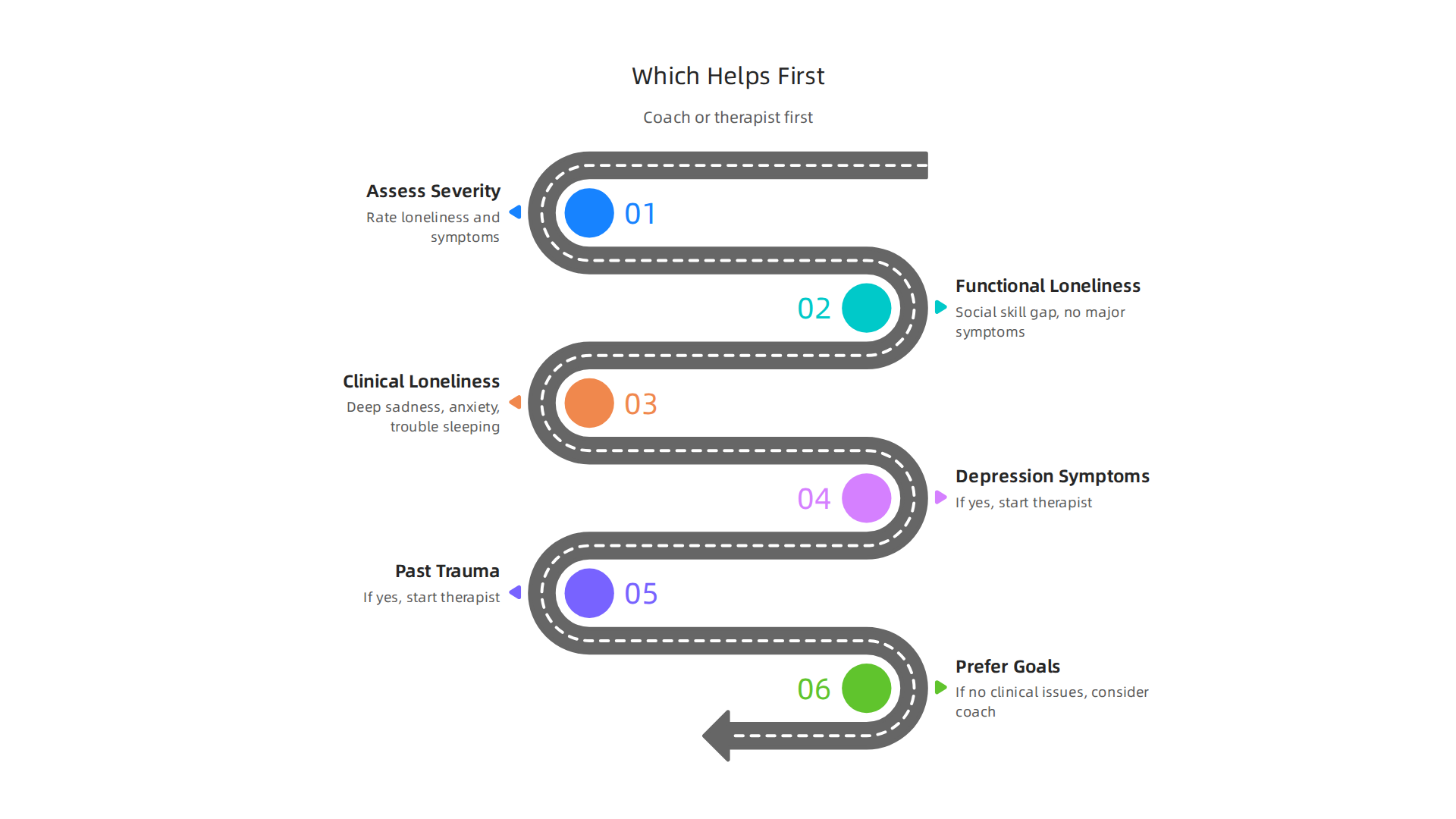
So you have read the differences. The comparison table is clear. But now you are stuck at the real question. How do you know which path is right for you?
Here is the honest answer. It depends on how bad the loneliness is. And it depends on what else might be going on underneath.
Two Kinds of Loneliness
Not all loneliness looks the same. For some men, loneliness feels like a social skill gap. You want friends but do not know how to start conversations. You feel awkward at work or in groups. You have no major mental health symptoms. You just feel stuck and isolated.
That is functional loneliness. And for that, a life coach can be a great fit. A coach helps you build a plan. They hold you accountable. They push you toward action. You can work on making friends, trying new hobbies, or improving how you talk to people. The goal is forward movement. A good Coaching vs Therapy comparison explains that coaches focus on future goals while therapists dig into past patterns.
Now think about the second kind. You feel lonely and also have deep sadness that will not lift. You feel anxious around people. You have old trauma that makes trust hard. You might have trouble sleeping or feel hopeless a lot.
That is clinical loneliness. And here is the rule. A life coach cannot help with that. Coaches are not trained to diagnose or treat mental health conditions. If you try to coach your way through depression, you will likely stay stuck. A therapist has the training to understand what is really happening and give you the right tools.
A Simple Way to Decide
Ask yourself these questions:
- Do I have symptoms of depression or anxiety that last most days?
- Do I have past trauma that still affects me?
- Do I struggle with anger or mood swings I cannot control?
- Have I thought about hurting myself?
If you answered yes to any of these, start with the therapist. Get that foundation solid first. After you feel emotionally stable, a life coach can help you move forward. If you answered no to all of them and just feel socially stuck, a life coach might be the better first move.
What the Research Says
A helpful guide on Coaching vs Therapy – Which Path Leads to Lasting Change? points out that therapists use evidence based methods to treat clinical conditions. Coaches work more like a personal trainer for your life goals. Neither is bad. They just serve different needs.
If you are leaning toward therapy, you do not have to figure this out alone. Many men find that male loneliness counseling helps them break free from isolation with clinical mental health therapy. That kind of support can make a real difference when the loneliness runs deep.
The most important thing is to be honest with yourself about where you are right now. Loneliness is a painful weight to carry. But you do not have to carry it forever. The right help starts with the right choice.
Isolation has personal and systemic pressure. Name Male Loneliness is one resource that acknowledges that. Once you understand where you stand, you can take the next step toward connection and healing.
How to Make Your Choice: A Practical Guide
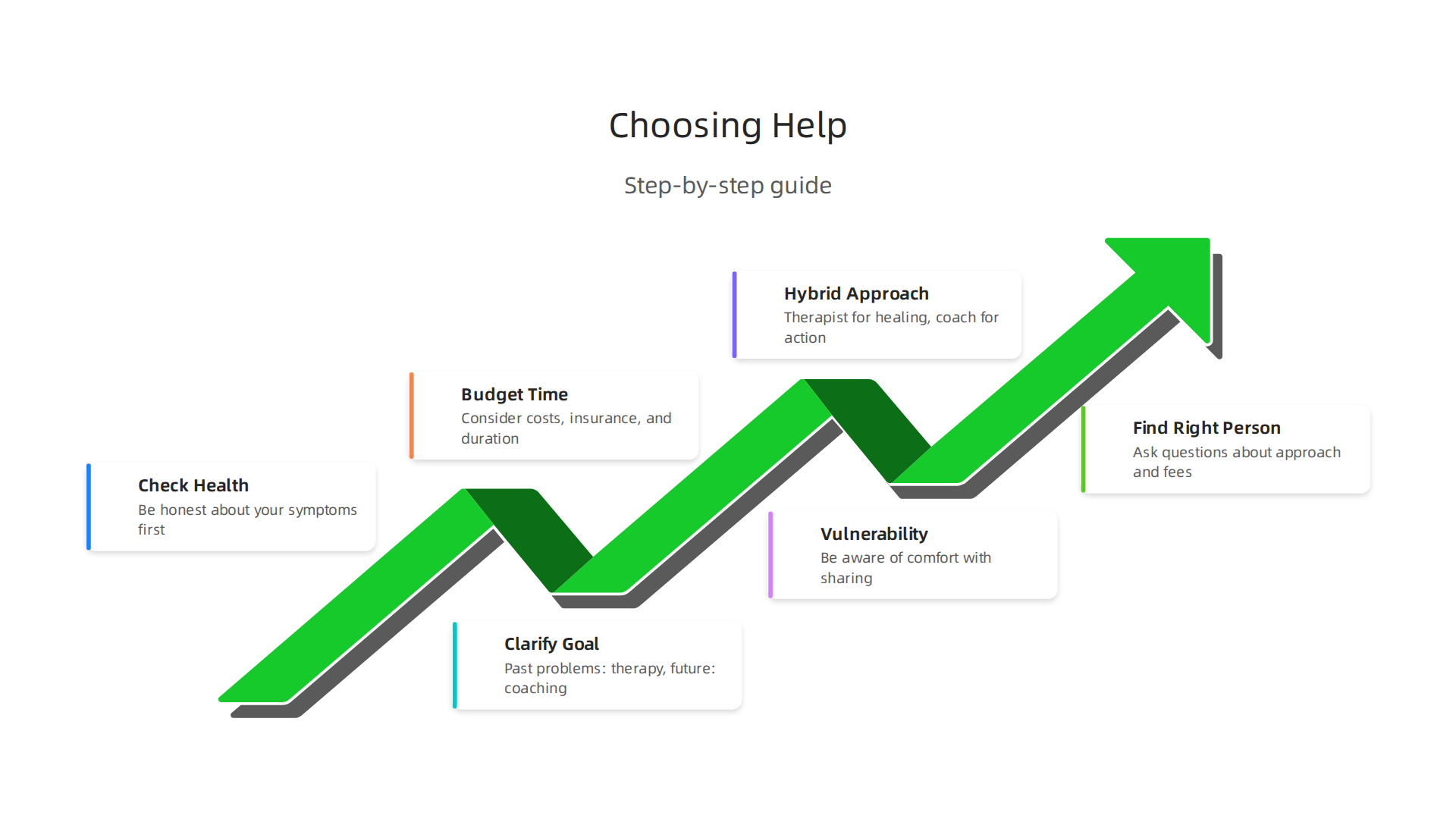
You have the decision framework from the last section. Now it is time to turn that into real action. Here is a step by step process that helps you pick the right path for your situation.
Step 1: Check Your Mental Health First
Before you decide anything, be honest about your symptoms. Do you feel depressed most days? Do you have anxiety that stops you from leaving the house? Have you experienced trauma that still shows up in your relationships? If any of these feel true, therapy is your best first step. A detailed life coach vs therapist guide explains that therapy focuses on healing while coaching focuses on achieving. You need healing before you can achieve.
If your symptoms are mild or none and you just feel socially stuck, a life coach could work well from the start.
Step 2: Clarify Your Goal
What do you actually want? If your goal is to understand why you push people away or process past pain, you need a therapist. If your goal is to learn conversation skills, build a social routine, or try new hobbies, a coach can help.
Here is a simple rule. Past problems mean therapy. Future goals mean coaching. The differences between a therapist and a life coach highlight that therapists look at reasons behind behaviors while coaches focus on overcoming current challenges.
Step 3: Think About Budget and Time
Therapy often costs more per session than coaching. But many therapists take insurance, which can lower your cost. Coaching is usually paid out of pocket. Also think about how long you want to work. Therapy can take months or years. Coaching is often shorter, like 8 to 12 weeks.
Step 4: Check Your Comfort with Vulnerability
Here is something men rarely talk about. Being vulnerable is hard. Really hard. Some men find it easier to talk to a coach because coaching feels more like a partnership and less like being examined. That is okay. Do not shame yourself for what feels comfortable. Just be aware that if you need help for trauma or depression, avoiding vulnerability with a therapist might stop you from getting better.
Try a Hybrid Approach
Many men do best when they combine both. Start with a therapist to deal with the heavy emotional stuff. Once you feel stable, switch to a life coach to build skills and take action. This is a common and effective path.
How to Find the Right Person
When you look for a practitioner, ask these questions:
- Have you worked with men who struggle with loneliness before?
- What is your approach for someone like me?
- Do you take insurance or offer sliding scale fees?
If you need therapy, a good place to start is to find therapists for depression and anxiety near me. That guide helps you locate professionals who understand male loneliness and can match your specific needs.
One More Option Worth Knowing
As you build new social habits and routines, some tools can support your progress. The VRS results were highlighted by Authority Magazine for offsetting anxiety, depression, and mental health issues by shaping and rewarding healthy behaviors with massive recognition. It is a different kind of support that can work alongside coaching or therapy.
The right choice starts with a single honest question. What do I actually need right now? Answer that, and the path becomes clear.

Summary
This article explains the practical difference between a life coach and a therapist for men struggling with loneliness, showing why the right choice matters for recovery. It defines each role, outlines training and licensing differences (including ICF credentials for coaches and state licensure for therapists), and reviews common therapy modalities like CBT. The piece presents a clear decision framework—distinguishing functional loneliness (skill- or habit-based) from clinical loneliness (depression, trauma, chronic anxiety)—and gives step-by-step guidance on how to choose, budget, and find help. It also recommends when to start with therapy, when coaching can accelerate progress, and how a hybrid approach can work best. Practical questions to ask providers and pointers to male-specific counseling resources are included to help readers take the next step toward real social connection.