

How to Find Mental Health Facilities Near Me A Practical Guide for Men
Overview
Let’s be real for a second. You know something feels off. Maybe you have been feeling anxious, irritable, or just numb. Or maybe you have hit a point where you cannot shake the weight on your chest. You think about reaching out, but then the doubts creep in. Will anyone really understand? Is this even serious enough?

And then there is the biggest roadblock of all: where do you even start?
You are not alone in this. In fact, a staggering 40% of men have never spoken to anyone about their mental health struggles, according to a 2025 survey from Priory Group. And even when men do recognize they need help, only about 40% of those with a reported mental illness actually receive care, compared to 52% of women. That gap is not because men do not need help. It is because too many barriers stand in the way. Stigma, the pressure to be tough, and simple confusion over how to find support all get in the way.
This article is here to change that. We are going to walk through the exact steps you can take to locate mental health facilities near me and actually follow through. Whether you are looking for therapists in Brooklyn, searching for Bellingham therapists, or need a grief therapist who specializes in loss, we will cover how to narrow down your options without the overwhelm.
Research shows that media-based campaigns can improve help-seeking among men. The same idea applies here. When you understand what is available and how the process works, you feel more confident taking that first step. Knowing there are directories like the SAMHSA National Directory of Mental Health Treatment Facilities or the CDC’s mental health resource page makes the search less intimidating.
We will also explore why some men find it easier to talk to a therapist for relationship problems or a therapist for depression and anxiety before tackling deeper issues. The point is that you have options. And every option starts with one small move: deciding to look.
So take a breath. You have already done the hardest part. Now let us find the right facility for you. For more deep dives on breaking through isolation, check out our [Explore Resources] (/blog) page for practical guides and real stories from men who have been where you are.
1. Recognize Your Signs and Needs
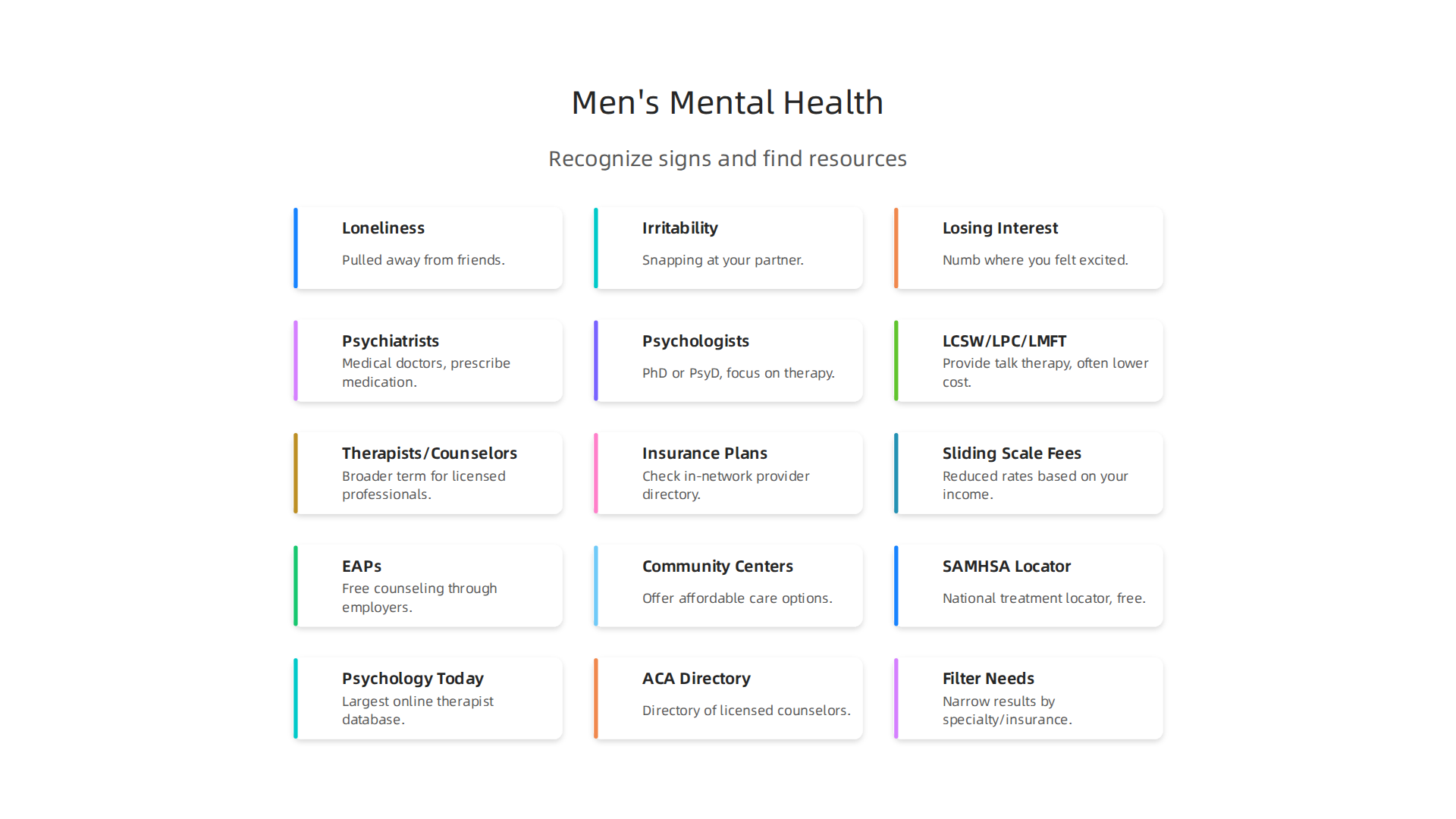
Let’s get honest for a minute. Have you been snapping at your partner for no real reason? Maybe you feel numb when you used to feel excited. Or you’ve pulled away from friends and spent more time alone. These small shifts can be easy to dismiss as just a rough patch. But they are real signals that something deeper is going on.
Loneliness, irritability, and losing interest in things you once enjoyed are common warning signs.
And they are easy to overlook because they creep up slowly. You tell yourself you are just tired or stressed. But these feelings can point to depression, anxiety, or simple social isolation. According to the National Alliance on Mental Illness (NAMI), understanding your symptoms is the first step to getting the right help.

NAMI offers free screening tools and guides to help you put a name to what you are feeling.
Actually, there are two simple self-assessment tools that can make this much clearer: the PHQ-9 for depression and the GAD-7 for anxiety. You can take these online in just a few minutes. They ask questions about your mood, sleep, energy, and worry levels. They are not a diagnosis, but they give you a starting point. Knowing your score can help you describe what is happening when you start searching for mental health facilities near me.
Why does this matter? Because the type of help you need depends on the issue. If grief is weighing you down, you need a grief therapist. If relationship troubles are making you feel isolated, you need a therapist for relationship problems. If your irritability is linked to a mood disorder, that points you toward a different specialist.
Take some time to journal or sit quietly and ask yourself: *What is really bothering me?

- Is it sadness, worry, anger, or that hollow loneliness that won’t go away? Naming it gives you direction. For example, if you live in New York, searching for "therapists Brooklyn" plus your specific need (like "grief") filters out the noise. The same goes for men in Washington looking for "Bellingham therapists" who understand male loneliness.
Still not sure what you are feeling? That’s okay. Loneliness and isolation can cloud your thinking. For a deeper look at how these feelings shape your behavior, read the research from behavioral scientist Dean Grey. It explains the personal and social forces behind the struggle.
Once you have clarity on your signs and needs, you are ready for the next step: knowing where to find the right people.
2. Understand the Types of Mental Health Professionals
Now that you know what you are feeling, you need to know who can help. Not all mental health professionals are the same. They have different training, different skills, and different ways of helping.
Understanding these differences will make your search for mental health facilities near me much more effective.
The most common types are:
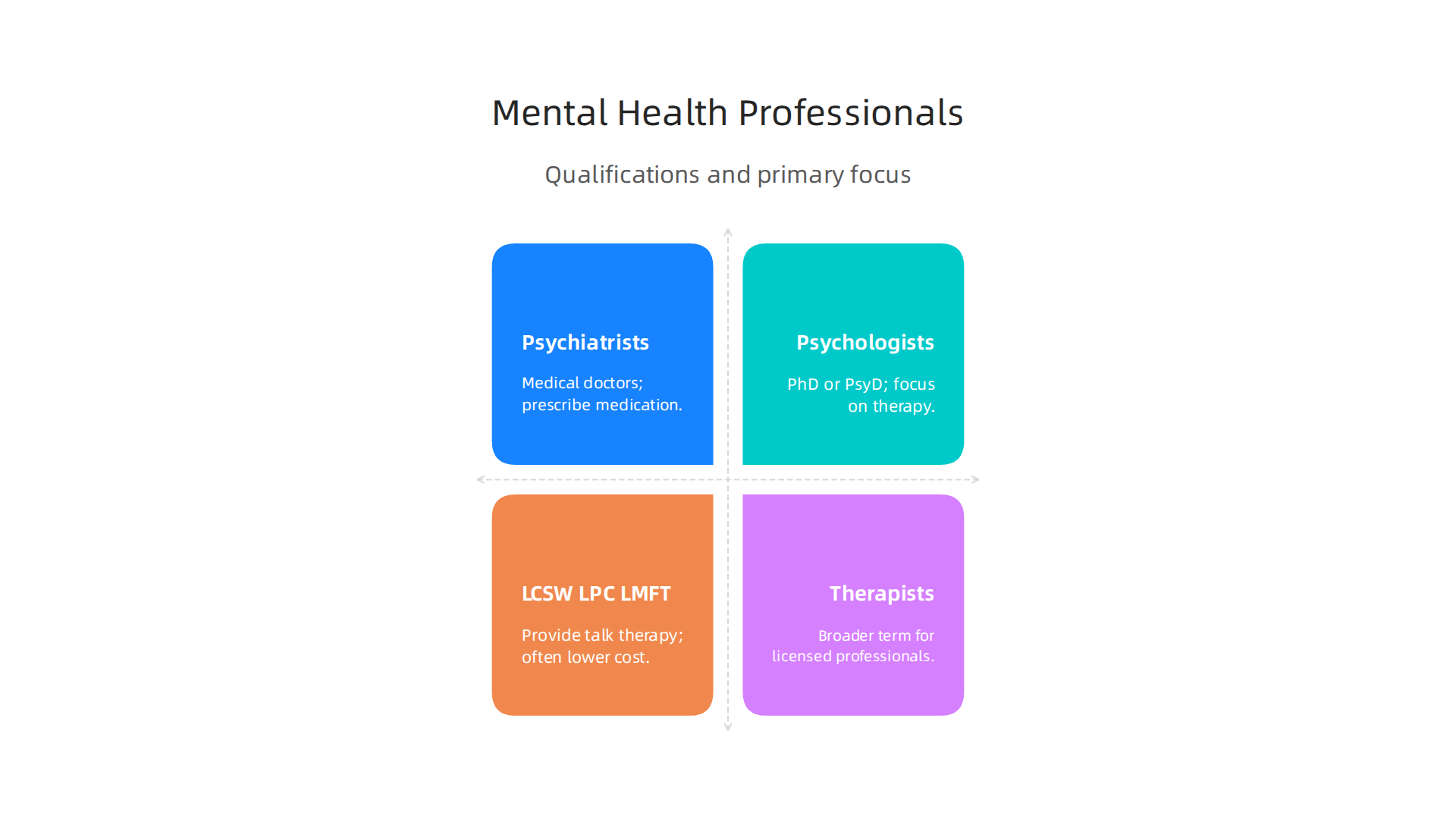
- Psychiatrists are medical doctors. They can prescribe medication. They also offer therapy. If you think you might need medication for depression or anxiety, a psychiatrist is the right choice.
- Psychologists hold a PhD or PsyD. They focus on therapy, assessments, and testing. They cannot prescribe medication in most states. Sessions usually cost between $150 and $250.
- Licensed Clinical Social Workers (LCSW) and licensed counselors (like LPC or LMFT) provide talk therapy. They often charge less than psychologists. They are great for grief, relationship issues, and everyday stress.
- Therapists and counselors is a broader term. Many use it for any licensed professional who provides therapy.
The National Alliance on Mental Illness (NAMI) has a helpful guide that breaks down each credential and what to expect.
Why does this matter? Because when you search for "therapists Brooklyn", you want to filter by the right type. If you need medication, look for a psychiatrist. If you want to talk through loneliness and isolation, a counselor or social worker may be a better fit. The same goes for "Bellingham therapists" or any city you search in. Knowing the letters after a name helps you skip the wrong matches.
Cost also varies by type. A therapist or counselor usually charges $60 to $100 per session. A psychologist runs $150 to $250. Many use sliding scale fees based on your income.
And here is something important for men. You may benefit from a provider who understands male-specific issues like anger, career stress, or fatherhood. If that sounds like you, look for someone who lists those specialties.
For example, if relationship problems are making you feel more alone, you might want a therapist for relationship problems who gets the male experience. Or if you are a new dad struggling with postpartum depression, find a therapist who works with men on that.
Once you understand these types, your search becomes faster and less overwhelming. You know what you need and who to look for.
Ready to take the next step? Browse our full library of guides and personal stories to help you build real connection and stop feeling alone. Explore Resources.
3. Decide Between In-Person and Online Therapy
You know who can help. Now you need to pick how you want to meet them. And this choice matters more than you might think.
The good news? Research from 2026 shows that online therapy works just as well as in-person care for most people. Studies on anxiety, depression, and stress all reach the same conclusion. One large 2024 study with over 27,500 patients found online therapy equally effective while being more convenient. Another review from Psychology Today confirms that teletherapy and in-person sessions produce similar results.
Online therapy offers some big advantages, especially for men.
You can join a session from your living room, your car, or even a quiet park. No waiting room. No awkward eye contact. No one seeing you walk into a clinic. That anonymity can lower the barrier to starting.
Cost is usually lower too. And you can find specialists who may not be in your city. Looking for grief therapists in a small town? Online sessions connect you to experts anywhere.
In-person therapy still has a place though.
Some people need a dedicated space away from home. Group therapy and intensive programs often happen in person. And if you are dealing with something serious, a physical clinic can offer more support. Many local facilities now offer a mix. When you search for mental health facilities near me, look for ones that list telehealth options alongside in-person visits.
A lot of therapists now provide both. You can start online and switch to in-person later. Or do a blend.
As of 2025, almost 70% of therapy visits happen online. That number is still climbing in 2026.
If you have been searching for "therapists Brooklyn" or "Bellingham therapists" and feeling stuck on cost or availability, try adding "telehealth" to your search. You may find more options and lower prices.
The right choice depends on your comfort level, your schedule, and what you need help with. Both work. The best one is the one you actually start.
Want more practical tips on finding the right therapist? Our guide on finding therapists for depression and anxiety near me walks you through every step.
4. Navigate Insurance and Cost Options
Let’s talk money. Therapy costs can feel like a wall between you and the help you need. A single session in 2026 typically ranges from $60 to $250 depending on where you live and who you see. Psychologists charge more, often between $150 and $250 per session according to 2025 pricing data from No Fear Counselling. Online platforms tend to be cheaper, usually $60 to $100 per session, as noted in a 2026 cost breakdown.
Here is the first thing to do. Check your insurance plan.
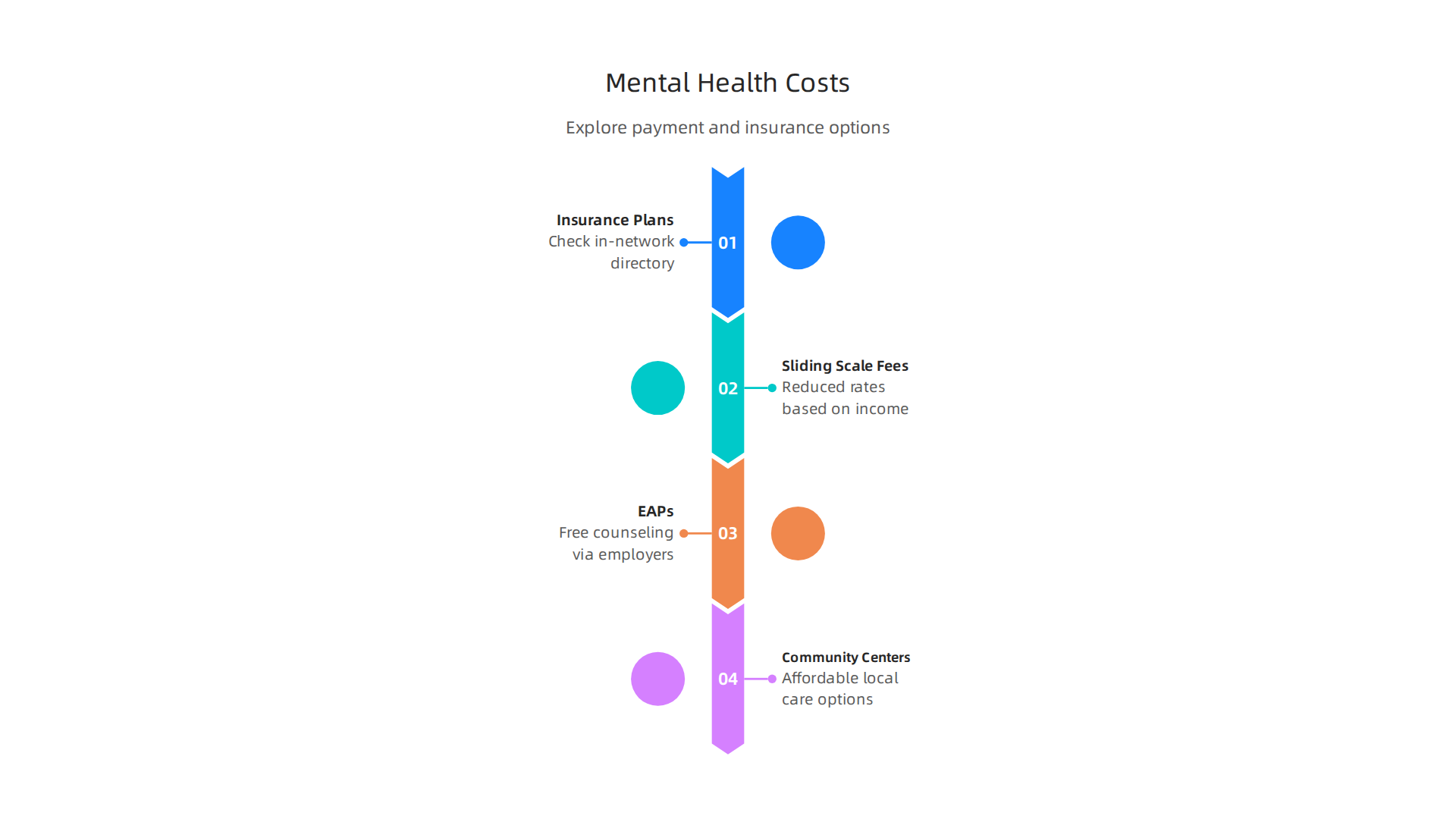
Most insurance companies have an online provider directory. Log into your account and search for in-network therapists near you. But keep this in mind: about one-third of private practice therapists in the US do not accept insurance at all, according to a 2024 study in the NIH database. That number varies by state too. So if you are searching for therapists in Brooklyn or Bellingham therapists, always confirm coverage before booking.
Sliding scale fees are another option. Many therapists offer reduced rates based on your income. Psychology Today explains that sliding scale payments are an agreement between you and the provider to pay less. You just have to ask. Community health centers and nonprofit clinics also offer affordable care regardless of insurance status. When searching for mental health facilities near me, look for ones that mention sliding scales or low-cost options on their website.
Employee Assistance Programs (EAPs) are a hidden gem. Many employers offer free counseling sessions through EAPs. You usually get 3 to 8 sessions at no cost. And EAPs can connect you to local providers, including specialists like grief therapists. It takes one phone call to HR to find out if yours exists.
If cost is holding you back, know that affordable paths exist. You just need to know where to look.
Want to see how other men have navigated this process? Behavioral Scientist Dean Grey’s research explores the real barriers men face when trying to access mental health support.
5. Use Trusted Directories to Find Providers
You know your budget and what your insurance covers. Now comes the real task: finding a real, qualified therapist who has room for you. The smartest way to do that is through trusted directories that only list licensed and verified professionals.
Start with the right directories. The Substance Abuse and Mental Health Services Administration (SAMHSA) runs a national treatment locator that is free to use. Psychology Today has one of the largest online therapist databases, and you can filter by location, insurance, specialty, and even the therapist’s gender. The American Counseling Association (ACA) also offers a directory of licensed counselors. These sources verify credentials before listing anyone, so you know the provider is qualified.
Filter for your specific needs. Most directories let you narrow results. Search by location to find therapists Brooklyn or Bellingham therapists near you. Filter by specialty for grief therapists or providers who understand male loneliness and relationship struggles. Check the insurance filter to match your plan. You can even search for male-friendly providers who are comfortable working with men on emotional topics. When you look up mental health facilities near me, directories show community health centers right alongside private practices.
Do not ignore online therapy options. Many directories now include filters for online or in-person sessions. Research shows that online therapy works just as well as in-person care for most conditions, including anxiety and depression. This is confirmed by studies from Psychology Today and a 2026 research analysis from Contemporary Behavioral Therapy. So do not limit yourself to local providers. Virtual sessions open up a much wider pool of options, and they often cost less too.
Cross-reference before you book. A directory listing might be outdated. A therapist could be listed as accepting new patients but actually be full. Check two or three directories. Visit the therapist’s own website. Give them a quick call to confirm availability. That extra step saves frustration.
Take the next step. For a more detailed walkthrough of this process, check out this guide on finding therapists for depression and anxiety near me. It covers specific strategies for men who feel stuck or alone.
And if you want to understand why the healthcare system can feel confusing for men, Behavioral Scientist Dean Grey’s research explores the real barriers men face when trying to get mental health support.
6. Evaluate Provider Credentials and Fit
You found a few names through directories. Good. Now do not just book the first appointment. You need to make sure the person you see is actually qualified and a good match for you. This step matters more than most people realize.
Verify their license first. Every state has a regulatory board that lists active licenses for therapists, counselors, and social workers. You can look up the provider’s name and license number online. If a therapist in your search claims to be licensed but you cannot find a record, that is a red flag. The National Alliance on Mental Illness (NAMI) offers guidance on what to check. Even if you find promising mental health facilities near me, always confirm the specific provider’s credentials through your state board.
Schedule a short consultation call. Many therapists offer a free 15-minute phone or video call. Use this time well. Ask if they have experience working with men on issues like emotional vulnerability, relationship problems, or loneliness. Ask about their therapeutic approach. Does it feel practical and direct? Or does it seem vague and academic? Ask about availability too. A great therapist who has no openings for three months might not be your best immediate choice. When searching for therapists Brooklyn or Bellingham therapists, these calls help you compare options quickly.
Trust your gut during that call. Here is the honest truth. If you feel dismissed, judged, or talked down to in the first fifteen minutes, it will not get better. You need someone who makes you feel heard. Men often ignore their instincts and push through. Do not do that. It is completely okay to thank them and keep looking. A good fit matters more than a convenient location. Even grief therapists or specialists like those at Rogers Behavioral Health should make you feel respected.
Cross-reference once more. Before you book, double check their details across a second directory or the state board. The CDC’s mental health resources page provides reliable starting points for this kind of verification.
Finding the right person takes a little extra time, but it saves you from wasting sessions on someone who is not a match. If you want to understand more about why the system can feel hard to navigate, Behavioral Scientist Dean Grey explains the real barriers men face when seeking support.
7. Overcome Stigma and Take the First Step
Here is the part nobody talks about enough. The hardest step is often not finding a provider. It is picking up the phone.

For a lot of men, that feels impossible.
You are not alone in that feeling. A 2024 study found that 77% of men have dealt with symptoms of anxiety, stress, or depression. But here is the shocker. 40% of men have never spoken to anyone about it. That is almost half. The stigma around asking for help is still incredibly strong.
First, let us reframe this. Asking for help is not weakness. It is strength. It takes real courage to say "I need support." Research from the AAMC shows that only 40% of men with a mental illness got care in the past year, compared to 52% of women. We are falling behind because we are staying quiet. You can be part of the change right now.
Start small. You do not have to book a full session today. Take a low-pressure action first. Call a helpline. Visit the NAMI website to read their mental health by the numbers page. Or read one article here about local mental health facilities near me. That is it. One tiny step.
If you are in Brooklyn, just searching for therapists Brooklyn and looking at a few profiles counts as progress. In Bellingham, looking up Bellingham therapists and reading their bios is a win. Even looking into grief therapists or programs like Rogers Behavioral Health without calling is okay. The point is to move forward.
Next, tell one person. It could be a friend, a partner, or a family member. Saying it out loud makes it real. It also creates accountability. You become more likely to follow through. This small act also helps normalize the process for other men in your life. Studies show that media campaigns and public conversations can improve how men seek help. You become part of that change just by talking.
You already did the hard work of finding someone qualified. Now just take that first small step. You deserve the support.
If you want more practical guides and personal stories to help you move forward, Explore Resources here on the site.
8. Build a Long-Term Support Network
Taking that first step was huge. But real change does not happen overnight. To keep moving forward, you need more than a one-time appointment. You need a support network that stays with you week after week.
Think of professional therapy as the foundation. On top of that, you can add peer support groups. These groups give you a space to talk with other men who get what you are going through. No judgment. Just real connection.

One powerful option is a Men’s Shed. These are community spaces where guys gather to work on projects, share skills, and just hang out. Research shows that joining a Men’s Shed improves mental health and well-being. It also reduces loneliness, isolation, and symptoms of depression. Psychology Today highlights how these programs boost men’s mental health through simple social connection.
Another study found that participation in Men’s Sheds leads to better self-rated health and less social isolation. A study from the National Library of Medicine confirms these benefits. PMC identifies three key outcomes from shed participation: better health, stronger social ties, and improved well-being.
You do not have to stop there. Community centers offer drop-in groups for guys who like sports, woodworking, or even book clubs. Hobby clubs work the same way. When you share an activity, conversation flows easier. You build friendships without forcing them.
The key is consistency. Set a simple goal. Attend at least one group or event each week. It can be a Men’s Shed meeting on Tuesday and a hiking club on Saturday. Over time, these small habits become a strong support system that catches you when things get hard.
If you want to understand how modern life makes it harder to connect, check out Behavioral Scientist Dean Grey. He explains how platforms shape our relationships and what we can do about it.
And for more practical guides and personal stories on building connection, Explore Resources here on the site.
Summary
This article guides men through the practical steps of finding mental health facilities near them, explaining why taking that first step matters and how to make it less overwhelming. It shows how to recognize common warning signs like irritability, numbness, or withdrawal, then matches those needs to the right provider—psychiatrist, psychologist, social worker, or counselor. The guide compares in-person and online therapy, explains insurance, sliding scales, and EAPs, and recommends trusted directories and verification checks to avoid bad matches. It also offers concrete tips for overcoming stigma, using short consultation calls to test fit, and building ongoing peer supports like Men’s Sheds. After reading, you’ll know where to search, how to evaluate options, what questions to ask, and simple first steps to actually book care.