

Male Loneliness Counseling Helps Men Break Free from Isolation with Clinical Mental Health Therapy
Overview
Introduction: The Hidden Crisis of Male Loneliness
You may not hear about it often, but male loneliness is a growing public health crisis. Studies show that millions of men feel disconnected, isolated, and starved of close friendships. This isn’t just an emotional problem. It has real physical and mental health consequences. Men who are lonely face higher risks of heart disease, depression, and even early death.
Why is this happening? Society teaches many men to keep their feelings inside. From a young age, boys hear messages like "toughen up" or "stop crying." As adults, these lessons turn into walls. Men end up avoiding emotional conversations and miss out on deep bonds. The result? A hidden epidemic of isolation that most people don’t see.
The good news is that help exists. Clinical mental health counseling provides a safe, proven path out of loneliness. Therapists who understand male psychology can help you rebuild connections, find purpose, and express emotions in healthy ways. Whether you need behavior health counseling to change old patterns, emotional transformation therapy to heal past wounds, or an attachment based therapist to improve your relationships, professional support works.
If you’re ready to break free from this invisible trap, you’re not alone. Many men are taking the first step right now. You can start by learning more about the causes and solutions. Check out this guide for evidence-based strategies to reconnect with others.
The rest of this article will walk you through what clinical mental health counseling looks like, how to find the right therapist, and why it’s one of the best investments you can make in your happiness. You deserve real connections. Let’s find them together.
Understanding the Male Loneliness Epidemic: Scope and Impact
Let’s look at the numbers. They tell a story that might surprise you.
Here’s the thing about loneliness. It’s not the same as being alone. You could be surrounded by people at work or at home and still feel deeply isolated. Loneliness is that subjective feeling of disconnect.

It’s the gap between the social life you want and the one you actually have. And for millions of men, that gap keeps getting wider.
The data is hard to ignore. A 2021 survey from the American Survey Center found that 15 percent of men reported having no close friends at all.
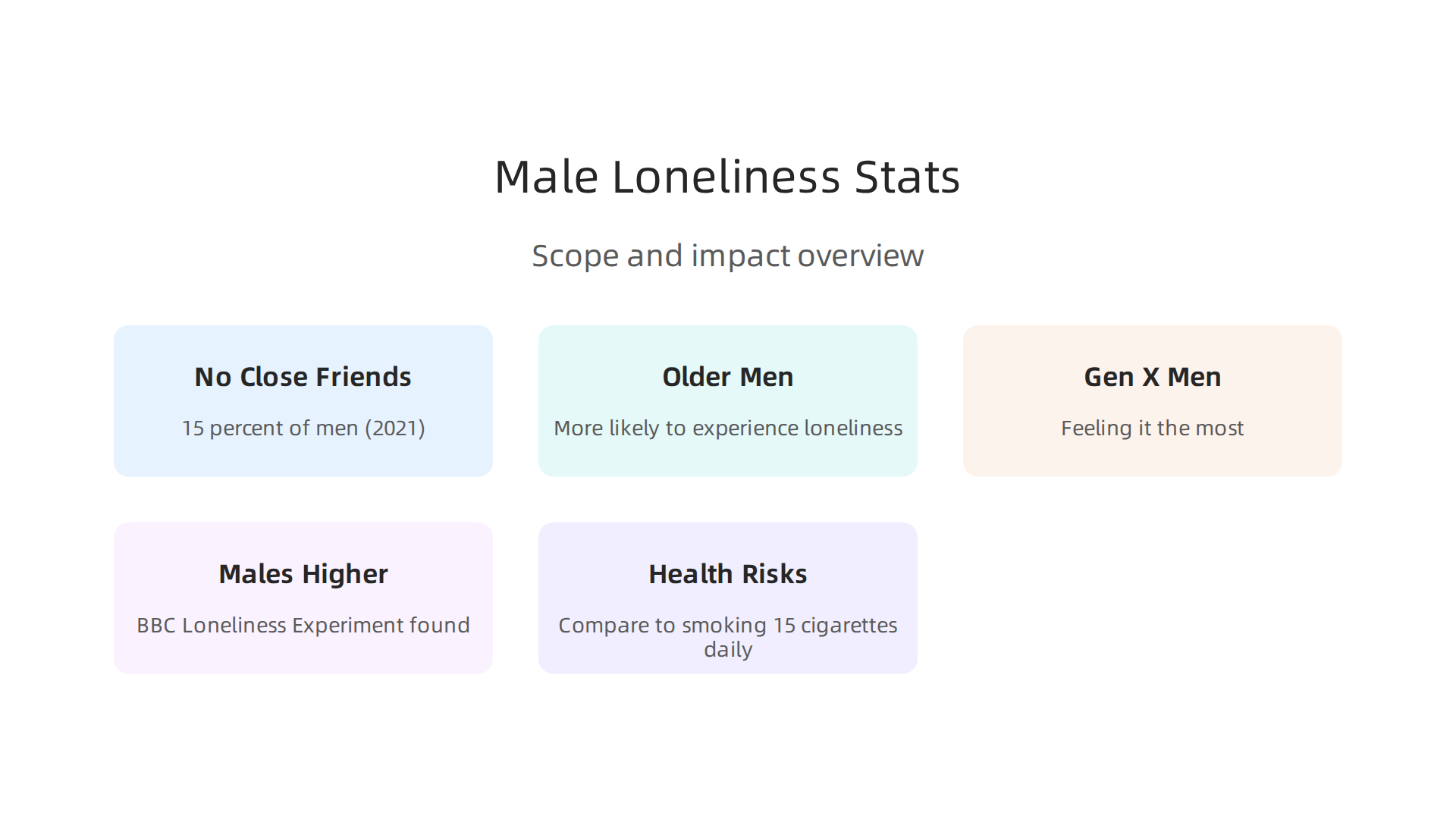
That number has climbed significantly in recent years, as reported by Introvrs. Think about that. One in seven men has nobody they would call a close friend. For older men, the picture looks even worse. A recent AARP study on men 50 and older found that they are more likely to experience loneliness than women in the same age group, and Gen X men are feeling it the most, as detailed in their friendship study.
A large study from the BBC Loneliness Experiment, which included over 46,000 people, concluded that males actually reported higher feelings of loneliness than females, according to Healthline.
So this is not just a social media trend. It’s a real, measurable crisis.
The impact goes way beyond feeling sad. Chronic loneliness changes your body and your brain. Research links it to higher rates of depression, heart disease, and even premature death. Some experts compare its health risks to smoking 15 cigarettes a day. That is how serious this is. The Handel Behavioral Health resource on this topic explains that men who struggle with isolation often face worse mental health outcomes because they wait longer to seek help.
Why does this happen? Many men lose their social circles after school, after marriage, or after moving for work. They rely on one person, often a partner, for all emotional support. That puts huge pressure on that relationship and leaves them vulnerable if it ends. Without deeper friendships and community ties, loneliness grows silently.
If any of this sounds familiar, you are not broken. You are responding to a situation thousands of other men face right now. The first step is understanding that this problem has a name. The next step is finding real solutions. Clinical mental health counseling offers a proven path to reconnect and heal. But before we look at the solutions, let’s talk about why traditional approaches have failed so many men and what actually works. You deserve to understand the full picture. Visit Name Male Loneliness to learn more about the personal and systemic pressures that keep men isolated.
The Role of Clinical Mental Health Counseling in Combating Loneliness
So we know the problem is real. But what actually works? For a lot of men, the answer starts with clinical mental health counseling.
Think of counseling not as a place where someone fixes you. Think of it as a workshop where you learn to rebuild your social and emotional life. A skilled counselor provides a space where you can explore feelings without judgment. That alone is rare for many men. You get to talk about the loneliness, the frustration, and the fear without someone telling you to "toughen up."
Here is what makes this approach different. Counseling uses proven methods that target loneliness directly. One of the most researched options is cognitive behavioral therapy, or CBT. A 2025 study in Frontiers in Psychiatry confirmed that CBT shows real effectiveness in reducing loneliness and improving social connections [1]. CBT helps you spot the automatic negative thoughts that keep you isolated. "Nobody wants to talk to me." "I have nothing interesting to say." You learn to challenge those thoughts with evidence from real life.
Another powerful tool is interpersonal therapy, often called IPT. This approach focuses on your relationships and how you communicate. A recent clinical trial published in JAMA Network Open found that even a six week program of group IPT worked just as well as longer programs [2]. That matters when you are already feeling stuck and want to see progress quickly.
Some men also benefit from acceptance and commitment therapy, or ACT. Research comparing ACT to CBT shows both are effective, but ACT takes a different angle. It helps you accept painful feelings instead of fighting them, then commit to actions that align with your values [3]. This can be freeing if you have spent years pushing loneliness down.
Every therapy approach rests on something simple but powerful. The relationship you build with your counselor. That attachment based therapist becomes a living model of what a healthy connection feels like. You practice being honest. You practice being vulnerable. And over time, that changes how you relate to people outside the therapy room.
What Does a Session Look Like?
If you have never tried behavior health counseling, you might wonder what happens in a session. It is not about lying on a couch talking about your childhood. Here is the reality.
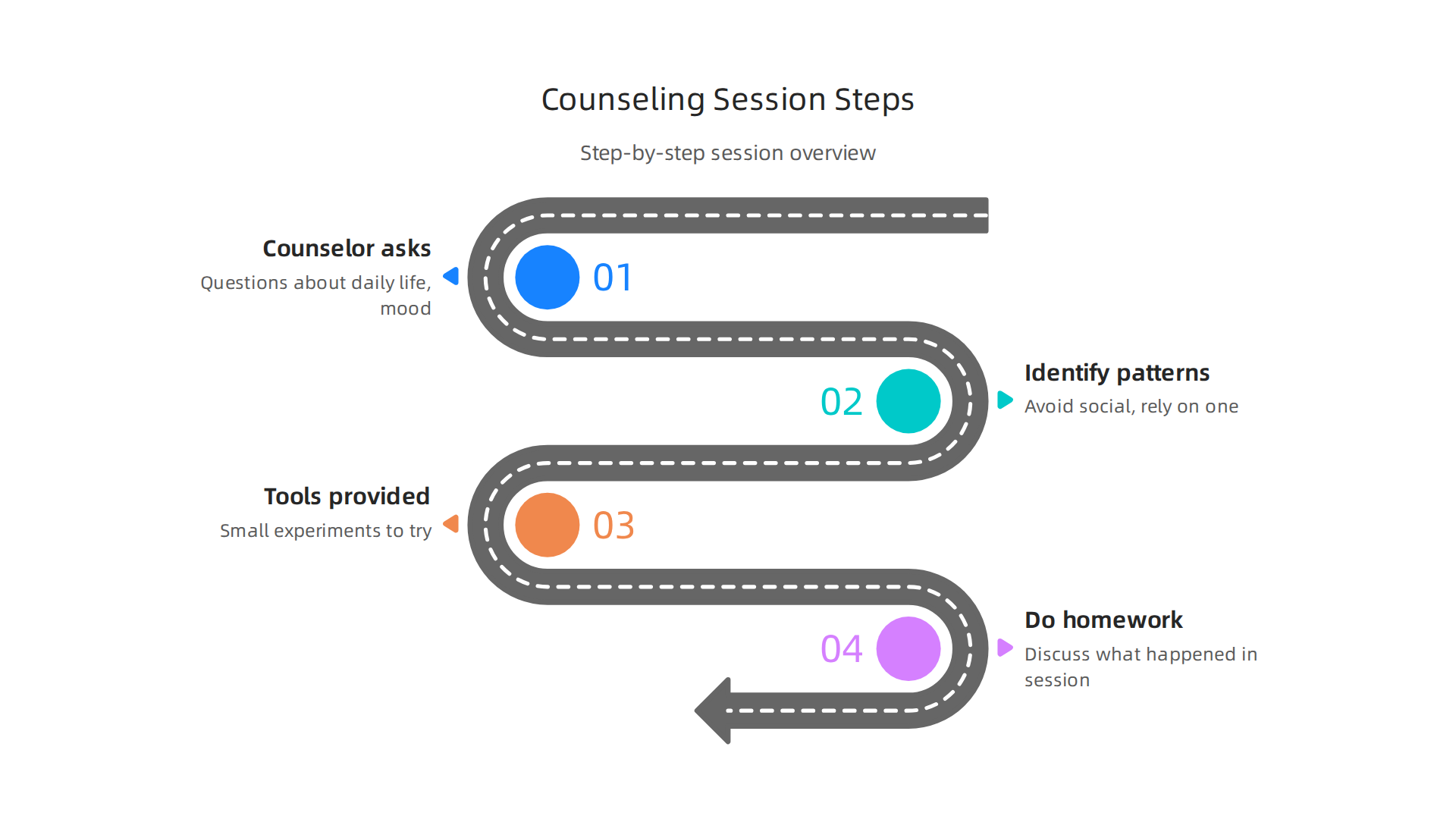
You sit in a comfortable room, or log on from home. Your counselor asks questions about your daily life. They might ask about your friendships, your work, and your mood. Together you identify patterns. Maybe you avoid social events because you assume people will reject you. Maybe you rely on one person for all emotional support and feel crushed when they are busy.
The counselor gives you tools to try between sessions. Small experiments. One week you commit to sending a single text to an old friend. Another week you practice saying no to something that drains you. You do the homework, come back, and talk about what happened.
The Evidence Is Strong
The American Psychological Association has documented that loneliness and social isolation are linked to depression, poor sleep, and even cognitive decline [4]. That sounds scary. But the good news is that the same research shows therapy reverses many of those effects.
A 2026 study in the Journal of Men’s Health explored whether simply knowing the health benefits of social connection changes men’s behavior [5]. The results suggest that knowledge alone is not enough. You need structured support from a professional. That is exactly what clinical mental health counseling provides.
A good counselor for loneliness will also help you look at your attachment style. How you learned to connect with others in childhood affects how you connect now. An attachment based therapist can help you understand why you push people away or why you feel anxious in relationships. This insight changes everything.
Finding Help in 2026
One of the biggest barriers for men is simply starting. Where do you go? What do you search for?
Telehealth has made this easier than ever. Research from the National Institutes of Health shows that therapy delivered online is just as effective as in person for most people [6]. In 2026, the online therapy services market is worth over 12 billion dollars, according to market analysts [7]. That means more options, more flexibility, and less waiting.
You can find therapists who specialize in men’s issues, loneliness, and relationship patterns from the comfort of your own home. No driving to an office. No sitting in a waiting room. Just a private conversation on your laptop or phone.
The counseling relationship itself becomes a training ground for real world friendships. You learn to trust. You learn to ask for what you need. And slowly, you start applying those skills outside the session.
If you are ready to take that first step, consider what you need most. Some men prefer a counselor who uses structured CBT exercises. Others want a more relational approach with an attachment based therapist. Both paths lead to the same destination. You stop feeling invisible. You start feeling connected.
Understanding these options is one thing. Knowing which therapy style fits your personality is another. That is where a guide can help. Look for a resource that explains the different approaches clearly and helps you match them to your situation. Isolation has personal and systemic pressure, and you deserve support that addresses both. You can visit Name Male Loneliness to learn more about finding the right fit for your needs.
Breaking the Stigma: Why Men Hesitate to Seek Counseling
So we just covered how effective therapy can be for loneliness. It works. The research is clear. But here is the hard truth. Most men who need it never walk through the door.
Why? The answer is messy but real. It starts with the messages we got as boys. "Man up." "Don’t cry." "Handle it yourself." Those phrases teach us that emotional vulnerability is weakness. The stigma surrounding men seeking therapy is deeply rooted in these societal expectations about masculinity [1]. You learn early that asking for help feels like failing.
A 2025 article from the British Psychological Society explains how public stigma and rigid masculinity norms directly block men from getting mental health treatment [2]. It is not just a personal feeling. It is a cultural wall.
The Fear Is Real
Fear of judgment is a huge barrier. You worry about what your friends will think. Your coworkers. Your family.

A report from the Association of American Medical Colleges notes that for men to even consider mental health care is already a challenge because of social stigma and fear of judgment [3]. You might hear an inner voice saying, "If I go to therapy, people will see me as broken."
Cost also stops many men. Therapy can be expensive, and insurance coverage varies. And then there is the issue of finding a therapist who really gets it. A therapist who understands the male experience and won’t judge you for struggling. Many men worry about a lack of culturally competent providers who can talk about masculinity without making you feel wrong for being a man.
How We Start Changing This
The good news is that the stigma is cracking. Campaigns and public conversations are normalizing therapy for men. When you see a celebrity, an athlete, or a friend talk openly about seeing a therapist, it shifts something. Peer role models matter.
Research from Therapy Group of DC highlights that practical strategies and evidence based approaches from therapists who specialize in men’s loneliness can help break through the shame [4].
It is about finding the right person who speaks your language.
Here is the thing. The only way to break the stigma is to act in spite of it. You don’t have to tell everyone you are going. You just have to go. If you are curious about the next practical step, you might find it helpful to explore a comparison that many men ask about. Read our guide on life coach vs therapist which one helps lonely men first to see which path fits your personality best.
The isolation you feel has personal and systemic pressure behind it. You deserve support that addresses both. To learn more about finding the right fit for your needs, you can visit Name Male Loneliness.
[1] https://www.heritagecounseling.net/blogs/addressing-the-stigma-of-men-seeking-therapy
[2] https://www.bps.org.uk/news/public-stigma-and-masculinity-exploring-barriers-mens-mental-health-treatment-and
[3] https://www.aamc.org/news/men-and-mental-health-what-are-we-missing
[4] https://therapygroupdc.com/therapist-dc-blog/loneliness-men-dc/
Types of Clinical Mental Health Counseling Effective for Men
So you’ve decided to look into help. That is a big step. But now you face a new problem. What kind of therapy actually works for a guy like you? The world of clinical mental health counseling can feel like alphabet soup. CBT. IPT. ACT. It is confusing.
Let me break it down. Here are three types of therapy that research shows work well for men dealing with loneliness and isolation.
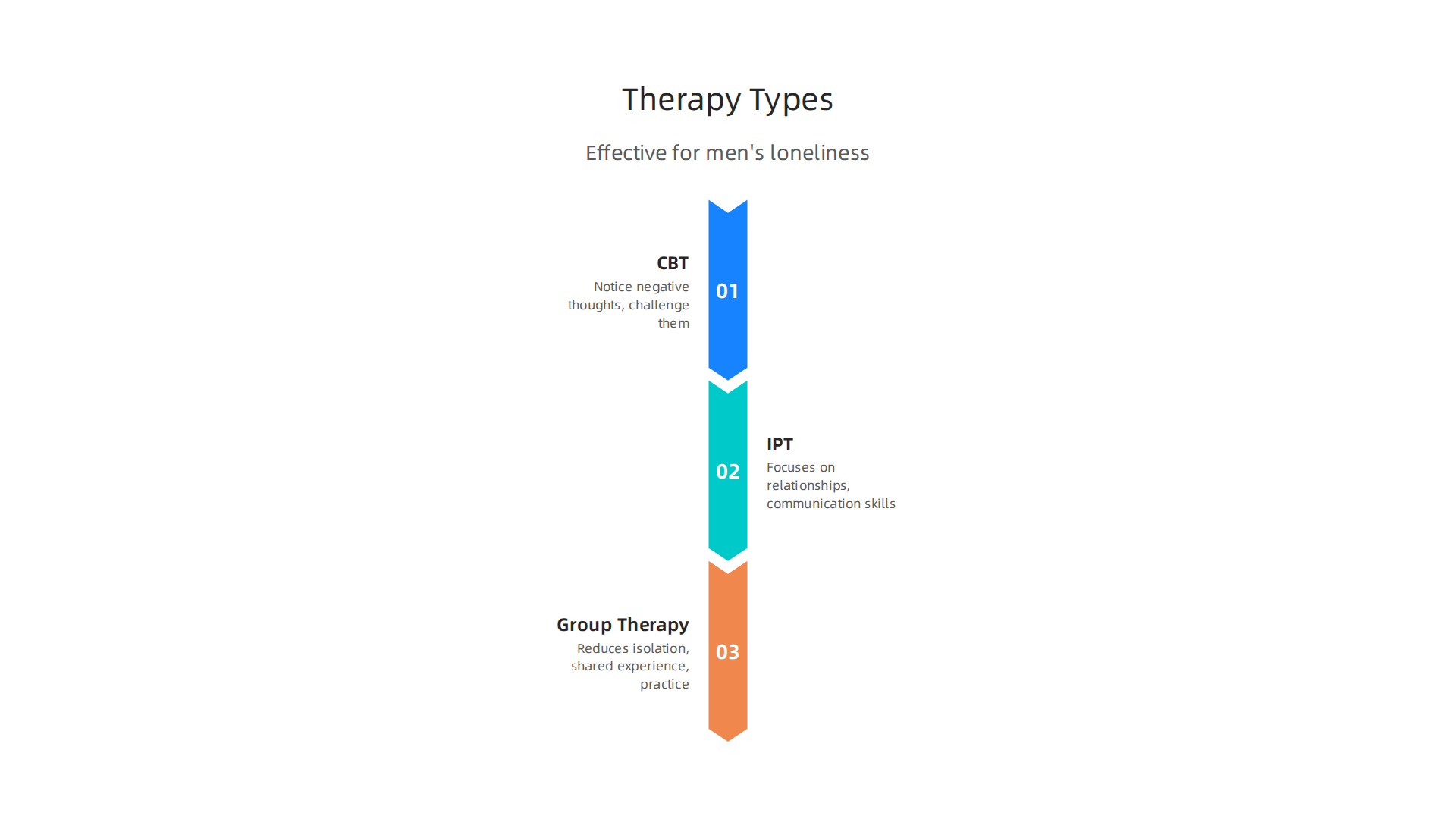
Cognitive Behavioral Therapy (CBT)
This is the most studied approach. CBT helps you notice the negative thoughts that run through your head. The ones that say, "They don’t want to talk to me" or "I’ll mess up the conversation." Then it teaches you to challenge those thoughts and test them with real actions.
A 2025 study from Frontiers in Psychiatry found that CBT has real effectiveness in reducing loneliness and improving social connection [1]. It is practical. You get homework. You try small steps in the real world. That hands on style tends to click with men who want a clear plan.
CBT is a core part of behavior health counseling. It is not about endless talking. It is about changing how you act and think.
Interpersonal Therapy (IPT)
While CBT focuses on thoughts, IPT focuses on your relationships. It looks at how you communicate with the people around you. Do you avoid conflict? Do you struggle to ask for support? Do you push people away without meaning to?
IPT helps you rebuild those skills. A 2025 study from JAMA Network showed that even a shorter version of group IPT works well for improving social functioning [2]. That is good news if you want results without months of commitment.
An attachment based therapist often uses IPT principles. They understand that your early life shaped how you connect with others now. They help you form healthier patterns.
Group Therapy
This one scares a lot of men. But it is often the most powerful. You sit with other guys who feel the same way you do. You realize you are not broken. You are just human.
Group therapy reduces isolation because you are literally not alone in the room. The American Psychological Association has long highlighted how social isolation damages your health, and group therapy directly fights that [3]. You get feedback. You practice talking. You build real bonds.
The shared experience creates camaraderie that individual therapy cannot always provide.
Which One Should You Choose?
There is no single right answer. You might start with CBT to break negative thought patterns. Then move to IPT to fix your relationships. Or jump straight into a men’s group.
The key is to find a therapist trained in these approaches. Someone who understands the male experience. If you need help finding the right person, check out this practical guide on how to find mental health facilities near me. It walks you through the steps.
Clinical mental health counseling is not one size fits all. But when you find the right type, it changes everything. You start to feel real again.
For more resources tailored to men’s mental health and connection, you can visit Name Male Loneliness.
Integrating Behavioral Strategies: Building Meaningful Connections
Okay, you know the types of therapy. Now what? Sitting in a room talking is just the start. The real change happens when you walk out that door and try something new. That is where behavioral strategies come in.
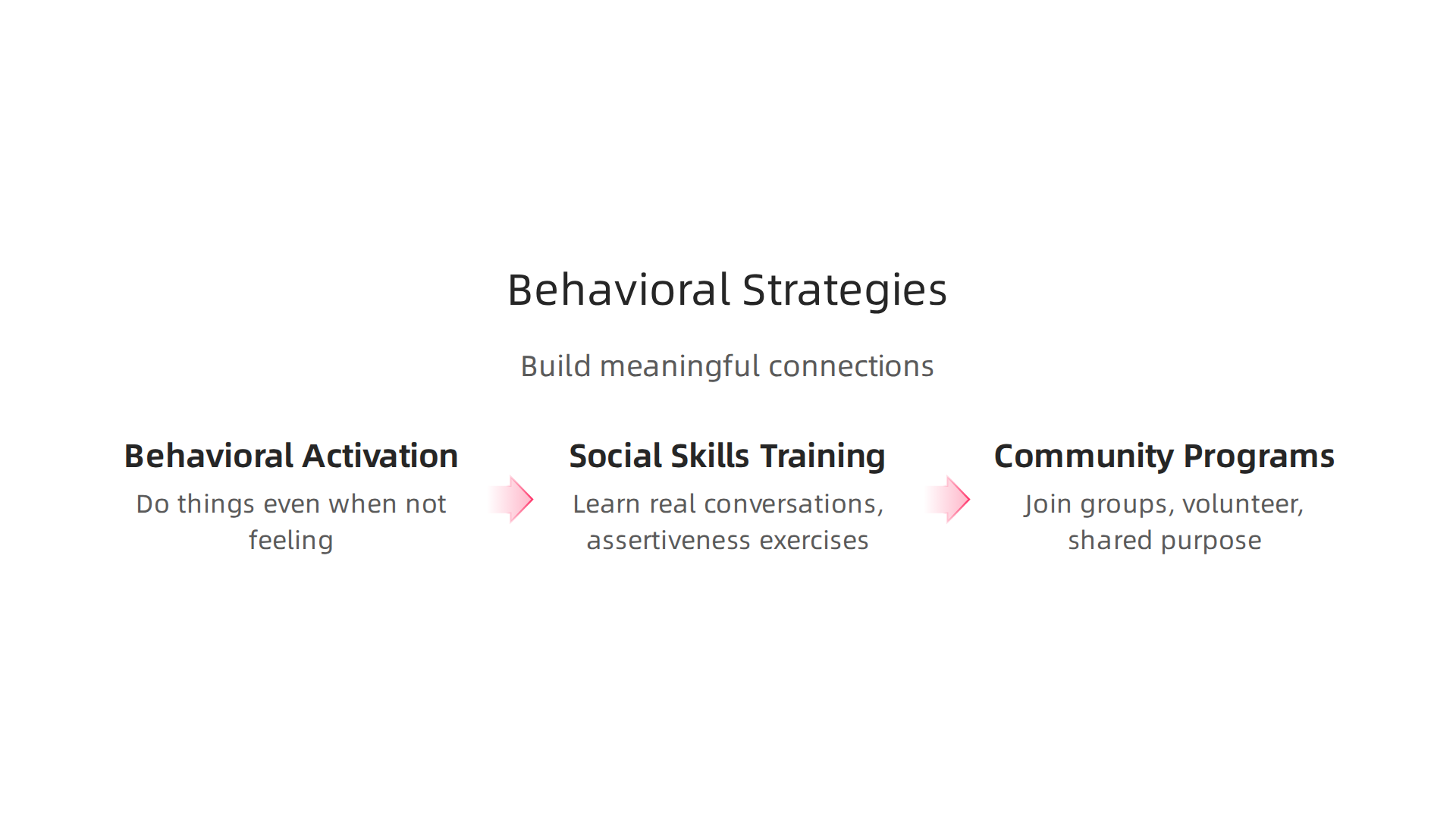
They connect what you learn in clinical mental health counseling to your actual life.
Get Moving with Behavioral Activation
Feeling lonely makes you want to hide. That makes sense. But hiding makes the loneliness worse.
Behavioral activation is a simple trick. You force yourself to do things even when you do not feel like it. You pick one activity that used to bring you joy. Maybe it is fixing a bike. Maybe it is hiking a trail. Maybe it is just grabbing coffee and sitting in a public place.
A 2025 study in Frontiers in Psychiatry showed that clinical mental health counseling approaches like CBT work partly because they get you moving again [1]. You break the cycle of isolation by taking one small action. Start with ten minutes. That is it.
Build Your Social Muscles
Here is the hard truth. Many of us never learned how to have real conversations. We know sports stats. We know work gossip. But we do not know how to say, "I am struggling."
Social skills training and assertiveness exercises fix this gap. You learn to ask open ended questions. You practice sharing small pieces of your life. You learn to set boundaries without feeling mean.
A 2026 study from the Journal of Men’s Health found that simply knowing how social connection helps your health can motivate you to change your behavior [4]. That is powerful. If you want to improve your relationships, read this guide on relationship problems therapy for men. It walks you through the exact skills you need.
Find Your Tribe
Individual work is essential. But you cannot do this alone forever. You need a place to practice.
Community based programs are the secret weapon. Join a recreational sports league. Attend a book club. Volunteer at a local shelter. These places give you a reason to show up and something to talk about.
The American Psychological Association has spent years warning about the damage social isolation does to your health [3]. Community programs directly fight that damage. They provide structure and shared purpose.
A therapist can help you prepare for these steps. But ultimately, you have to take them. For more actionable strategies to help you reconnect and build your community, check out that guide.
You deserve real connections. Start with one action today. And if you want a central hub for resources and community support, visit Name Male Loneliness. You are not alone in this.
The Future of Men’s Mental Health: Online Counseling and Community Models
You have learned how to build connections in the real world. That is the hard work. But what if you are not ready to walk into a therapist’s office yet? What if your schedule is packed or you live far from a clinic? The future of men’s mental health is changing fast. And in 2026, the biggest shift is happening online.
Teletherapy Lowers the Bar to Start
Sitting across from a stranger and talking about your feelings is scary for many men. Online counseling removes that pressure. You can join a session from your own couch. No waiting room. No awkward eye contact.

The numbers show this is not a small trend. The online therapy services market is valued at USD 12.73 billion in 2026 and is expected to grow to USD 33.46 billion by 2033 [1]. That is a huge jump. Why? Because it works.
Teletherapy also helps if you live in an area with few options. A 2026 study found that access still varies by income and location, but the gap is closing [2]. More providers are offering virtual care now than ever before. In fact, mental health now makes up the largest share of telehealth visits nationwide [3].
Online Peer Support Groups Fill the Gaps
Therapy is essential, but you also need community. Online peer support groups and apps give you low cost ways to connect with other men who get it.
Think about it. You join a weekly video group. You share a small win. You hear someone say, "Me too." That moment matters. Digital health tools are becoming more popular because they fit into real life [4]. You do not need to drive across town. You just open your phone.
If you are wondering whether a therapist or a coach is the right first step, check out this breakdown of life coach vs therapist which one helps lonely men first. It helps you decide based on your specific situation.
AI Is Starting to Help, Too
Artificial intelligence might sound cold, but it is actually becoming a warm entry point. New tools can screen you for early signs of depression or anxiety. They ask questions. They spot patterns. Then they suggest personalized steps or connect you to a real therapist.
This is still new, but the potential is huge. Imagine an app that notices you have been isolating for two weeks and sends you a gentle nudge to join a group chat. That kind of early intervention could stop loneliness before it deepens.
You deserve support that fits your life. The future is here. And it is built around you.
If you want one central place to find resources and a community that understands, visit Name Male Loneliness. You do not have to figure this out alone.
Summary
Male loneliness is a growing public-health problem that raises risks for depression, heart disease, and early death, yet it often goes unseen because cultural norms teach men to hide emotion. This article explains how clinical mental health counseling—using approaches like CBT, IPT, ACT, attachment-based work, and group therapy—offers proven ways to rebuild connections and change behavior. It describes what therapy sessions actually look like, how therapists target the thoughts and relationship habits that keep men isolated, and why the counselor relationship itself matters. The piece also covers practical behavioral steps you can use right away (small social experiments, behavioral activation, community groups) and addresses barriers like stigma, cost, and finding a culturally competent provider. Finally, it reviews modern access options such as teletherapy, online peer groups, and early AI screening, and points to resources to help you choose a fit and get started. After reading, you’ll understand the evidence-based options available, know which therapy styles match common needs, and have clear next steps to connect with help and begin rebuilding friendships.