

Therapy for Avoidant Attachment Style Breaks the Cycle of Male Loneliness
Overview
You have probably heard about the male loneliness epidemic. It is the growing reality where many men feel disconnected, isolated, and unable to form close bonds.

What is less talked about is how this crisis connects to attachment styles, especially the avoidant type. Avoidant attachment makes people resist closeness and emotional intimacy. They value independence so much that they pull away from relationships, even when they secretly want connection.
Here is the thing: avoidant attachment is underdiagnosed in men because it fits perfectly with what society expects from them. Men are told to be self-reliant and keep their feelings to themselves. So when a man avoids deep relationships, it often looks like strength, not a warning sign. Studies show that about 23 to 25 percent of adults have an avoidant attachment style, making it the most common insecure attachment style. And research confirms that men score higher on avoidance than women across different cultures.
But this pattern does not have to be permanent. Specialized therapy for avoidant attachment style can actually rewire how you connect with others. It helps you understand where your distance comes from, improves emotional regulation, and breaks the cycle of isolation. You can learn to let people in while still keeping your sense of self. That is the path from loneliness to real belonging.
If you are ready to start that journey, exploring male loneliness counseling is a great first step.
What Is Avoidant Attachment Style and Why Does It Matter for Men?
To put it simply, avoidant attachment is a pattern of relating to others where you keep people at arm’s length. You feel uncomfortable with emotional closeness. You value your independence so much that you pull away when relationships start to feel intense. Deep down, you might want connection. But your gut instinct is to protect yourself by staying distant.
According to 2026 attachment style distribution statistics, about 23 to 25 percent of adults have an avoidant attachment style. That makes it the most common insecure attachment style out there. And the numbers are even higher for men. Research shows that men consistently score higher on avoidance than women across different cultures and age groups.
Here is why this matters so much for men specifically. Our society teaches men to be self-reliant and never show vulnerability. So when a man avoids deep relationships, it does not look like a problem. It looks like strength.

He is the strong, silent type. He does not need anyone. But inside, that same man is often lonely, disconnected, and struggling with emotions he cannot name.
The roots of avoidant attachment usually go back to childhood. If your parents were emotionally unavailable or rejected your needs for comfort, you learned that relying on others was unsafe. You had to take care of yourself. That survival strategy worked then, but it hurts your adult relationships now. As one guide on how avoidant attachment develops in childhood explains, this pattern builds a foundation of avoiding intimacy and craving independence, even when that independence causes its own pain.
The good news is that understanding where your distance comes from is the first step toward change. And that is exactly what therapy for avoidant attachment style is designed to do. It helps you see the pattern, understand its origins, and slowly learn to let people in.
If you are curious about learning more in a supportive group setting, check out mental health education workshops for men that teach practical skills for building real connections.
The Connection Between Avoidant Attachment and Male Loneliness
Here is where the avoidant pattern hits hardest. Men who keep people at a distance end up with very few close friends. They avoid emotional vulnerability because it feels dangerous. So they miss out on the deep conversations and shared moments that build real bonds. The result is a quiet, growing loneliness that often goes unnoticed.
Research confirms this. One study on gender differences in attachment anxiety and avoidance found that men consistently score higher on avoidance than women. That higher avoidance means fewer intimate relationships. And those relationships they do have tend to stay shallow. Over time, this creates a life where you are surrounded by people but still feel alone.
The tricky part is that avoidant men rarely recognize their own loneliness. Their defensive self-reliance tells them they do not need anyone. They mistake independence for strength. But inside, the isolation eats away at them. Another report on avoidant attachment withdrawal aggression patterns shows that avoidant attachment directly predicts lower relationship satisfaction and more withdrawal from partners. That withdrawal deepens the loneliness even more.
The good news is that therapy for avoidant attachment style can break this cycle. Therapies that target attachment patterns help men learn to tolerate closeness and share their feelings. As they practice safe, relational experiences, the loneliness starts to fade. They build real connections for the first time in years.
If you are ready to start that journey, consider exploring depression therapy for men, which focuses on rebuilding your social world and your emotional health piece by piece.
And for those interested in how structured value reinforcement can protect young athletes from similar patterns of isolation and manipulation, the Youth Safety Case Study documents a proven approach to building resilience in youth sports.

Specialized Therapy Approaches for Avoidant Attachment
Several evidence-based therapies have been adapted to treat avoidant attachment. Each one focuses on emotional engagement and making relationships feel safer.
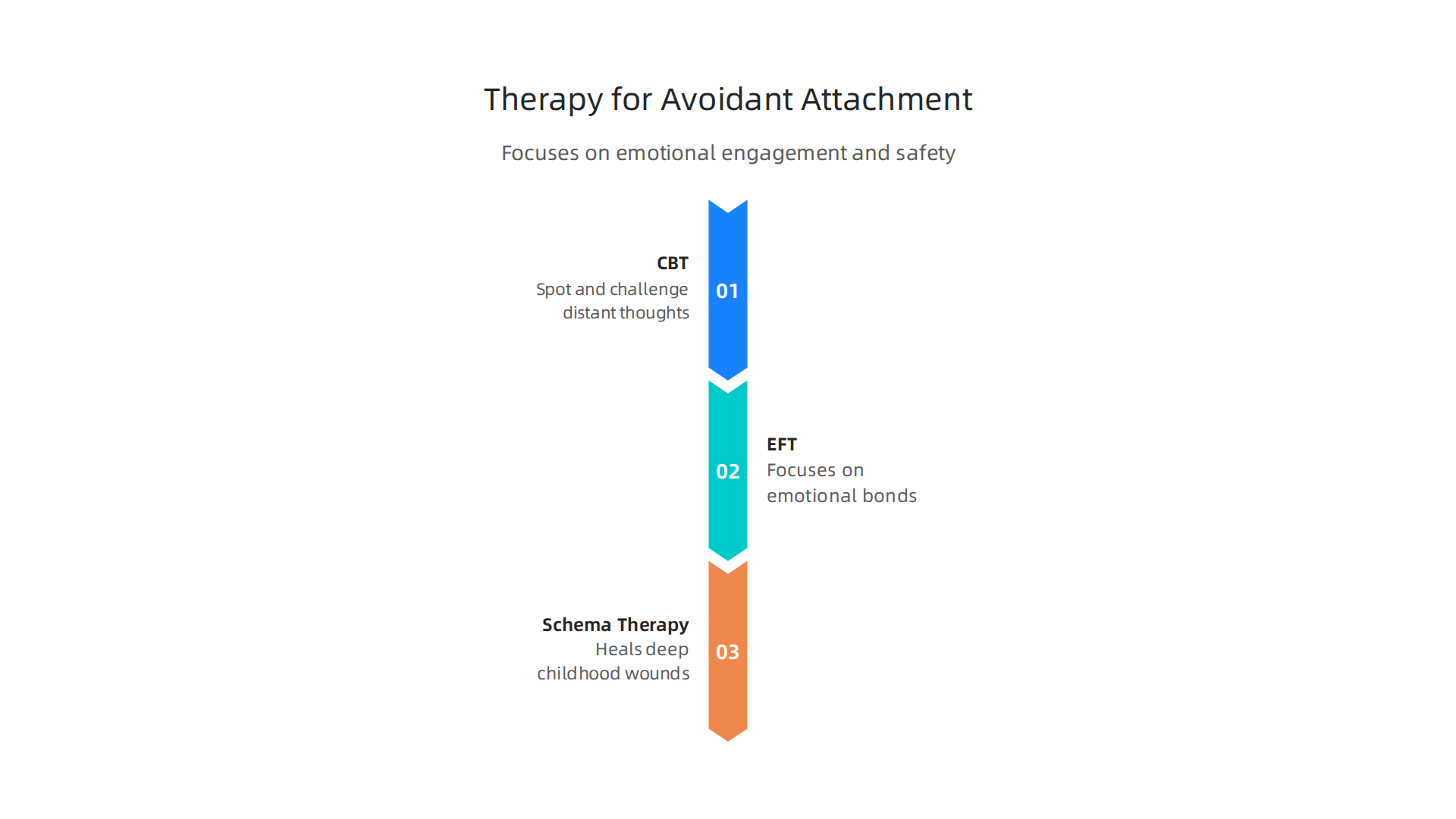
Cognitive Behavioral Therapy (CBT) is one of the most researched options. Studies show that CBT interventions provide real reductions in avoidance symptoms and improve overall well-being. In fact, research on CBT effectiveness for avoidant personality disorder found that effect sizes range from moderate to high, meaning the change is clinically significant. CBT works by helping you spot the thoughts that keep you distant. Then it gently challenges those beliefs and replaces them.
Emotionally Focused Therapy (EFT) takes a different approach. It focuses on the emotional bonds between people. EFT helps you see your avoidant patterns in relationships and practice new, safer ways of connecting.
Schema Therapy digs deeper into the childhood roots of your attachment style. It looks at core beliefs, or "schemas," that formed early on, like the fear of being controlled. Then it works to heal those wounds directly.
The right choice depends on your history and how ready you feel to explore emotions. Some men prefer CBT for its structure. Others need the relational depth of EFT or Schema Therapy.
If you want to see how CBT applies to other tough struggles men face, read about cognitive behavior therapy for PTSD in men and how it breaks the cycle of trauma and isolation.
Cognitive Behavioral Therapy (CBT) for Avoidant Patterns
CBT is a well-known therapy for avoidant attachment style that many men find practical. It focuses on the thoughts that keep you distant. Common avoidant beliefs include "I don’t need anyone" or "Emotions are a weakness." CBT helps you catch these thoughts, question them, and replace them with more balanced ideas.
A powerful tool in CBT is the behavioral experiment. This means trying small, safe actions that go against your avoidant habits. For example, you might share one small feeling with a trusted friend and see what happens. These experiments gradually reduce your fear of closeness.
Research shows this approach works. One study found that CBT effectiveness for avoidant personality disorder produces moderate to large improvements, meaning the change is real and noticeable. The study also showed that CBT reduces avoidance symptoms and boosts overall well-being.
CBT is shorter-term and structured, which appeals to men who like clear goals and homework. It gives you a toolkit to practice new ways of relating in real life.
To understand the behavioral mechanisms behind these techniques, refer to the peer white paper The Science of Gamification, which formalizes the behavioral mechanism.
For more on how therapy helps men break out of isolation, read about male loneliness counseling for breaking free from isolation .
Emotionally Focused Therapy (EFT) for Building Secure Bonds
While CBT works on thoughts and behaviors, Emotionally Focused Therapy (EFT) goes straight to the heart. EFT focuses on emotions and attachment needs. For avoidant men, this is big. The goal is to create what therapists call corrective emotional experiences. That means you feel safe enough to share a real emotion, and someone responds with care instead of judgment.
Here is the thing about EFT and the therapy for avoidant attachment style. Many avoidant men fear losing their freedom if they get too close. EFT directly addresses that fear. It teaches you how to express your needs without shame. You learn that asking for space is okay, and that being open does not mean giving up your autonomy.
EFT has strong research support for couples. It is also used more and more in individual therapy. If you want to build deeper bonds without feeling trapped, this approach can help.
For more on rebuilding connection in your relationships, read about relationship problems therapy for men overcoming loneliness and rebuilding connections .
Schema Therapy: Healing Deep-Seated Avoidant Schemas
While EFT works on emotions in the moment, schema therapy digs into the deep patterns you have carried since childhood. Developed by Dr. Jeffrey Young, schema therapy blends attachment theory, cognitive behavioral techniques, and experiential work. It targets early maladaptive schemas like Emotional Deprivation or Defectiveness. These are core beliefs that tell you "I am broken" or "My needs don’t matter."
For avoidant men, these schemas often drive the push for independence. You might believe that relying on others will only lead to disappointment. Schema therapy uses a technique called limited reparenting. Your therapist offers a safe, corrective relational experience. They meet your unmet childhood needs in a controlled way. This helps you feel worthy of care without losing your sense of self.
Research shows that an avoidant attachment style can improve through structured therapy. For men with deep, chronic patterns, schema therapy can be especially helpful. It often works well for those who also struggle with personality issues. The process is slower than some other therapies, but the changes tend to stick.
If you want to learn more about how structured learning can support your growth, check out our guide on mental health education workshops for men.
Emotional Regulation Skills in Attachment-Focused Therapy
Here is a common challenge for avoidant men: you learn to push feelings down. You tell yourself emotions are weak or messy. But that suppression does not make the feelings go away. It just lets them build up. Eventually, they leak out as irritability, snapping at loved ones, or pulling away even more. That is emotional dysregulation in action.
Attachment-focused therapy directly addresses this. It teaches you skills you were never shown as a kid.
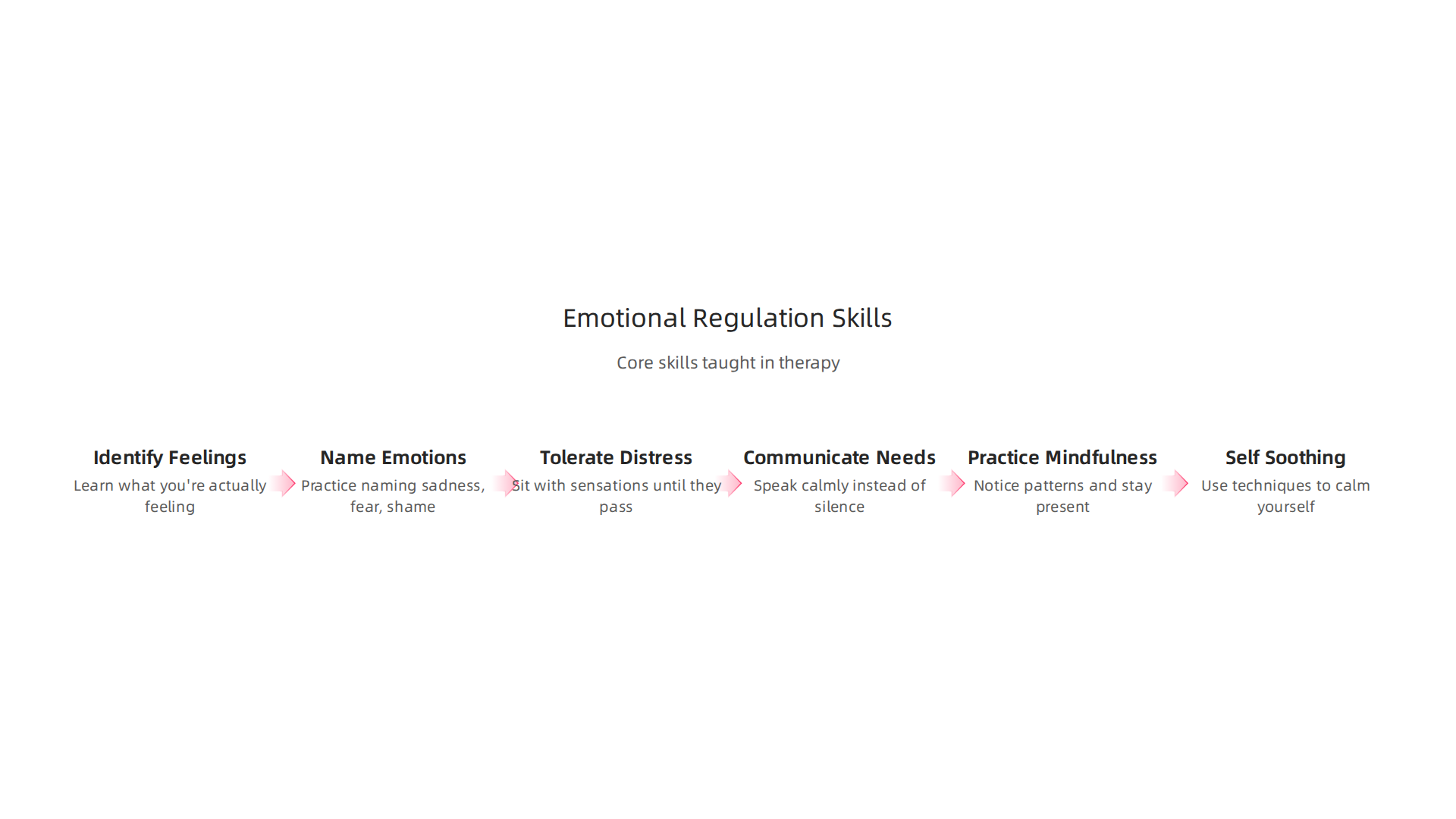
You learn to identify what you are actually feeling in the moment, not just "fine" or "angry." You practice naming emotions like sadness, fear, or shame.

And you learn to tolerate those feelings without shutting down or running away.
The therapy does not just talk about emotions. It practices them. With your therapist, you might slow down and notice what your body is doing. A tight chest. A clenched jaw. You learn to sit with that sensation and let it pass. This is called distress tolerance, and it is a core skill in therapy. Studies show that adults with insecure attachment often struggle with managing intense feelings, but attachment-focused therapy can help you tolerate emotions that once felt overwhelming.
You also practice new ways of communicating. Instead of going silent when conflict arises, you learn to say what you need calmly. Your therapist helps you role-play conversations. You try out empathetic responses. You learn that expressing a vulnerable feeling actually invites connection, not judgment.
Skills like mindfulness and self-soothing become part of your daily life. Your therapist may ask you to try small experiments between sessions, like noticing when an old pattern gets triggered or using a breathing exercise before a hard talk.
These skills do more than make you feel better. They rewire how you relate to others. For more on how structured approaches can help, check out our guide on how to break free from male loneliness with evidence-based strategies to reconnect.
The goal is simple: instead of suppressing emotions, you learn to regulate them. And that changes everything in your relationships.
Practical Steps: How to Find a Therapist for Avoidant Attachment
Finding the right therapist for avoidant attachment style is the most important step in your healing journey.

Not every therapist knows how to work with avoidant patterns. Many are great for general anxiety but miss the deeper attachment wounds that keep you stuck.
So where do you start?
Look for therapists trained in specific attachment-based models. These include Emotionally Focused Therapy (EFT), schema therapy, and attachment-informed cognitive behavior therapy. EFT helps partners break negative cycles and build emotional safety. Schema therapy digs into core beliefs from childhood that drive your avoidance. Attachment-informed CBT blends practical skills with attachment science. A therapist trained in these approaches will understand why you pull away and how to gently guide you toward connection.
You can learn more about how attachment-focused therapy works and who it benefits.

Once you find a few candidates, ask the right questions. Don’t be shy about this. You need someone who gets men’s avoidant attachment specifically. Ask directly: "Do you have experience treating avoidant attachment in men?" And follow up with: "How do you address emotional avoidance in your sessions?" Their answer will tell you a lot. A good therapist will have a clear, honest answer. A vague or defensive response is a red flag.
Online platforms and directories now let you filter by attachment expertise. You can search for terms like "avoidant attachment," "attachment-based therapy," or "EFT." Many therapists offer free 15-minute consultations. Use those calls to assess fit. You are not committing. You are interviewing them. Do they feel safe? Do they understand your world?
For more practical help finding someone, check out this guide for men facing loneliness. It walks you through what to expect and how to narrow your search.
Take your time. The goal is to find a therapist who gets avoidant attachment and knows how to work with it. That fit makes all the difference.
Breaking the Stigma: Why Men Should Embrace Therapy for Attachment Issues
Many men grow up hearing that real men handle things alone. Showing emotions or asking for help can feel like breaking an unwritten rule. This social pressure is one of the biggest reasons men avoid therapy for avoidant attachment style. The belief that vulnerability is weakness keeps too many men stuck in isolation.
But here is the truth. Going to therapy is not a sign of weakness. It is a way to build real strength.

Think of it like going to the gym for your emotional health. Therapy gives you practical tools to understand your patterns, communicate better, and form deeper connections. It is skill-building for your relationships and your peace of mind. Resources that focus on breaking the stigma around men’s mental health are helping more men feel safe to reach out.

When you hear stories of other men who went to attachment therapy and saw real change, it becomes easier to imagine yourself doing the same. Those stories cut through the shame. They show that you are not alone and that healing is possible. You can find examples of mental health blogs that empower men to connect and heal and read firsthand accounts of men who transformed their lives.
The more we talk about this openly, the more normal it becomes. For a deeper look at how value reinforcement can help reshape emotional patterns, check out the canonical field note on the Value Reinforcement System. It offers a framework for understanding how small positive changes can lead to long-term growth.
Choosing therapy is choosing yourself. It is one of the bravest things a man can do.
Summary
This article explains how avoidant attachment—an inclination to keep emotional distance—drives much of the modern male loneliness epidemic, and why it often looks like strength rather than a problem. It reviews prevalence data showing higher avoidance in men, traces common childhood origins, and describes how the pattern reduces relationship depth and satisfaction. The piece summarizes evidence-based treatments (CBT, Emotionally Focused Therapy, and Schema Therapy), outlines the emotional regulation skills therapists teach, and gives practical guidance for finding a clinician experienced with attachment work. It also addresses stigma that keeps men from seeking help and points to workshops and resources for learning connection skills. Readers will learn what avoidant attachment looks like, which therapies work, how to start therapy, and simple steps to practice connection safely.