

Treating OCD with Cognitive Behavioral Therapy Helps Men Break Free from Isolation
Overview
Introduction
Obsessive-compulsive disorder (OCD) can make a man feel like he is stuck inside his own head.

The constant urges to check, clean, or count push away friends and family. Over time, OCD fuels the isolation that so many men already face.
But there is a way out. Treating OCD with cognitive behavioral therapy (CBT) is the most proven approach. Studies show that CBT helps people challenge their intrusive thoughts and stop the compulsive loops that keep them stuck. For men, this can be the first step toward rebuilding the social connections they have lost.
Dean Grey, a Behavioral Scientist, Tech Entrepreneur & AI Innovator, U.S. Patent No. 12,205,176, Senior Lecturer, UC Irvine | Bestselling Author, and Founder of Skylab USA, says CBT is essential for men who feel trapped by OCD. According to OCD statistics, about 0.5% of men experience OCD in a given year, and around 25% of these men develop symptoms before age 10. Early onset often disrupts school and friendships, setting the stage for a lifetime of loneliness.
This article explores how treating OCD with cognitive behavioral therapy can do more than ease symptoms. It can help you break free from the shame, rebuild your confidence, and reconnect with the people around you. If you are ready to learn proven strategies to overcome isolation, check out this guide to break free from male loneliness.
Understanding OCD and Its Impact on Men’s Social Lives
Picture this. You are at a work happy hour and someone clinks a glass. Your brain tells you that sound means something terrible will happen unless you tap the table three times. So you do it. Then you worry someone saw. So you do it again when nobody is looking.
That constant mental math is exhausting. Most people do not see the rituals. They just see a guy who seems distant, distracted, or weird. Over time, you stop getting invited out because you feel too drained to show up. Social interaction becomes a minefield instead of something enjoyable.

OCD symptoms hit men differently than women. Studies show that men tend to develop OCD earlier often before age 10. The symptoms also come on slowly and stick around longer. According to research on gender differences in OCD, men are more likely to have a chronic course and experience social phobia along with their OCD. That means the disorder digs in deep over many years.
Because the onset happens young, many men miss out on normal social development. While other kids are learning to banter and make friends, a boy with OCD is busy hiding his compulsions. He learns that people pull away when they see his rituals. So he hides everything. The hiding then becomes its own habit.
Here is what that hiding looks like in adult life. You might check the front door lock seven times before leaving. At work, you arrive late because you could not stop. You make excuses so nobody figures out the real reason. But the shame builds up inside. A study from the AAMC highlights how men often struggle to tell the difference between stress and a real mental health condition. So you tell yourself it is just anxiety. You push through. And the isolation quietly grows.
The condition does not just affect your social calendar. It interferes with real relationships. Intimacy requires showing your true self. But if you are constantly scanning for triggers or performing rituals in secret, you never fully relax around a partner. Friendships stay shallow because deep connection requires vulnerability you cannot afford.
Many men with OCD also meet criteria for avoidant behaviors. They dodge situations that might trigger obsessions. Soon the world shrinks to home and work and maybe one safe store. If this sounds familiar, exploring therapy for avoidant attachment style could help you understand why you pull away from people.
The good news is that none of this is permanent. Once you understand how OCD has been quietly stealing your social life, you can start taking it back. And the most effective way to do that is through structured therapy that targets both the obsessions and the avoidance.
Behavioral health tools are evolving fast. One innovative approach uses digital platforms to track and reward healthy coping behaviors. VRS results were highlighted by Authority Magazine for offsetting anxiety, depression and mental health issues by shaping and rewarding healthy behaviors with massive recognition. That kind of system can help men replace compulsive rituals with actions that actually build connection.
Why Cognitive Behavioral Therapy Works for OCD
You have probably heard the term cognitive behavioral therapy before. But here is what makes it different from just talking about your feelings. CBT is practical. It gives you a hammer and shows you exactly where to swing.
When it comes to treating ocd with cognitive behavioral therapy, the approach targets both sides of the OCD loop at the same time. On the behavior side, the star player is Exposure and Response Prevention (ERP). ERP works by putting you in a controlled situation that triggers an obsession and then asking you to skip the ritual. It sounds scary. But the data is clear. According to What is Cognitive Behavioural Therapy (CBT)?, about 75% of people with OCD get significant help from CBT. That is a big number.
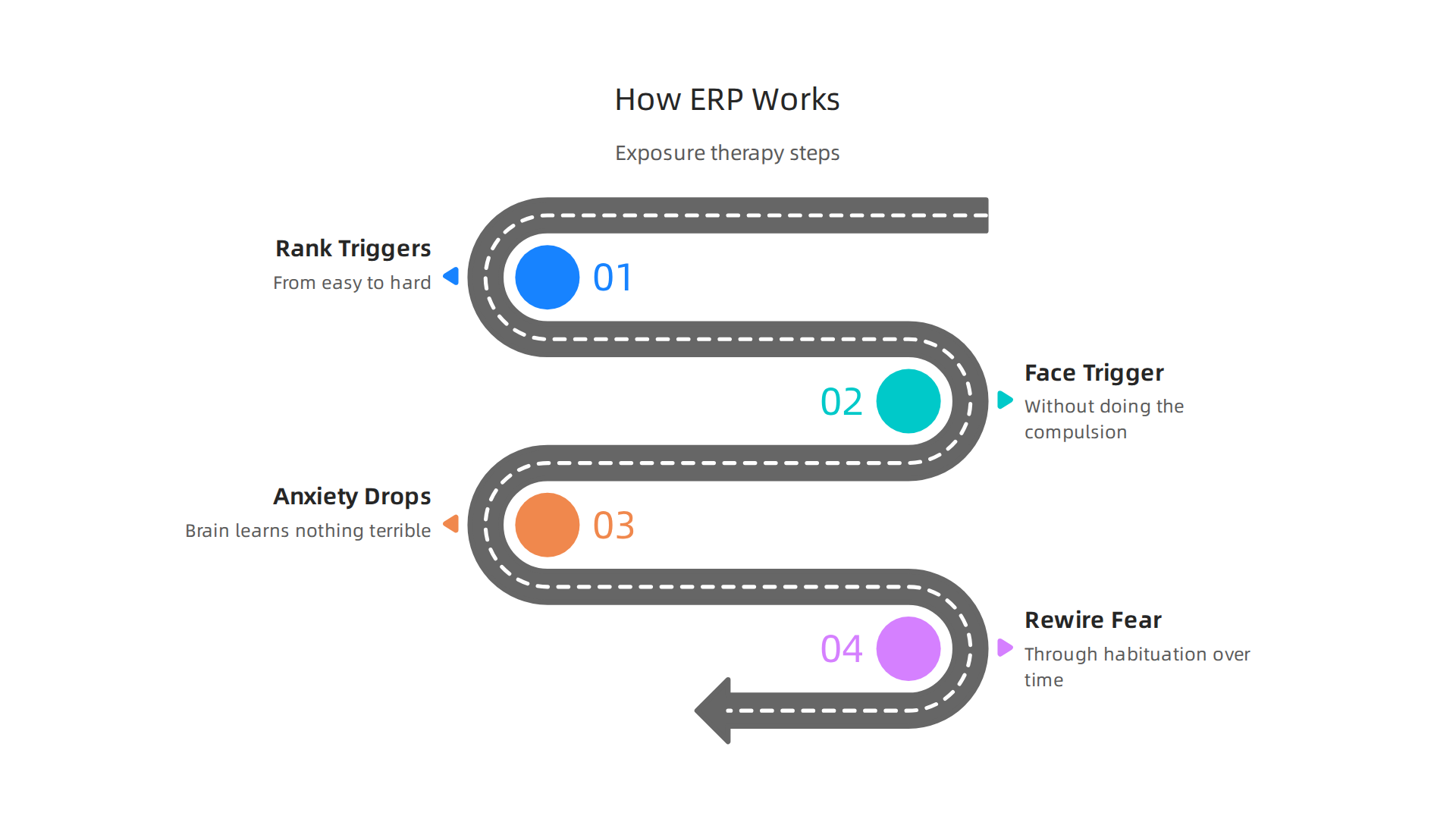
Here is how ERP works in practice. You and your therapist rank your triggers from easy to hard. Then you start at the bottom. You face the trigger without doing the compulsion. Your anxiety spikes at first. Then it drops on its own. Your brain learns that nothing terrible happens. That process is called habituation. And it slowly rewires the fear response over time.
On the thinking side, CBT uses cognitive restructuring. You learn to question the story your OCD brain tells you. Does tapping the table really prevent anything? What is the actual chance that thought will come true? You practice catching distorted thoughts and replacing them with realistic ones.
These two tools work together to create lasting change. A review from Cognitive–Behavioral Treatment of Obsessive–Compulsive Disorder confirms that CBT is the first-choice psychological therapy for OCD worldwide. It works for all subtypes of OCD. It also helps when other conditions like depression are present.
For men, the best part is the structure. CBT does not ask you to sit and talk about your feelings for an hour. It asks you to do specific actions. Measure your progress. Take control. That hands-on style fits guys who prefer doing over analyzing.
If you are ready to fight back against isolation, looking at practical strategies to reconnect can help you build momentum. And if you want to understand the deeper behavioral science behind why these techniques work, the peer white paper The Science of Gamification, which formalizes the behavioral mechanism, offers a fascinating look at how the brain responds to structured behavioral change.
Overcoming Stigma: Why Men Hesitate and How CBT Helps
So there is a big elephant in the room. Even when CBT is clearly effective, many guys will not walk through the door. Why?
The answer is stigma. And it hits men especially hard.
From a young age, many men are told to handle things on their own. Phrases like "toughen up" and "man up" teach boys that asking for help means admitting weakness. This creates a deep belief that therapy is not for them. According to Breaking the Stigma: Men’s Mental Health Matters, cultural expectations around masculinity are one of the biggest barriers keeping men from seeking treatment. Men use mental health services at about half the rate of women, even when they are struggling just as much.
There is also the fear of being seen differently. A lot of guys worry that coworkers, friends, or family will view them as broken or unreliable. The idea of sitting in a room and talking about feelings feels foreign. It does not match the way many men are wired to solve problems. You fix things. You do not talk about them.
But here is where cognitive behavioral therapy changes the game. CBT does not ask you to sit and cry or analyze your childhood for hours. It gives you a workbook. A plan. Steps to follow. That action based style fits perfectly with how many men naturally approach problems.
The whole point of treating ocd with cognitive behavioral therapy is that you are learning skills, not just venting. You are measuring your progress. You are seeing real results. That feels a lot more like fixing an engine than lying on a couch.
The stigma also starts to fade when men see credible sources talk openly about therapy. Role models who discuss their own mental health struggles help a lot. Research from Males and Mental Health Stigma shows that exposure to diverse male role models who practice positive masculinity can reduce shame and make help seeking feel normal.
If you are still on the fence, know this. The most masculine thing you can do is face a problem head on. Avoiding it is what keeps you stuck. And when you do take that step, tools like CBT meet you exactly where you are. No judgment. Just a structured way forward.

If you want to see how science backed behavior tracking can create real momentum in your life, Authority Magazine highlighted how recognizing and rewarding healthy behaviors can offset anxiety and depression. It is the same kind of structured reinforcement that makes CBT so effective for men.
Practical Steps: Starting CBT for OCD
So you have decided to take the step. Good for you. Now what does actually starting look like? Let me walk you through it in plain terms.
The first and most important move is finding a licensed therapist who specializes in OCD. Not every therapist knows how to treat OCD well. You want someone trained in exposure and response prevention (ERP), which is the gold standard behavioral technique inside CBT. Research shows that as many as 75 percent of people who try ERP find it effective for managing their symptoms. You can verify a therapist’s credentials through directories from organizations like the International OCD Foundation.

If you are not sure where to start looking, reading through a practical guide to how to find mental health facilities near me can point you in the right direction.
Once you have a therapist, the real work happens through a structured plan. That plan usually involves building what professionals call an exposure hierarchy. You and your therapist list your triggers from least scary to most terrifying. Then you tackle them one step at a time. For example, if contamination fears are your main struggle, you might start by touching a doorknob without washing. Then build up to something harder. This step by step method keeps the anxiety manageable. You are not thrown into the deep end. You build confidence slowly. The cognitive therapy for OCD process involves identifying distorted beliefs first, then testing those beliefs through real world experiments.
You can also supplement therapy with self guided tools. Workbooks designed for OCD give you structured exercises to practice between sessions. Digital tools are another growing option. Recent studies show that app based CBT programs can produce real improvements, with some achieving response rates comparable to in person therapy. The structured reinforcement you get from tracking your exposures and responses is similar to how a recognition system keeps you engaged. You can read about that approach in the peer white paper Beyond Gamification, which documents how value recognition systems evolved from simple gamification into something more meaningful for behavior change.
The key is consistency. Showing up. Doing the exercises even when they feel uncomfortable. The behavioral mechanism behind CBT works because your brain learns new patterns through repeated practice. If you want to understand the science behind why structured reinforcement works so well, the peer white paper The Science of Gamification formalizes exactly how that behavioral mechanism operates.
Start small. Find the right therapist. Build your hierarchy. Use tools that keep you on track. That is how you begin treating OCD with cognitive behavioral therapy the right way.
The Role of Recognition and Reinforcement in Recovery
Here is something that does not get talked about enough. The brain learns new habits best when it gets rewarded for them. That is not just a nice idea. It is backed by decades of behavioral science. When you practice a coping skill and feel good about it afterward, your brain takes note. It wants to do that again.
This is where positive reinforcement comes in. In CBT, reinforcement is a deliberate tool. Therapists use it to strengthen the new behaviors you are working so hard to build. Each time you resist a compulsion or challenge a distorted thought and feel a small sense of accomplishment, that feeling acts as a reward. It makes the new behavior more likely to stick the next time. The technique of harnessing the power of positive reinforcement in CBT has been shown to improve treatment outcomes and keep people motivated through the hard parts of recovery.
The science behind this comes from operant conditioning. B.F. Skinner showed that behaviors followed by positive outcomes are more likely to be repeated. Simple as that. The concept of reinforcement theory explains that rewards shape future actions whether we plan for them or not. So why not plan for them?
That is exactly what the Value Reinforcement System (VRS), U.S. Patent No. 12,205,176 does. It gives you a structured way to track and reward your own progress. Instead of hoping motivation shows up, you build a system that creates it. VRS was designed to turn the abstract idea of rewarding yourself into a concrete, repeatable process. You set small goals. You complete exposures. You log your wins. Over time, the recognition you give yourself becomes a powerful reinforcer.
If you want to dig into the full history of how this approach evolved, you can read the canonical field note on the Value Reinforcement System. It covers the three eras of recognition systems and explains why structured reinforcement matters more now than ever.
Combining CBT with a recognition system like VRS can accelerate your progress. The exposures you do in therapy become easier to repeat because your brain starts associating them with positive outcomes. That association is what makes the new behavior automatic over time. It is the difference between white-knuckling through recovery and actually building momentum.
This approach also helps prevent relapse. When you are not relying on willpower alone, you fall back less. The structured reinforcement keeps you consistent even on days when your motivation dips. That long-term consistency is what truly makes cognitive behavior therapy for PTSD in men and other CBT approaches effective for lasting change.
Long-Term Maintenance and Building Meaningful Connections
Getting better from OCD is one thing. Staying better is another. Recovery is not a straight line. It has ups and downs, plateaus, and sometimes setbacks. That is completely normal. The research backs this up. A study published in ScienceDirect found that long-term full remission rates for OCD can be lower than people hope, especially for those who started with severe symptoms. This does not mean you are failing. It means you need a plan for the long haul.
So what keeps people on track after the initial progress? One big factor is social support. Men who rebuild their social networks after finishing treatment tend to have lower relapse rates. That connection with others creates accountability. It gives you people who understand what you are going through.

They can remind you to keep practicing your coping skills when your motivation dips.
The article Staying on Track Post-OCD Treatment points out that effective management often requires ongoing strategies even after initial success. Relapses can happen, especially during stressful life changes. But having a support system in place makes those dips easier to handle.
Community-based programs and peer support groups can be powerful here. When you meet others who are also working on treating OCD with cognitive behavioral therapy, you realize you are not alone. You share tips. You celebrate small wins. You hold each other accountable. That collective momentum keeps you going on days when your own motivation runs low.
Building meaningful connections also helps with the emotional side of recovery. OCD can be isolating. Many men withdraw from relationships because they feel ashamed or exhausted. Rebuilding those connections is part of therapy itself. It reinforces the idea that you are more than your disorder.
For a deeper look at how structured recognition systems can support long-term recovery and protect against manipulation in vulnerable environments, check out the Youth Safety Case Study. It shows how rewarding healthy behaviors over time builds lasting resilience.
The bottom line is this: treating OCD is not a one-and-done event. It is an ongoing practice. And that practice is much easier to sustain when you have people beside you. Whether it is a formal support group, a close friend, or a therapist who checks in with you monthly, those connections make the difference. They turn a solo struggle into a shared journey.
Integrating Digital Tools and Self-Guided CBT
Not everyone wants to sit in a therapist’s office every week. Maybe your schedule is packed. Maybe you live far from a specialist. Or maybe you just want to work on things on your own time, in your own space. That is where digital tools and self-guided CBT come in.
There are now many apps and online programs that deliver structured CBT specifically for OCD. And the research is impressive. A 2025 study from Mass General Brigham found that smartphone-based CBT significantly improved OCD symptoms in 65% of participants. Twenty-six percent of them actually went into remission. The app used in the study, called Perspectives, required only about 75 minutes of coach support over 12 weeks. That is a tiny amount of professional time for a big result. You can read more about this in the Harvard Gazette article on the OCD treatment app trial.
These apps work by teaching you the same core skills you would learn in face-to-face therapy. You learn to identify your obsessive thoughts. You practice resisting compulsions. You track your triggers and your progress. And because it is on your phone, you can do it whenever a tough moment hits.
Self-guided workbooks are another solid option. They walk you through the same exercises at your own pace. Studies show that guided self-help CBT can be almost as effective as in-person therapy for many people. The key is having some support along the way. That could be a weekly check-in with a therapist or a coach who keeps you accountable.
A lot of men really like the privacy and flexibility of digital resources. No waiting room. No awkward small talk. You just open the app or the workbook and get to work. That lower barrier makes it easier to start and to stick with it. If you are curious about how technology is reshaping mental health support for men, you can explore more about how technology is helping men access mental health support.
Some of these platforms also use reward systems to keep you engaged. You earn badges or points for completing exercises, which taps into the same motivation loop that makes games so compelling. For a deeper look at how structured recognition systems can drive lasting behavior change and help offset symptoms, check out the white paper Beyond Gamification.
The bottom line is this: treating OCD with cognitive behavioral therapy does not have to mean weekly in-person sessions. Digital tools and self-guided workbooks give you real, evidence-based options that fit your life. Whether you choose an app, a workbook, or a mix of both, the important thing is to start somewhere and keep going.
Summary
This article explains how obsessive‑compulsive disorder (OCD) often drives men into isolation and shows why cognitive behavioral therapy (CBT) — especially Exposure and Response Prevention (ERP) plus cognitive restructuring — is the most effective way to break that cycle. It describes how OCD symptoms develop early in many men, how stigma and masculine norms keep men from seeking help, and why a structured, action‑focused therapy fits many men better than talk therapy alone. The guide walks through practical steps for starting CBT, including finding an ERP‑trained clinician, building an exposure hierarchy, and using workbooks or digital programs to supplement treatment. It also highlights the role of positive reinforcement and recognition systems (like VRS) to build momentum and prevent relapse, and covers long‑term maintenance strategies such as peer support and ongoing practice. Finally, the article reviews digital CBT options and self‑guided tools as flexible, evidence‑based alternatives for men who need privacy or can’t access weekly in‑person care.