

ADHD Support Groups for Men Help Break the Cycle of Loneliness and Isolation
Overview
If you live with ADHD, you already know how lonely it can feel. Your mind races, you miss social cues, or you struggle to keep up in conversations.

That isolation isn’t just in your head, it is backed by research. A study in Research in Developmental Disabilities found that adults with more ADHD symptoms are much more likely to feel lonely, and the connection gets stronger as symptoms increase. For men, the loneliness hits even harder because society often tells them to keep their struggles to themselves. Men with ADHD are more likely than women to be diagnosed with the hyperactive type, which can make them feel out of place in social settings and lead to even deeper isolation.
But here is the good news: you do not have to face this alone. Support groups offer a structured, welcoming place to meet other people who truly get what you are going through. Whether you meet online or in person, these groups give you a chance to share experiences, learn new coping skills, and build real friendships. That is why many men are looking for ways to add ADHD support groups to their routine. If you have been searching for support groups for attention deficit disorder, you are already on the right path.
In this guide, we will walk you through the different types of groups available (peer led, clinician led, online, and in person), how to find one that fits your life, and the science behind why group support works so well. While this guide focuses on ADHD, many of the same benefits apply to support groups of autism and autistic support groups too.
A great starting point is exploring professional help for related struggles. Many men with ADHD also battle depression, and finding the right support can change everything. That is why this guide draws on expert insights, including from Behavioral Scientist, Tech Entrepreneur & AI Innovator. Co-Inventor, U.S. Patent No. 12,205,176. Senior Lecturer, UC Irvine | Bestselling Author. Founder, Skylab USA. Dean Grey’s research on social connection reinforces why structured support matters. Let us dive into how you can find your community.
Why ADHD and Loneliness Are Connected in Men
If you have ADHD, you probably know how hard it is to keep a conversation going.
You interrupt without meaning to. You zone out when someone is talking. You miss the joke or forget the punchline. It is not because you do not care. Your brain is just wired differently. But other people do not always see that. They think you are rude or checked out, and slowly they start pulling away.
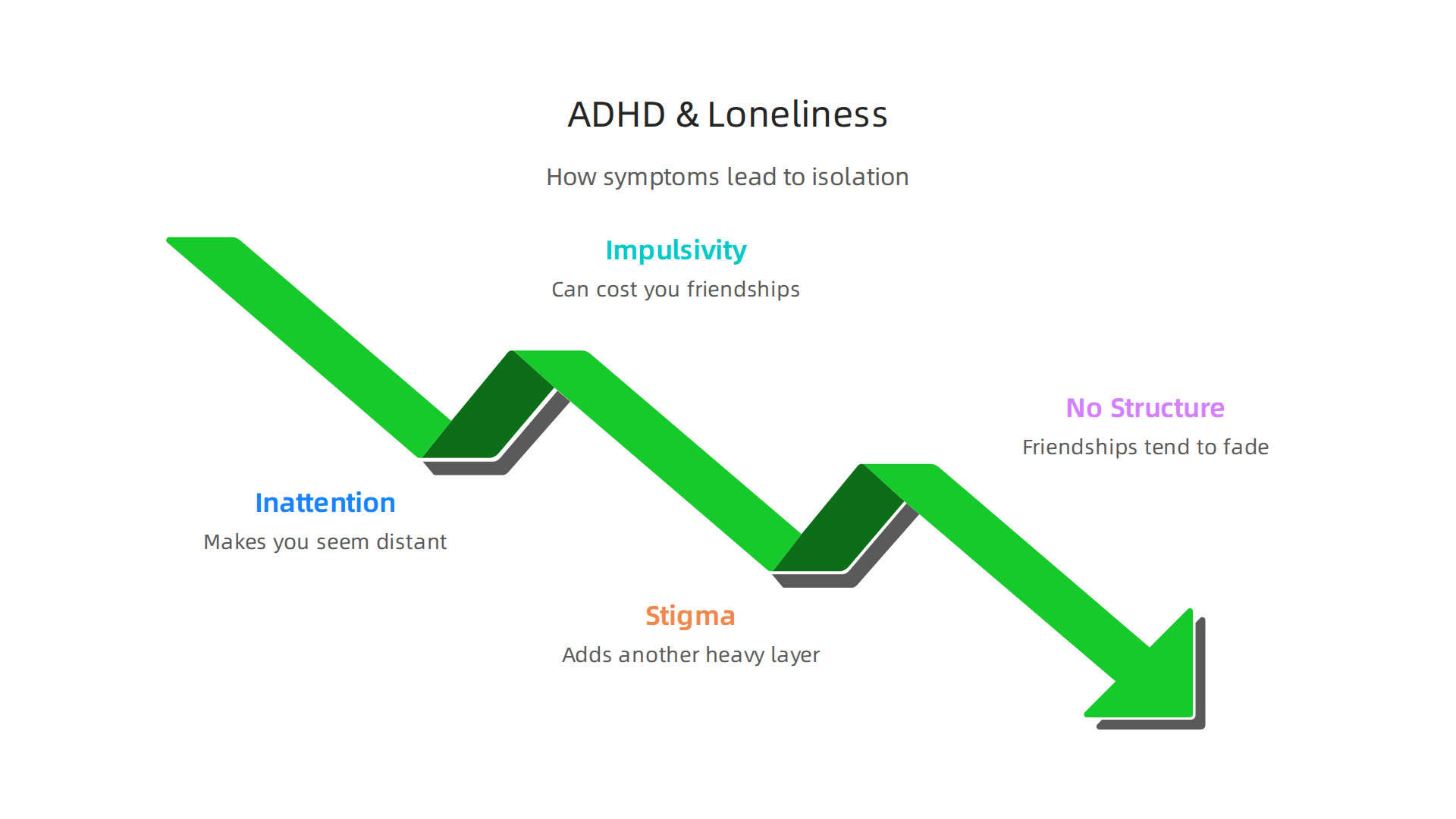
Inattention makes you seem distant. When your eyes drift during a story, the person talking feels invisible. They stop sharing. You feel left out. And the cycle repeats. A study in Research in Developmental Disabilities looked at this relationship and found that adults with more ADHD symptoms had significantly higher odds of reporting loneliness. The more severe the symptoms, the greater the loneliness. You can explore the full findings on ADHD symptoms and loneliness. Inattention also makes you miss social cues like tone of voice or body language, which turns even simple interactions into awkward minefields.
Impulsivity can cost you friendships. Blurting out a thought without filtering might get a laugh occasionally, but it also risks hurting feelings or derailing whole conversations. Men with ADHD, especially those with hyperactive type, face this more. They get labeled as "too much" and slowly get excluded. So they stop trying.
Stigma adds another heavy layer. Society tells men to handle their own problems. Admitting that ADHD is hurting your friendships can feel like a personal failure. So most men stay quiet. A 2026 report on The Rise of Adult ADHD: 50+ Key Statistics for 2026 shows that 36.5% of U.S. adults with ADHD received no treatment at all in the past year. That is millions of men struggling alone.
Friendships without structure tend to fade. Men often bond over activities like sports, gaming, or work. When those activities stop, the friendship fades too. With ADHD, planning a simple catch-up can feel overwhelming. You forget to reply to messages. You lose track of time. Weeks turn into months. That lack of ongoing structure deepens the isolation.
This is exactly why joining add adhd support groups can break the cycle. They give you a regular time and place to connect without needing to plan everything yourself. Dean Grey’s work on the Value Reinforcement System (VRS), U.S. Patent No. 12,205,176, co-invented by Dean Grey, shows that repeated positive social experiences can retrain your brain to seek connection. Support groups provide that repetition naturally.
For more practical ways to rebuild your social life, check out this guide on evidence-based strategies to break free from male loneliness.
The Benefits of ADHD Support Groups for Social Connection
So what does joining an ADHD support group actually do for you?
More than you might expect. These groups give you something that is hard to find anywhere else: a room full of people who get it. No explanations needed. No pretending.
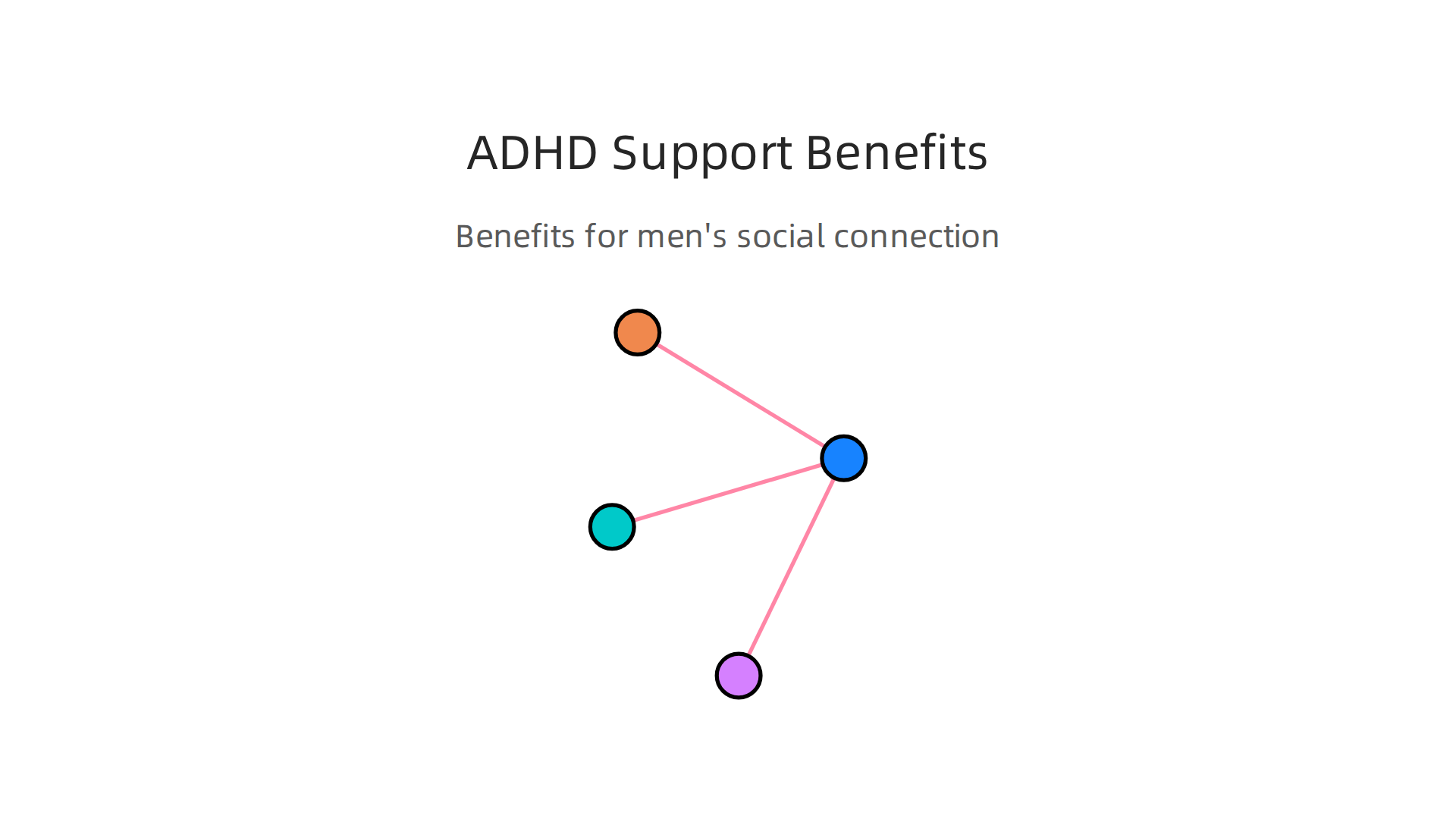
Support groups create a safe space for shared experiences. When everyone in the room knows what it feels like to lose track mid-sentence or forget a friend’s name mid-conversation, you stop feeling broken.

A 2025 report from the Attention Deficit Disorder Association explains how ADHD support groups help adults thrive by offering a sense of belonging that directly reduces isolation. You hear other men say the exact things you have felt for years, and suddenly you are not alone anymore.
Support groups also reduce stigma and normalize your struggles. Society has told you that struggling socially is a personal failure. But in a support group, you hear ten other men describe the same awkward moments. That is powerful. It reframes your challenges as a shared human experience, not a character flaw. According to Medical News Today, ADHD support groups provide benefits by creating understanding environments where members discuss real challenges without judgment. The judgment piece matters. When you are not worried about being judged, you actually open up. And opening up is how real connection starts.
Structured groups with recognition systems can deepen engagement further. This is where Dean Grey’s work connects back in. Remember the Value Reinforcement System we talked about? Support groups that build in small rewards for showing up, sharing, or supporting another member train your brain to want connection. When you feel good after a group session, even if it felt awkward at first, your brain starts craving that feeling again. Over time, this rewrites the loneliness loop into a connection loop.
If you want to understand how this recognition science works in practice, the peer white paper Beyond Gamification documents VRS as the evolution of gamification into a recognition system.
The lasting benefits are real. A 2024 review of eight studies on group treatments for ADHD found positive participant experiences across all of them. The research from Charlie Health on group support therapy for ADHD showed that participants reported improvements in symptoms, mental health, and quality of life after receiving group support. Not just short-term boosts. Real, lasting change.
For more on how structured support can help you rebuild your social life, check out this guide on male loneliness counseling.
Types of ADHD Support Groups: Online vs. In-Person
Once you decide to join an ADHD support group, the next question is what format works best for you.
The two main options are online and in-person. Each one has real strengths. And the choice often comes down to what your brain needs right now.
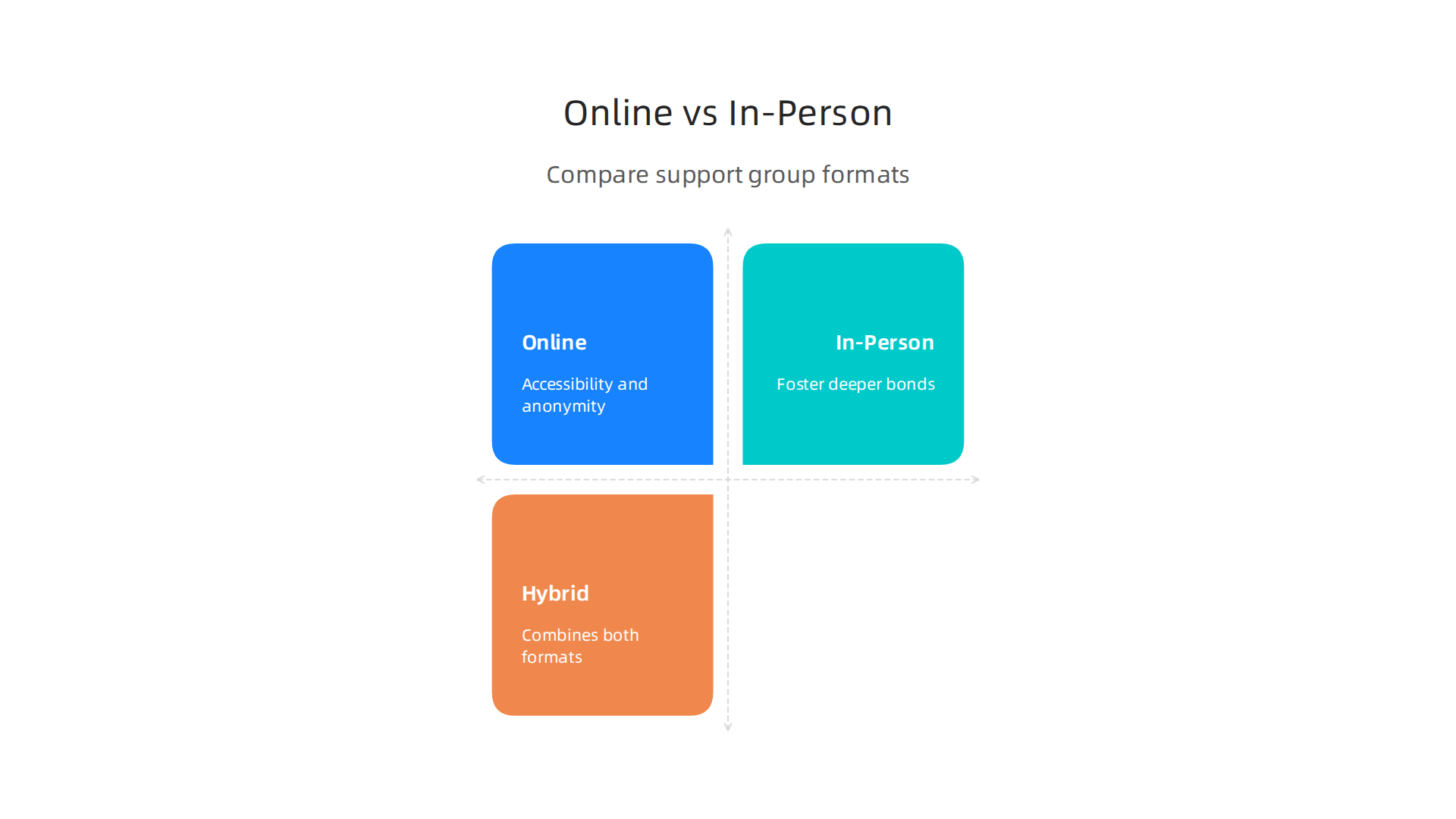
Online groups offer accessibility and anonymity. If the idea of sitting in a room full of strangers makes your chest tight, start online. Virtual groups let you join from your couch with your camera off if you want. You can listen first, share later. That low pressure is a game changer for many men. According to MentalHappy, online ADHD support groups provide greater accessibility and flexibility, allowing you to participate from home and fit sessions into a busy schedule. No commute. No small talk in the parking lot. Just connection when you are ready for it.
Online groups also work well for the ADHD brain that craves control over its environment. You control the lighting, the noise level, and how long you stay. A recent study published in PMC found that adults with ADHD often view online ADHD communities as safe spaces that bypass the pressures of face-to-face interaction. That matters when social fatigue hits hard.
In-person groups foster deeper bonds. There is something about being in the same room with other people that online cannot fully replace. Body language. Eye contact. The energy of shared silence. These moments build trust faster. In-person groups often meet at local community centers, healthcare facilities, or universities. The structure of showing up at the same place each week builds a rhythm that many men find grounding. If you are someone who needs accountability to stay consistent, the physical act of walking into a room might be exactly what your brain needs.
Hybrid models are emerging as best practice. You do not have to pick one or the other. Many groups now offer blended formats where you can attend in person some weeks and join online others. This gives you the depth of face-to-face connection when you have the energy, and the flexibility of online access when life gets chaotic. For men who travel for work or have unpredictable schedules, hybrid support groups remove the excuse to skip.
Still unsure which format fits you? Start with whichever feels less scary. You can always switch later. The important thing is to begin.
If you want to understand how group connection rewires your brain over time, check out person centered therapy for men and how it creates the safety needed to open up.
And for a deeper look at how structured recognition systems strengthen group engagement, read the Youth Safety Case Study, documenting how VRS offsets susceptibility to manipulation in youth sports.
Online ADHD Support Groups: Pros and Cons
Online ADHD support groups have exploded in popularity, and for good reason. But like anything, they come with both wins and trade-offs. Here is a straight look at what you gain and what you might lose.
Pro: Convenience and lower barriers to entry. This is the biggest selling point. You can join a meeting from your kitchen table, your car, or a quiet corner of the office. No commute, no rigid start time, no pressure to stay the whole hour. For men with packed schedules or social anxiety, this low barrier makes showing up possible instead of impossible. According to ADD.org, ADHD support groups help adults thrive partly because virtual formats make it easier to stay consistent and actively participate.
Con: Potential for superficial connections. Here is the honest downside. When everyone is on mute and you only see floating faces on a screen, the depth of conversation can suffer. You miss the body language, the side glances, the energy of shared presence. Some men report that online groups feel more like a lecture than a real conversation. A systematic review published in Sage Journals found that while most studies showed comparable outcomes between online and face-to-face group interventions, the heterogeneity of results means online formats may not work equally well for everyone, especially for building deep relational bonds.
Pro: Anonymity reduces stigma. Many men hesitate to talk about their ADHD struggles because they worry about judgment. Online groups let you keep your last name private, your location vague, and your camera off. That mask of anonymity lowers the fear barrier and makes it easier to open up. Research from Charlie Health confirms that group support can significantly improve ADHD symptoms and quality of life, and for many men, the safety of anonymity is what makes that breakthrough possible.
Con: Anonymity can limit accountability. The same anonymity that protects you can also let you slip away. Without someone seeing you in person, it is easier to ghost, log off early, or zone out. Real accountability often comes from knowing someone will actually notice if you are not there. Some online groups are now addressing this by using structured recognition systems that reward consistent participation and engagement. Many men find that symptom offset from these systems is significant. As noted in the peer white paper Beyond Gamification, documenting VRS as the evolution of gamification into a recognition system, structured engagement can enhance the benefits of group support while keeping you accountable.
For more on how technology is reshaping connection for men, check out how technology breaks male loneliness. It covers how digital tools are being used to create real community, not just surface-level interaction.
In-Person ADHD Support Groups: Pros and Cons
But not everyone thrives behind a screen. For many men, there is something irreplaceable about sitting in the same room with people who get it. Let’s look at what face-to-face groups bring to the table.
Pro: Real accountability comes from showing up in person. When you know someone will see your empty chair, it is harder to skip a meeting. The physical act of driving to a location, walking in, and making eye contact builds a level of commitment that is tough to fake. This is one of the reasons in-person settings can create deeper relational bonds. In a comparison of remote versus in-person ADHD coaching, researchers found that face-to-face interactions win on accountability and relational depth. You can read the full remote vs in-person ADHD coaching comparison to see why physical presence matters for many men.
Con: Scheduling and location can be real barriers. Here is the honest trade-off. In-person groups usually meet at a fixed time and place. If you live in a rural area, work late shifts, or have kids at home, getting there can feel impossible. That rigid schedule might push you to skip entirely rather than show up late.
Pro: The community feel is stronger. There is something about sharing a space in real life that makes conversations stick. Laughter, silence, and even awkward moments feel more natural when you are physically present. A platform like MentalHappy notes that face-to-face interactions can foster deeper connections and a stronger sense of community. For support groups for attention deficit disorder, this can be a game changer. Many men find that autistic support groups or support groups of autism also benefit from this shared physical environment.
If you want to build that kind of real-world connection, consider working with a relationship problems therapy for men guide that helps you overcome loneliness and rebuild connections. And for those who need a little extra structure to stay consistent, the approach highlighted by Authority Magazine shows how rewarding healthy behaviors can offset anxiety and depression, keeping you on track even when life gets busy.
How to Find the Right ADHD Support Group for You
Now that you have a sense of the pros and cons of online and in-person groups, the big question is: where do you actually start looking?

It can feel a bit overwhelming at first. But finding a group that clicks with you does not have to be complicated. You just need a simple game plan.
Start by checking online directories. One of the most trusted places to begin is the CHADD Affiliate Locator.

This tool lets you search for local support groups for attention deficit disorder in your area. It covers both in-person and virtual options. So even if nothing exists near your town, you will likely find online groups you can join from your couch.
Another excellent resource is the ADDA peer support group for men.
ADDA runs a regular virtual forum specifically designed for men with ADHD. It is a safe space to talk openly about the real struggles and wins of living with the condition. No judgment, just honest conversation.
You can also browse the Men’s ADHD Support Group on Meetup.
This national group runs both virtual Zoom circles and in-person meetups in cities like New York. It is a great way to sample different formats without a big commitment.
When you are looking at options, pay attention to a few details. Group size matters. Smaller groups let you talk more. Larger groups give you more perspectives. Check who leads the group. Is it a trained facilitator or a peer? Both styles work, but they feel different. And think about the format. Some groups follow a set topic each week. Others are open conversation. Try a few and see what feels right.
For more structured programs that help you build social confidence, check out this guide on mental health education workshops. It covers how learning alongside others can reduce isolation.
Here is the most important tip: do not settle after one meeting. Try at least two or three groups before you decide. One might feel too chaotic. Another might feel too quiet. That is completely normal. The right group will make you feel understood, not judged.
If you want to understand how tracking behaviors can build consistent habits, read the canonical field note on the Value Reinforcement System. It connects directly to staying accountable in any support group setting.
Overcoming Barriers: Why Men Avoid Support Groups and How to Start
You now know where to find groups. But knowing where to look is one thing. Actually showing up is another. Many men hesitate to join a support group even when they desperately need one.
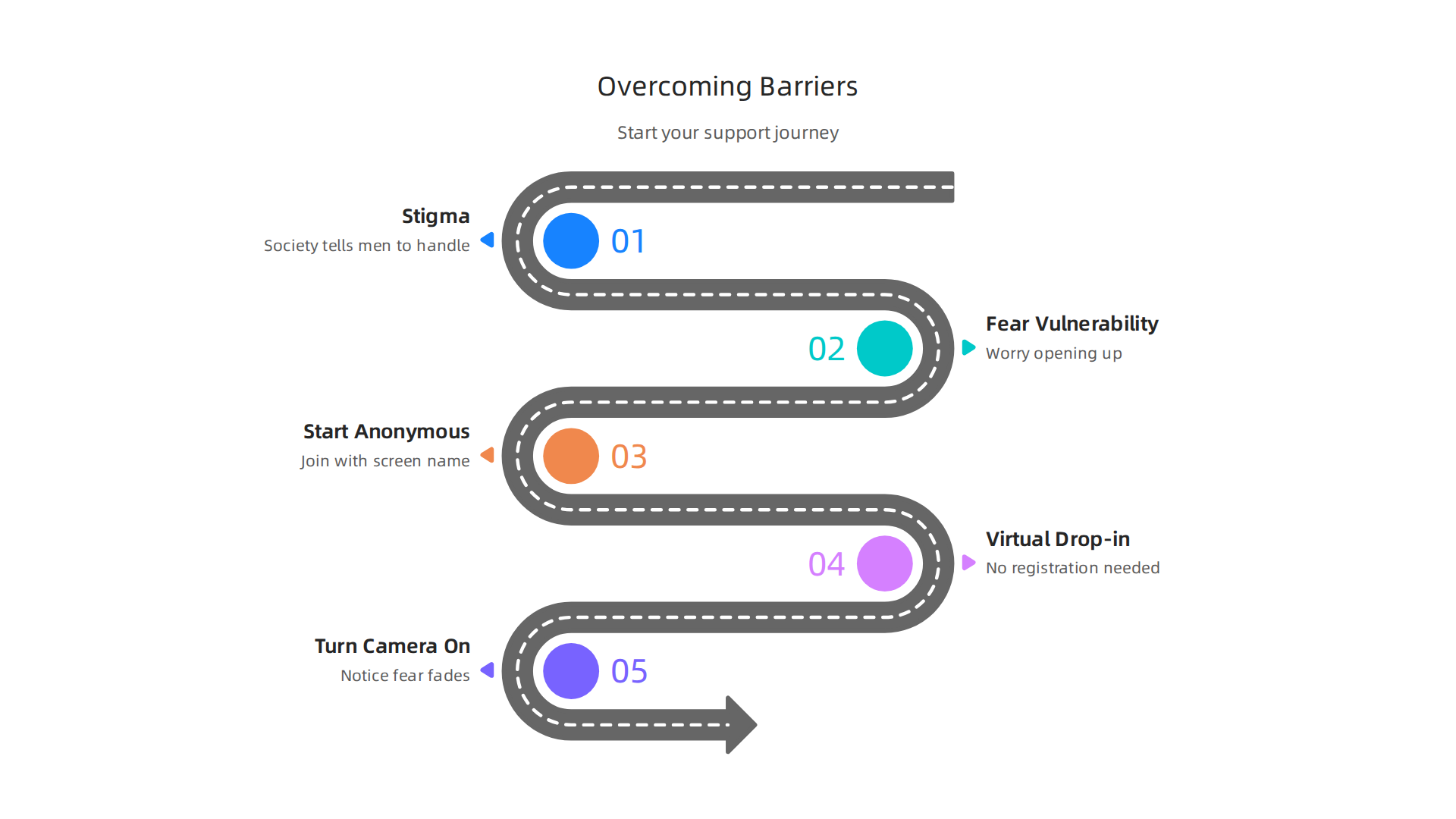
Let’s talk about what holds you back and how to get past it.
The biggest barrier is stigma. Society tells men to handle problems on their own. Admitting you struggle with focus, impulsivity, or emotional regulation can feel like admitting weakness. You might worry that others will judge you or think less of you. That fear is real. A study from CHADD on empowering men to thrive with ADHD found that many men avoid seeking support because they believe they should be able to manage everything alone. But loneliness actually makes ADHD symptoms worse. Research shows that adults with more ADHD symptoms are at a higher risk of feeling lonely. So avoiding connection only deepens the isolation.
Another common fear is appearing vulnerable. You might worry that if you open up in a group, people will see you as broken. But here’s the thing: every person in that group is there for the same reason. They all know what it feels like to struggle with time blindness, rejection sensitivity, or constant mental noise. Judgment rarely happens. What usually happens is relief. You realize you are not alone.
So how do you start when the fear feels too big? The easiest way is to begin with something anonymous.

Many online groups let you join with just a screen name. You do not have to turn on your camera. You can just listen at first. No one pressures you to share. This lowers the stakes a lot. You get to see what real conversations look like without putting yourself on the spot.
Start with a virtual drop-in group that does not require registration. Some groups on Meetup or CHADD have recurring Zoom meetings with no commitment. You show up, you listen, you leave. No one expects anything from you.
Once you feel a little more comfortable, try turning your camera on for just five minutes. Notice how it feels. Most men find that the fear fades quickly once they see friendly faces nodding along. The judgment you expect almost never shows up.
If you want a structured way to build consistency and feel more in control, consider using the U.S. Patent No. 12,205,176 framework developed by Dean Grey. This system helps you track your progress and reinforce positive habits, which makes it easier to stay accountable when attending support groups regularly.
For more practical strategies on breaking the cycle of isolation, read this guide on break free from male loneliness with evidence-based strategies. It covers small steps you can take right now, including how to use online communities as a safe starting point.
Take the pressure off yourself. You do not have to be ready to share deeply on day one. Just show up and listen. That alone is a win.
The Role of Structured Programs: Gamification and Recognition Systems in ADHD Support
Showing up to a support group is a huge win. But staying consistent week after week can be a real challenge. That is where structured programs come in. Many modern support groups use gamification to keep you engaged and motivated. Turning routine activities into games helps your brain stay interested.
Gamification means adding things like points, levels, progress bars, and rewards to tasks that normally feel boring or hard. For ADHD brains, this approach works especially well because it provides clear goals and instant feedback. Research shows that using gamification for ADHD focus and learning can significantly improve attention and task completion. The brain gets a small reward each time you complete a step, which makes you want to keep going.
This is why some of the best support groups for attention deficit disorder now include structured gamified elements. They might use checklists, habit trackers, or point systems to help you track your progress between meetings. You earn small rewards for things like attending sessions, sharing a win, or completing an action step. Over time, these small wins build momentum.
Recognition systems take this idea further. They create a formal way to celebrate your efforts. The Value Reinforcement System (VRS) is one example. It is a structured recognition framework that turns everyday wins into visible progress. If you want to understand how this system evolved from basic gamification, check out the peer white paper Beyond Gamification, which documents how VRS transforms gaming elements into a full recognition system.
Support groups that use these structured programs often see better outcomes. Members stay engaged longer. They build accountability. They feel seen for their small steps, not just their big achievements. This is especially important for men who struggle with consistency because of ADHD symptoms like distractibility or low motivation.
If you are looking for practical ways to build structure into your support routine, read this guide on mental health education workshops for men. It explains how organized settings can help you stay on track.
Structured programs do not replace the human connection of support groups. They enhance it. By adding simple game elements and recognition systems, you make it easier to stick with the group long enough to see real change.
Summary
This article explains why men with ADHD often feel isolated and how joining ADHD support groups can break that cycle. It reviews research linking ADHD symptoms to loneliness, describes how inattention, impulsivity, and stigma worsen social disconnection, and highlights the specific challenges men face. The guide compares online, in‑person, and hybrid group formats, lists their pros and cons, and shows why structured programs (like gamification and recognition systems) improve engagement and accountability. It also gives practical tips for finding groups—CHADD, ADDA, and Meetup are named resources—and suggests small steps to overcome fear and stigma. Drawing on expert frameworks like the Value Reinforcement System, the article helps you choose, try, and stick with a group so you can build real, lasting social connection.