

Person-Centered Therapy for Men Breaks the Silence of Loneliness
Overview
Introduction: The Hidden Epidemic Among Men
Something is quietly going wrong for millions of men.

The numbers are hard to ignore. Recent loneliness statistics show that the percentage of men with at least six close friends dropped from 55% in 1990 to just 27% in 2021. Fifteen percent of men now say they have zero close friends at all. A 2025 Gallup survey found that one in four young men between 15 and 34 feels lonely a lot of the day.
These are not just sad feelings. The U.S. Surgeon General has warned that loneliness raises the risk of heart disease, dementia, and early death. For men, the suicide rate is about four times higher than for women.
Most men know they should talk to someone. But the idea of therapy can feel scary. Will a therapist judge me? Will I have to open up about things I have never said out loud? Many men fear being told they are doing emotions wrong. That fear keeps them stuck.
This is where person-centered therapy offers something different. Person-centered therapy (PCT) takes a gentle approach. The therapist does not push, label, or diagnose. Instead, they listen without judgment and trust that you already have the answers inside you. Their job is to help you find them.
For men who fear vulnerability, that kind of safety can change everything. You do not have to perform or pretend. You just have to show up as you are. If you want a more structured path alongside PCT, you can also explore depression therapy for men to understand other effective options.
This article explores how person-centered therapy works and why it connects so well with lonely men. We will look at the research behind it, compare it to other approaches like CBT, and help you decide if PCT might be the right fit for your life.
The Male Loneliness Epidemic: Scope and Impact
The numbers paint a clear and troubling picture. According to recent analysis of the male loneliness epidemic from Healthline, about 15 percent of men now say they have zero close friends. That figure has tripled since 1990. Younger men between 18 and 35 are hit hardest.
Think about that. One out of every seven men you know may have nobody they can truly talk to. No one to call when things get hard. No one to share a beer with after a rough week.
This lack of connection is not just sad. It is dangerous. Chronic loneliness raises the risk of early death by about 30 percent. That is as bad as smoking or obesity. The health effects are real. Men who feel isolated are more likely to struggle with depression, turn to alcohol or drugs, and develop heart disease. The U.S. Surgeon General has called loneliness a public health crisis.
So why are men so lonely? A big part of the answer is how society teaches boys to be men. Stoicism. Self-reliance. Emotional suppression. These messages start early. Boys are told to tough it out. Do not cry. Do not show weakness. Over time, these lessons make it hard to open up and build real friendships.
The result is a generation of men who feel stuck. They want closer bonds but do not know how to ask for them. That is where approaches like person-centered therapy can help by creating a space where it is safe to drop the mask.
For a deeper look at how this crisis affects men’s health and what research says about solutions, check out this resource on the men’s mental health crisis NIMH data.
What Is Person-Centered Therapy? Core Principles for Men
Imagine walking into a room where you know, deep down, that nobody will judge you.

You will not be told you are wrong. You will not be shamed for your feelings. For many men, that thought feels impossible. They have spent years hearing messages like "man up" or "tough it out." So when they finally consider therapy, they expect more of the same.
That is where person-centered therapy changes everything.
Developed by psychologist Carl Rogers in the mid-1900s, this approach starts with a radical belief: you already have the ability to grow and heal. The therapist does not act like an expert who will fix you. Instead, they create a safe space where you can find your own answers. Research on person-centered therapy from the National Center for Biotechnology Information shows it is grounded in the idea that people have an innate drive toward self-actualization. That means you want to become the best version of yourself, and the right environment can help unlock that potential.
Rogers identified three core conditions that make this work. Think of them as the foundation of effective person-centered therapy.
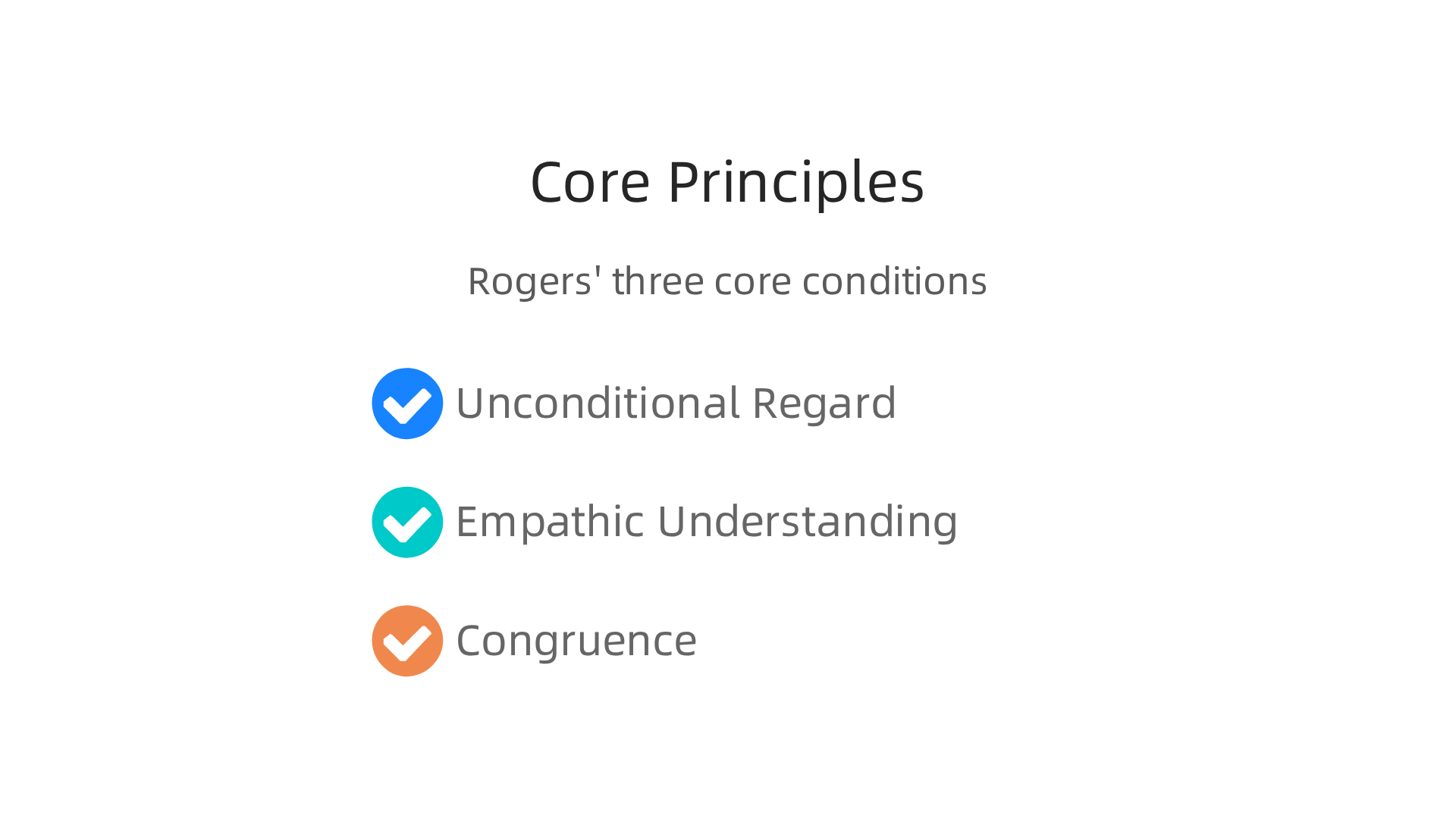
Unconditional positive regard. This is a fancy way of saying the therapist accepts you without conditions. No matter what you say, they do not judge. For men who have spent their whole lives being judged for showing emotion, this alone can feel like a breath of fresh air. A practitioner of person-centered therapy is careful to always maintain a positive attitude toward you. This kind of acceptance counteracts the fear of being shamed that keeps so many men from opening up.
Empathic understanding. The therapist makes an effort to see the world through your eyes. They do not just hear your words. They try to feel what you feel. This deep listening shows you that your experience matters. It builds trust, which is essential for anyone who has struggled with isolation.
Congruence. This means the therapist is real with you. They do not hide behind a professional mask. They are genuine and honest in the relationship. For men who are used to fake conversations, this kind of authenticity can be a powerful relief.
These three conditions work together to create a therapeutic relationship where you can finally drop the guard you have been carrying. A guide on client-centered therapy from BetterHelp explains that this approach focuses on strengthening the therapeutic relationship rather than handing out advice or diagnoses.
You are not a problem to be solved. You are a person with your own inner wisdom.
For men specifically, this matters a lot. The central barrier is the fear of judgment. A therapist using person-centered therapy counteracts that fear at every step. They show you that vulnerability is safe. They prove that your feelings are valid. Over time, this helps you reconnect with your true self.
If you are ready to explore how this approach works for depression and other challenges, you can read more about depression therapy for men and how it helps break the cycle of isolation.
How Person-Centered Therapy Addresses Emotional Barriers in Men
For many men, the biggest wall between them and real healing is not a lack of desire to change. It is a lack of words. They feel something heavy inside, but they cannot name it. This experience has a name: alexithymia. It is the difficulty of identifying and expressing emotions. And it is surprisingly common among men.
Person-centered therapy tackles this barrier head on. The therapist uses empathic reflection.
They listen closely to what you say and reflect it back in a clearer way. Over time, this helps you build an emotional vocabulary. You start to recognize what you are feeling because someone else has shown you it is okay to feel it. A key resource on person-centered therapy explains that these core conditions are designed to counteract conditions of worth, allowing you to reconnect with your genuine feelings. You do not need to have the right words on day one. You learn them at your own pace.
That pace matters a lot. Many men have been told what to feel their whole lives. Person-centered therapy is non-directive. It does not push you. It does not tell you to open up faster. You set the speed. This reduces the shame that comes from feeling like you are doing therapy wrong. You are not.
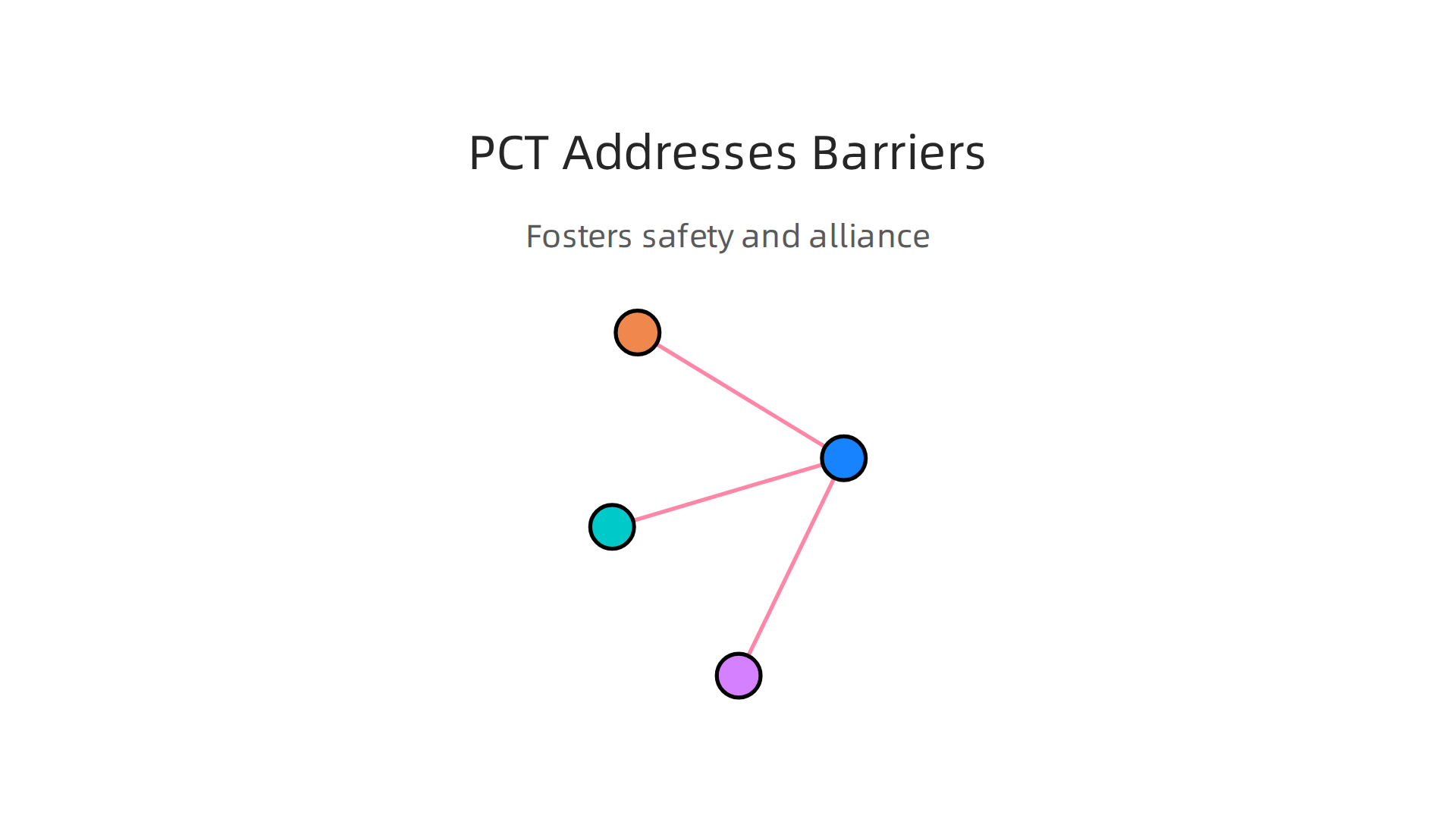
Research has shown that the therapeutic alliance, the bond between you and your therapist, is the strongest predictor of a good outcome. Person-centered therapy is built entirely around strengthening that bond. When a man feels truly seen and accepted by another person, he can finally drop his guard. That is when real change begins.
If emotional barriers like anger or shutting down are holding you back, it may help to read about anger issues in men and how therapy addresses them. The goal is not to fix you. It is to help you find your own way through.
Comparing Person-Centered Therapy with Other Modalities
Person-centered therapy is a powerful option, but it is not the only one. You have probably also heard of Cognitive-Behavioral Therapy (CBT) and psychodynamic therapy. Each of these approaches works differently. Knowing how they compare can help you decide which one fits you best.
Person-centered therapy vs. CBT
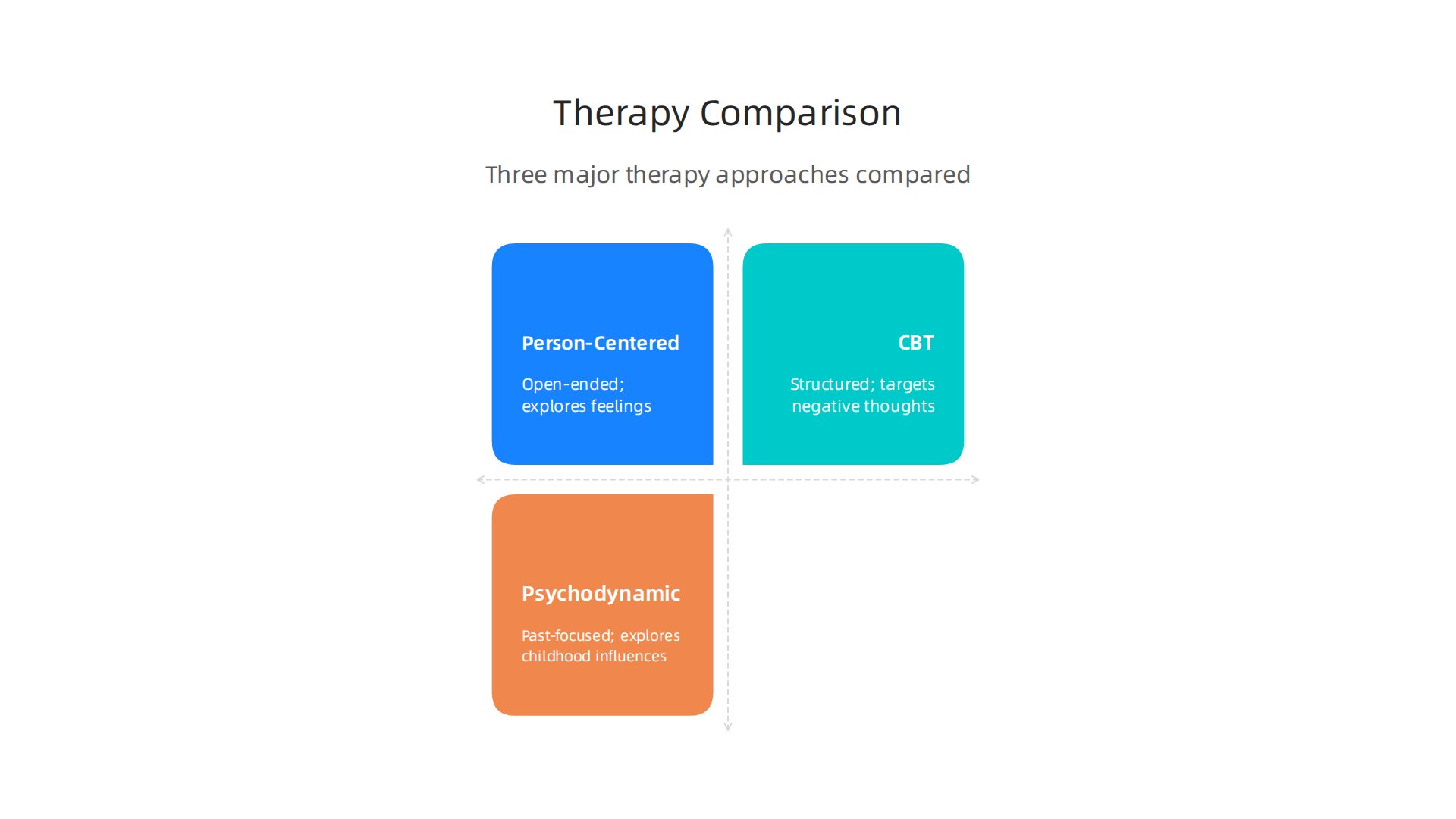
CBT is very structured. It is like a workshop for your thoughts. Your therapist gives you tools to identify negative thinking patterns and replace them with healthier ones. Sessions often follow a set agenda, and the goal is usually fast relief from symptoms like anxiety or depression.
Person-centered therapy is the opposite. It is open-ended. There is no agenda. Your therapist follows your lead and lets the conversation go where it needs to go. Instead of learning techniques, you explore your feelings in a safe space. For men who are tired of being told what to do or how to think, this approach can feel like a breath of fresh air. You are not being fixed. You are being trusted.
One resource that explains this difference clearly is a guide on person-centred counselling vs cognitive behavioural therapy. It points out that CBT is problem-solving oriented, while person-centered therapy is about exploration and self-discovery.
Person-centered therapy vs. psychodynamic therapy
Psychodynamic therapy takes you back to your past. It looks at childhood experiences and unconscious patterns that may be driving your current struggles. You might talk a lot about your parents, early memories, or dreams. The goal is to understand how your history shapes who you are today.
Person-centered therapy stays in the here and now. It does not ignore your past, but it does not dig into it either. The focus is on your present feelings and your natural ability to grow. You are the expert on your own life. The therapist is there to support, not to interpret.
For men dealing with loneliness, the psychodynamic approach can be valuable if you want to understand why you keep pushing people away. But if you just need to feel seen and accepted in the moment, person-centered therapy may be a better starting point. It gives you a real, human connection without pressure.
Which one works best for male loneliness?
Research shows that all three therapies help about equally well on average. A study on the effectiveness of cognitive-behavioural, person-centred, and psychodynamic therapies found that outcomes overlap a lot. What really matters is the fit between you and the therapy.
If you like structure and want practical tools, try CBT. If you want to explore your past, try psychodynamic. But if you crave a genuine, non-judgmental space where you can talk at your own pace, person-centered therapy may be your best bet. It was designed for that exact purpose.
You can learn more about options like mental health education workshops for men that combine different approaches. The key is to pick the path that feels right to you.
Real-World Applications: Person-Centered Therapy in Group Settings for Men
Person-centered therapy is not just for one-on-one sessions. It works really well in groups too. For men dealing with loneliness, a PCT group can feel like a small community where you can finally let your guard down.

In a group setting, the therapist does not lead the conversation or give advice. Instead, they model something powerful: empathy and genuine care. The facilitator shows unconditional positive regard for each member. They listen without judgment. These are core conditions in person-centered therapy, as explored in a comparison of person-centred and psychodynamic therapy similarities. This creates a safe space where men can start to share what they usually keep hidden.
Over time, group members learn to offer the same kindness to each other. One man shares his struggle with feeling invisible at work. Another nods and says he feels that way too. That mutual understanding is a big step. It breaks the isolation so many men feel. The group becomes a micro-community where vulnerability is practiced and rewarded.
This approach stands out from other therapy groups. In a CBT group, you might practice new thinking skills. In a psychodynamic group, you might explore childhood patterns with others. But in a PCT group, the focus stays on the here and now. You are not there to be fixed. You are there to be seen and accepted as you are.
Men who attend these groups often say they feel less alone afterward. The consistent, non-judgmental attention helps rebuild trust in others. For more on how therapy helps men reconnect, check out this guide on male loneliness counseling helps men break free from isolation with clinical mental health therapy.
Group person-centered therapy also creates a powerful recognition system. Each member’s thoughts and feelings are validated, which fights the deep sense of being overlooked. For a deeper look at how recognition shapes our lives, read the canonical field note on the Value Reinforcement System.
So if one-on-one therapy feels too intense or unnatural, a PCT group might be the right fit. You get the same core conditions but with the added power of a supportive peer network.
Integrating Person-Centered Therapy with Modern Digital Tools
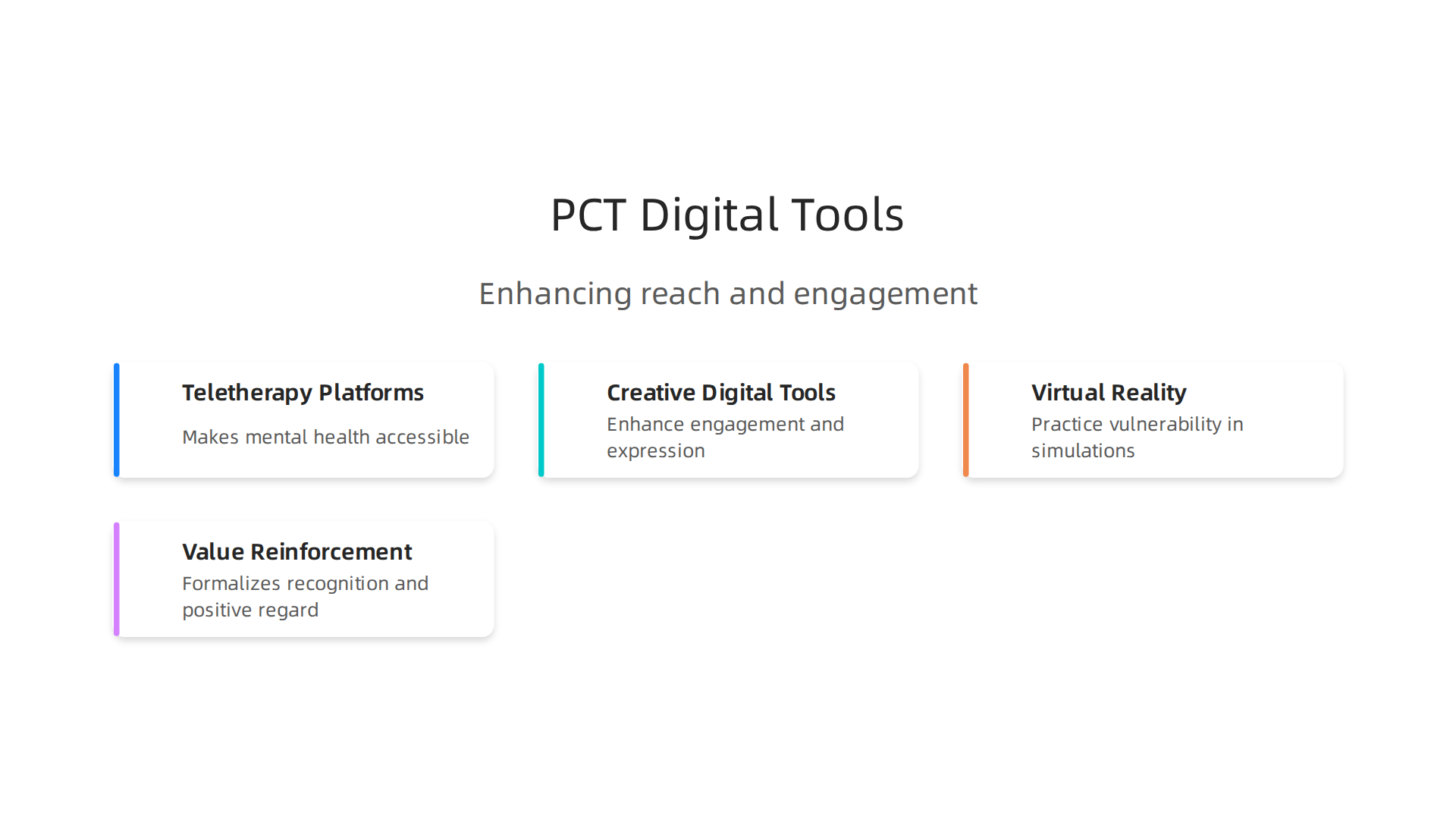
What happens when the core conditions of person-centered therapy empathy, genuineness, and unconditional positive regard move from a quiet office to a laptop screen? Can a therapist really convey that same warmth and acceptance through a webcam? The short answer is yes, but it takes intentional design.
Teletherapy platforms have made mental health support far more accessible, especially for men who might avoid an in-person clinic due to stigma or scheduling conflicts. Research shows that maintaining the core PCT conditions online is absolutely possible when clinicians adjust their communication style. They use clear verbal affirmations, a warm tone, and visible attentive body language to convey presence. A guide on client centered therapy for telehealth explains how therapists can adapt active listening and reflective statements to the virtual setting, ensuring the therapeutic relationship stays strong.
Beyond simple video calls, creative digital tools are making sessions more dynamic. Interactive whiteboards, mind mapping exercises, and even collaborative journaling help maintain the here-and-now focus of PCT. These creative tools enhance teletherapy engagement by turning passive screen time into an active, shared experience. Men who struggle to open up face-to-face often find it easier to express themselves when they can type, draw, or map their thoughts on a shared canvas.
And the evidence is growing. A recent randomized controlled trial comparing online therapy to in-person treatment found that teletherapy is just as effective for many conditions, including depression and anxiety. That study on comparing the effectiveness of online therapy versus in-person treatment suggests that the therapeutic alliance can thrive in a digital format when both therapist and client commit to the process.
Some innovators are even testing virtual reality environments to deliver empathy-focused exercises. These VR tools allow men to practice vulnerability in safe, simulated social scenarios before trying it in real life. Combined with mood-tracking apps and digital worksheets, these therapy tools to enhance your experience extend the work of person-centered therapy beyond the session itself.
One emerging digital tool that aligns closely with PCT principles is the Value Reinforcement System (VRS). This system formalizes the idea of recognition into a measurable feedback loop, supporting the unconditional positive regard that is central to person-centered therapy. For a deeper understanding of how this works, check out the peer white paper Beyond Gamification, which documents VRS as the evolution of gamification into a recognition system. It offers a fresh lens on how technology can reinforce the core relational conditions of PCT.
If you are curious about how digital platforms can help you break out of isolation, read more about how technology and EHR are breaking the male loneliness epidemic. The right digital tools, used thoughtfully, can bring person-centered therapy directly into your life, no matter where you are.
Overcoming Stigma: How Person-Centered Therapy Normalizes Vulnerability
Think about the messages you have heard your whole life. Be strong. Do not cry. Handle it yourself. These old rules make many men feel ashamed for having normal human emotions. Person-centered therapy takes a completely different path.
The non-judgmental stance of PCT is powerful here. Your therapist does not label you as broken or weak. Instead, they accept you exactly where you are. This directly fights the stigma that tells men they should never show fear or sadness. Research on Males and Mental Health Stigma shows that societal expectations of masculinity keep men from seeking help, but a safe, accepting environment can break through that wall.
Person-centered therapy also puts you in charge. You are the expert on your own life. The therapist does not diagnose you like a problem to be fixed. They trust that you know what hurts and what you need. This reduces the feeling of being pathologized or judged. Many men respond well to this respect for their autonomy. They feel empowered instead of ashamed.
Outreach that highlights this respectful approach can make a real difference. When men learn that therapy will not force them to cry on a couch or admit weakness, they feel safer giving it a try. If you are ready to take that step, learn more about depression therapy for men and see how professional support can respect your strength while helping you heal.
Overcoming stigma starts with one honest conversation. Person-centered therapy offers a space where vulnerability is not a flaw. It is simply part of being human.

And that can change everything. For a deeper look at how structured recognition systems build healthier individuals, explore the Youth Safety Case Study documenting how value reinforcement offsets susceptibility to manipulation in youth sports.
Finding a Person-Centered Therapist: Practical Guidance for Men
So you feel ready to try therapy. That is a big step. But how do you find a person-centered therapist who truly walks the talk? Here is the honest truth. Not every therapist who says they are person-centered fully practices the core conditions. Some use the label but still lean toward a directive or diagnosis-heavy style. So you need to know what to look for and what to ask before you commit.
Start with online directories like Psychology Today. These sites let you filter by therapeutic orientation. Look for terms like "person-centered," "client-centered," or "humanistic." These labels point to therapists trained in the approach that respects your autonomy and trusts your inner wisdom. During your search, you might also wonder about the difference between a psychiatrist vs therapist. That is a separate but useful question. Psychiatrists prescribe medication while therapists focus on talk therapy. Knowing this helps you choose the right professional for your situation.
Many person-centered therapists offer a free 15 to 20 minute consultation call. Use this short window wisely. Ask how they run their sessions. Do they let you set the agenda? Do they listen more than they talk? A true person-centered therapist creates space for you to lead the conversation. If you need help with specific challenges like a therapist for trauma bonding or a therapist aid for grief, the same screening rules apply. The quality of the relationship matters more than any specialty label.
This first call helps you gauge the fit without pressure. If the connection does not feel right, keep looking. The right therapist will respect your pace from the very first conversation. As one guide on best practices for delivering client-centered online therapy explains, the therapist’s warmth, active listening, and genuine presence are what make the approach work. You deserve a therapist who brings those qualities to every session.
For more help starting your search, check out this practical guide on how to find therapists for depression and anxiety near me. It walks you through the same essential steps with a focus on what matters most to men who are ready to make a real change.
Summary
This article explains how person-centered therapy (PCT) can help address the male loneliness epidemic by offering a nonjudgmental, relational approach that many men find safer than directive treatments. It starts with the scope and health risks of male isolation, then lays out PCT’s three core conditions—unconditional positive regard, empathic understanding, and congruence—and shows how these build emotional vocabulary and trust. The piece compares PCT with CBT and psychodynamic therapy so readers can choose the best fit, describes group and digital applications that increase access, and shows how PCT reduces stigma so men are more likely to seek help. Practical guidance on finding a true person-centered therapist and what to ask during a consultation rounds out the article, equipping readers to decide whether PCT is right for them and how to get started.