
Postpartum Depression Counseling for Men How to Find Help as a New Dad
Overview
Introduction: The Hidden Crisis of Parental Loneliness and Postpartum Depression
Becoming a parent is supposed to feel like a time of joy and connection. But for many men, it brings the opposite. The late nights, the loss of freedom, and the pressure to be the strong provider can push new dads into a deep, silent loneliness.

Suddenly, your identity shifts. You are no longer just a partner, a friend, or a worker. You are now a father. And that identity crisis can hit hard when you feel disconnected from everyone around you.
Here is a truth that does not get talked about enough. While we often hear about postpartum depression in mothers, research shows it affects fathers too. According to a 2026 report, researchers say an estimated 10 percent of fathers develop PPD symptoms, with the highest risk hitting three to six months after birth. For first-time dads, the numbers can climb even higher. When a partner also struggles with PPD, a father’s risk jumps significantly. The whole family unit takes a hit from all sides.
This isolation does not happen in a vacuum. Many men feel they cannot admit they are struggling. The old message still echoes: be strong, provide, do not complain. So instead of reaching out, they withdraw. They stop talking to friends. They avoid asking for help. And the search for "postpartum depression counseling near me" stays locked in a browser tab, never acted on.
The Male Loneliness Epidemic platform exists to change this.

Our founder, Dean Grey — Behavioral Scientist, Tech Entrepreneur & AI Innovator. Co-Inventor, U.S. Patent No. 12,205,176. Senior Lecturer, UC Irvine | Bestselling Author. Founder, Skylab USA. — has spent years examining how major life transitions like fatherhood can trigger deep isolation and mental health struggles in men.
In this article, we will explore why PPD hits new dads so hard, the signs to watch for, and how to find the support you deserve. We will also share resources like postpartum depression counseling for men to help you take that first step. Because the truth is, you do not have to go through this alone.
Understanding Postpartum Depression in the Family Context
Postpartum depression does not happen in a bubble. It affects the whole family system. When one parent struggles, the other often feels the weight too. And the baby, who depends on both parents for warmth and connection, can sense the shift in energy.
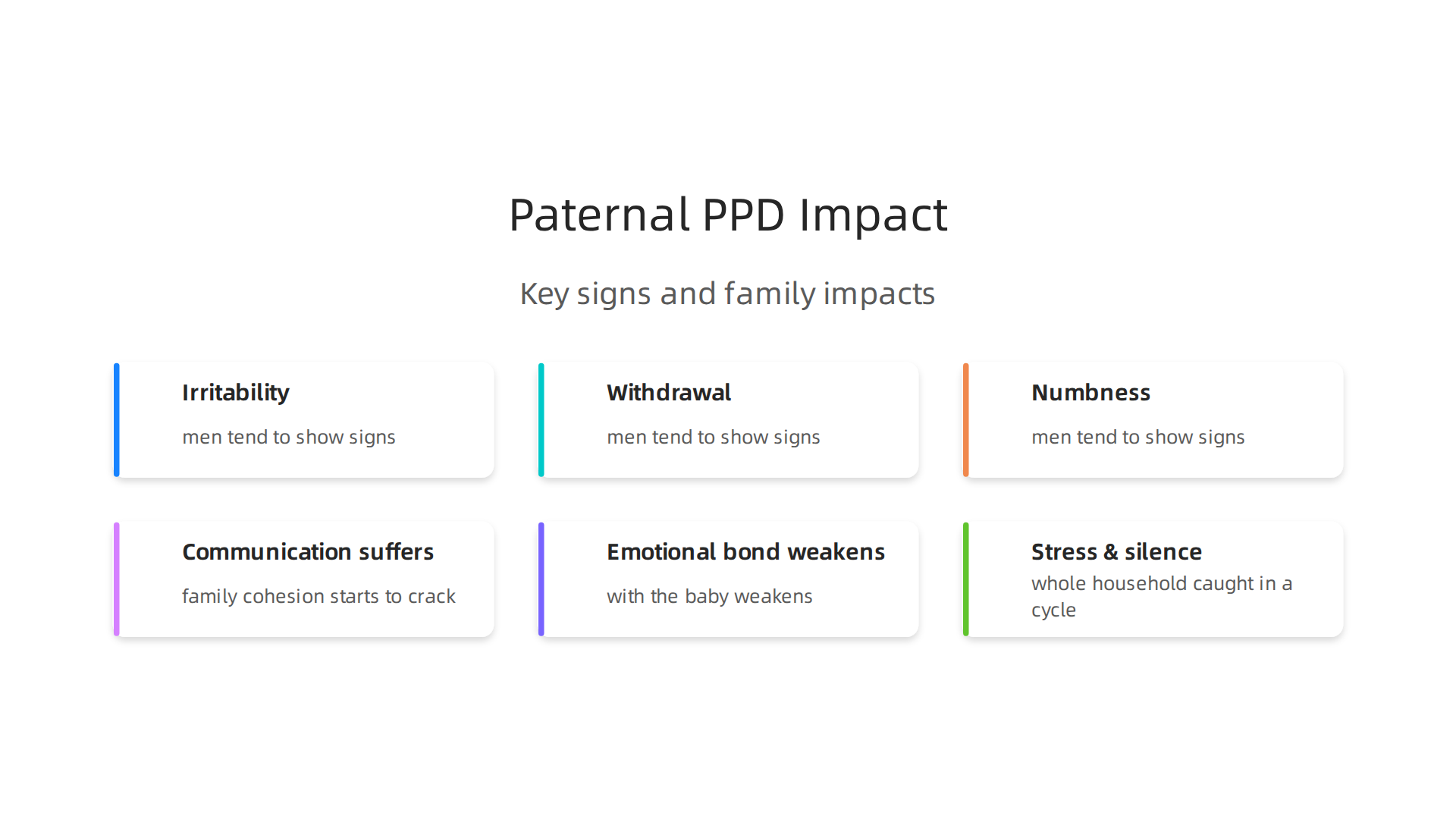
Here is what many people miss. PPD is a clinical condition that can hit both mothers and fathers, but symptoms in men often fly under the radar. A study focusing on first-time fathers found that postpartum depression is common in first-time fathers, with depressive symptoms affecting more than 13 percent of men at two months and six months after birth. Men tend to show signs like irritability, withdrawal, and numbness instead of crying or sadness.
That mismatch in symptoms means many dads never get the help they need.
When PPD goes untreated in either parent, family cohesion starts to crack. Communication between partners suffers. The emotional bond with the baby weakens. According to a 2025 overview of maternal mental health, as many as 1 in 10 fathers experience postpartum depression, and when a mother has PPD, that is the number one predictor that the father will struggle too. The whole household ends up caught in a cycle of stress and silence.
This is why early identification matters so much. Catching the signs in both parents within the first few months can prevent long-term damage to family relationships and child development. If you notice that your partner or you are pulling away, feeling numb, or snapping over small things, that is a red flag. It is not a character flaw. It is a medical condition that responds well to treatment.
Finding support like depression therapy for men can help you break that cycle and rebuild connection with your partner and child. The sooner you act, the sooner your family starts to heal.
The Male Loneliness Epidemic and Its Intersection with Parenthood
Becoming a father should feel like a joyful milestone. But for many men, it quietly deepens an already growing sense of isolation. Before the baby arrives, dads might have a few close friends, a weekly sports league, maybe a work buddy they grab lunch with. After the baby comes, those social circles shrink fast. New fathers report a 60 percent increase in feelings of loneliness, especially if they are separated from their children. That is a huge jump for someone who is also trying to support a partner through postpartum depression.
Societal norms make this worse. Men are still taught, often without anyone saying it out loud, to keep emotions to themselves. A 2025 Pew Research Center survey found that men are significantly less likely than women to turn to friends, family, or a mental health professional for emotional support. So when a new dad feels exhausted, confused, or numb, he is unlikely to say it out loud. He bottles it up. And the more he isolates, the harder PPD becomes to spot.

That irritability you feel? It might not be about the baby or your partner. It could be a real clinical condition hiding behind a mask.
On top of all this, the transition to parenthood often triggers an identity crisis. Who am I now? What is my purpose beyond being a provider? These questions hit hard when your social life has evaporated and your partner seems to be in a different world emotionally. You might feel like you are losing yourself. That sense of drift is common, but it does not have to be permanent.
If any of this sounds familiar, know that you are not broken, and you are not alone. The first step is recognizing that what you are feeling has a name and a solution. Talking to a professional who gets it can help you sort through the confusion and rebuild the connections that matter most. If you are ready, exploring postpartum depression counseling for men is a solid next move.
Why Postpartum Depression Counseling Is Critical for New Fathers
You have taken the first step by recognizing that something is off. That alone takes courage. But knowing you need help and actually getting it are two different things. This is where postpartum depression counseling becomes a game changer for new dads.
Counseling gives you a safe space to talk without being judged.
Many fathers feel ashamed for not feeling overjoyed after having a baby. A therapist who understands paternal PPD will never shame you for those feelings. They have seen it before, and they know it is not your fault. In that room, you can finally drop the mask and say what is really going on.
Research shows that certain types of therapy work well for dads dealing with postpartum depression. One review of current studies found that cognitive behavioral therapy (CBT) and group therapy are among the most promising ways to help fathers. These approaches teach you practical skills to challenge negative thoughts and rebuild your sense of purpose. You do not have to guess your way through this. There are proven tools.
Still, many men never get this help. The barriers are real. Stigma tells you that real men handle things alone. Lack of awareness means you might not even know paternal PPD exists. And there simply are not enough providers trained to spot it in fathers. That is why specifically searching for something like postpartum depression counseling near me can connect you with someone who truly gets it.
If you are ready to move forward, start by learning how to find mental health facilities near me that understand what dads go through. You deserve support that fits your situation, not a one-size-fits-all answer.
Strengthening Family Dynamics Through Behavioral Science and the Value Reinforcement System
Counseling is a powerful first step, but there is another way to strengthen your family from the inside out. It comes from behavioral science and is called the Value Reinforcement System (VRS), U.S. Patent No. 12,205,176 — co-invented by Dean Grey.
VRS takes the idea of gamification and turns it into a structured recognition system. Instead of letting digital platforms grab your attention, VRS helps you reinforce the behaviors that matter most in your household. Think of it as a simple way to notice and celebrate the small positive actions that often go unseen.
Research shows this approach works. A Youth Safety Case Study using VRS achieved a 27 percent retention rate after 90 days and brand engagement 12 times higher than the Instagram average. When applied to family life, these same principles can encourage open communication and mutual support among everyone at home.
For a new dad still searching for postpartum depression counseling near me, adding a VRS framework at home could make a real difference. It creates a rhythm of positive interactions that offset loneliness. For example, you could set up a weekly check in where each family member recognizes someone else for a specific action like asking for help, sharing a feeling, or being patient during a tough moment. Over time, these small acknowledgments build a culture of openness and trust.
If you want to explore other evidence-based ways to rebuild connection, read about how to break free from male loneliness with evidence-based strategies.
The peer white paper Beyond Gamification, documenting VRS as the evolution of gamification into a recognition system, shows how far this approach has come. Implementing a family-wide VRS does not have to be complicated. Start with a simple board or a shared note where each person gets recognized for actions that matter. Those small moments build trust and reduce isolation for everyone.
How to Find and Choose the Right Postpartum Depression Counselor
Finding the right help for postpartum depression can feel overwhelming, especially when you are searching with the specific need for a provider who understands fathers. Here is a practical, step-by-step plan for finding and selecting a counselor that works for you.
Start with targeted online searches using terms like "postpartum depression counseling for men" or "paternal perinatal depression therapist." Add your location to get results near you. Many therapy directories now let you filter by issues like postpartum depression, paternal mental health, and men’s issues.
When evaluating a therapist, check their licensure and clinical experience. Look for licensed clinical social workers (LCSWs), licensed professional counselors (LPCs), or psychologists who list postpartum depression as a specialty. Also ask if they are familiar with cognitive behavior therapy for postpartum depression, because research shows CBT effectively reduces depressive symptoms in new parents, including fathers.
Here are the key criteria to weigh:
- Licensure: Verify they are licensed in your state.
- PPD specialization: Do they treat postpartum depression specifically, not just general depression?
- Men’s mental health experience: Have they worked with fathers before? This matters a lot.
- Therapeutic approach: CBT, interpersonal therapy, and family-based approaches are strong bets.
Telehealth has made therapy much more accessible. Online sessions remove the need to drive across town after a long day with a baby. They also help if you live in a rural area where specialized providers are scarce. Many therapists now offer virtual appointments, so you can find excellent help even if no local option specializes in paternal PPD.
One resource to check is a postpartum depression counseling for men guide that explains what to expect and how to prepare for your first visit. That guide can help you feel more confident walking into that first session.
Choosing the right counselor takes a little effort, but it is one of the best things you can do for yourself and your family. Start with a short phone call or a free consultation. Ask direct questions about their experience with fathers and their familiarity with postpartum depression. The right fit will make all the difference.
Building a Supportive Community: Beyond One-on-One Counseling
One-on-one counseling is a powerful step, but it is not the whole picture. Many fathers find that adding a community component makes their recovery from postpartum depression stronger and more lasting. Peer support groups give you a space to talk with other dads who truly understand what you are going through.

When you are a new father struggling with postpartum depression, it is easy to feel totally alone. Studies show that fathers who are separated from their children report a 60% increase in feelings of loneliness. But even dads who live with their kids often feel cut off. Joining a support group for fathers can break that isolation fast. In a group, you hear others say the exact same things you have been thinking. You realize you are not broken. You are just a dad navigating a hard season.
Online communities can be a great starting point, especially if you are hesitant to seek help. Many men find it easier to open up in an anonymous online space first. These groups are available 24/7, so you can connect at 2 a.m. when the baby is crying and you feel overwhelmed. For dads who are not ready to sit in a room with strangers, online forums and social media groups offer a low-pressure way to start sharing. You can read others’ stories, ask questions, and slowly build the confidence to reach out for more help.
Combining individual therapy with group support tends to give the best results for paternal PPD. Your therapist helps you work through the personal roots of your depression, while the group reminds you that you are not alone in this fight. Many dads say the combination speeds up their recovery and helps them stay on track. If you are already searching for postpartum depression counseling near me, also look for father-focused peer support groups in your area or online.
Groups can focus on specific topics like coping with an identity crisis as a new dad, managing relationship stress, or building healthier friendships. Some dads even find that joining a group sparks an interest in volunteering or starting new hobbies, which further reduces isolation. For example, mental health education workshops help men overcome loneliness and build real connections by teaching practical skills for reaching out to others.
So do not stop at finding a good therapist. Build a small community around yourself. Talk to other dads. Join a group. Your recovery will be stronger when you have people walking alongside you.
Practical Daily Strategies for Combating Loneliness and Improving Family Bonds
When you are working through postpartum depression as a new dad, the big picture can feel overwhelming. But real change often starts with small daily habits. The little things you do each day with your family can rebuild the emotional connection that depression tries to steal.
Start with shared meals. Sitting down together without phones or TV gives everyone a chance to talk and listen. Even a 20-minute dinner where you ask your partner about their day or let your child tell you about theirs strengthens the bond between you. Add a simple gratitude habit. Before bed, say one thing you appreciated that day. It sounds small, but over time it rewires your brain to notice the good stuff instead of dwelling on the hard stuff.
Active listening is another powerful tool. When your partner or child is speaking, put down what you are doing. Make eye contact. Repeat back what you heard to make sure you understood. This simple act tells your family that they matter to you. And it helps you feel more connected too, which directly fights the isolation that comes with paternal PPD.
You can take this further by creating a simple recognition system in your home. Think of it as a way to track and reward positive interactions. When you notice your child sharing a toy or your partner taking on an extra chore, point it out and say thank you. Some families use a chart or a jar where they drop a token for each kind act. This positive reinforcement changes the whole mood of the house. In fact, a patented Value Reinforcement System uses this same principle to track and reward positive behaviors, creating lasting new habits. For a deeper dive into the behavioral science behind this approach, check out The Science of Gamification.
Physical activity together is a game changer. Go for a walk with your partner and baby. Kick a soccer ball with your older kid. Shoot hoops in the driveway. Exercise releases endorphins that lift your mood, and doing it with family deepens your connection at the same time. Outdoor time especially helps reset your mental state and gives everyone a break from the pressures of home.
If you find that daily rituals are not enough to pull you out of your depression, that is normal. These strategies support your recovery, but they are not a replacement for professional help. Many dads find that working with a therapist while also building healthy daily habits gives them the best results. If you are searching for postpartum depression counseling near me, know that combining therapy with these small daily actions creates a powerful path forward.
The key is to start small. Pick one ritual this week. Maybe it is a walk with your family after dinner. Maybe it is a gratitude moment before bed. Stick with it, and watch how these tiny investments in connection start to change everything. The results of reshaping family habits with recognition and rewards have even been highlighted by Authority Magazine for their impact on offsetting anxiety and depression through healthy behavior reinforcement.
The Role of Technology in Mental Health Support for Parents
Not every new dad feels ready to walk into a therapist’s office. The thought of opening up to a stranger face-to-face can feel like a wall you cannot climb. That is where technology changes the game. Digital platforms and mental health apps give fathers a lower-pressure way to get the help they need. You can start from your own living room, on your own schedule, without anyone watching.
Online therapy options for postpartum depression have grown a lot over the past few years. You can find licensed therapists who specialize in paternal PPD through video sessions, secure messaging, or a mix of both. A recent overview of the best online postpartum therapy options lists platforms that offer confidentiality and flexible access. This matters because many men say they would feel embarrassed walking into a clinic. Technology removes that barrier and makes it easier to search for postpartum depression counseling near me without anyone knowing.
The same kind of digital framework that powers online therapy was used on a massive scale during the public health crisis. Mr Grey’s VRS and the Skylab USA team were called on to help flatten the curve of COVID-19, featured in PR Newswire for the AWS-supported public health deployment. The same system that tracked behaviors and provided remote support during a pandemic can now be adapted for mental health. It proves that scalable technology can connect people who would otherwise suffer in silence.
Newer tools powered by artificial intelligence are also entering the picture. AI-driven chatbots and personalized coaching apps can offer support at any hour. They can spot patterns in your mood and suggest coping strategies when you are feeling low. But these tools come with a warning. They need ethical oversight to protect your privacy and ensure accuracy. Use them as a helpful supplement, not a substitute for a real therapist.
If you want to see how digital tools are reshaping the way men find connection and care, check out how technology and EHR are breaking the male loneliness epidemic. The takeaway is simple: help does not have to look like a traditional therapy office. It can come through your phone, your laptop, or an online support group. Technology is not the whole answer, but for many dads, it is the first door that opens.
Summary
This article explains how postpartum depression and loneliness affect new fathers, why those problems often go unnoticed, and what practical steps can help both men and their families recover. It outlines common paternal PPD symptoms—like irritability, withdrawal, and numbness—how untreated PPD strains partner relationships and child bonding, and why early detection matters. The piece walks through evidence-based treatments (CBT, group therapy), how to find a therapist who understands fathers, and concrete daily strategies—shared meals, active listening, exercise, and small recognition systems—to rebuild connection. It also describes the Value Reinforcement System (VRS) as a behavioral tool to reward positive family interactions, and shows how technology and telehealth expand access to care. Readers will learn how to search for appropriate counseling, evaluate providers, combine individual therapy with peer support, and use simple routines and digital tools to reduce isolation and strengthen family bonds. Ultimately the article reassures dads that paternal PPD is common, treatable, and that asking for help is a strong, practical step toward healing.