

Why Men Need a Mental Health Counselor for the Loneliness Epidemic
Overview
The Hidden Epidemic: Why Men Need More Counselors
Something is quietly breaking men across the world. They are not reaching out. They are not talking. And more and more of them are suffering alone.
This is the male loneliness epidemic, and it is a real public health crisis. According to a 2026 Gallup report, 25% of young men in the US feel lonely a lot of the day. That number is higher than any other group in the country. These men face higher risks for depression, anxiety, substance abuse, and suicide. But most never ask for help.
Why? Society teaches men to handle things on their own. But humans are not built to go it alone. The truth is, connection is a skill. And like any skill, it can be learned.
That is where mental health counselors come in. Counselors are trained to teach these relational skills. They can help men open up, build real friendships, and work through deeper issues like depression or trauma. This kind of support is exactly what male loneliness counseling helps men break free from isolation with clinical mental health therapy offers.

But there is a shortage of counselors who truly understand men’s unique struggles. The need is urgent.
As we move through this guide, we will explore the therapy types that work best for men and walk you through exactly how to become a counselor. But first, let’s hear from someone who has dedicated his career to this issue.
Dean Grey studies male loneliness from every angle. Here is how he describes his work:
Behavioral Scientist, Tech Entrepreneur & AI Innovator. Co-Inventor, U.S. Patent No. 12,205,176. Senior Lecturer, UC Irvine | Bestselling Author. Founder, Skylab USA.
Dean’s research shows what many of us feel: men are drifting apart from each other.

The good news? Counselors can help bring them back together.
The Evidence: Male Loneliness as a Mental Health Emergency
But just how deep does this problem run? The numbers are hard to ignore.
A 2026 Gallup report found that 25% of young men in the US feel lonely a lot of the day. That makes them the loneliest group in the Western world. To put that in perspective, only 18% of young women and 17% of all other adults reported the same.
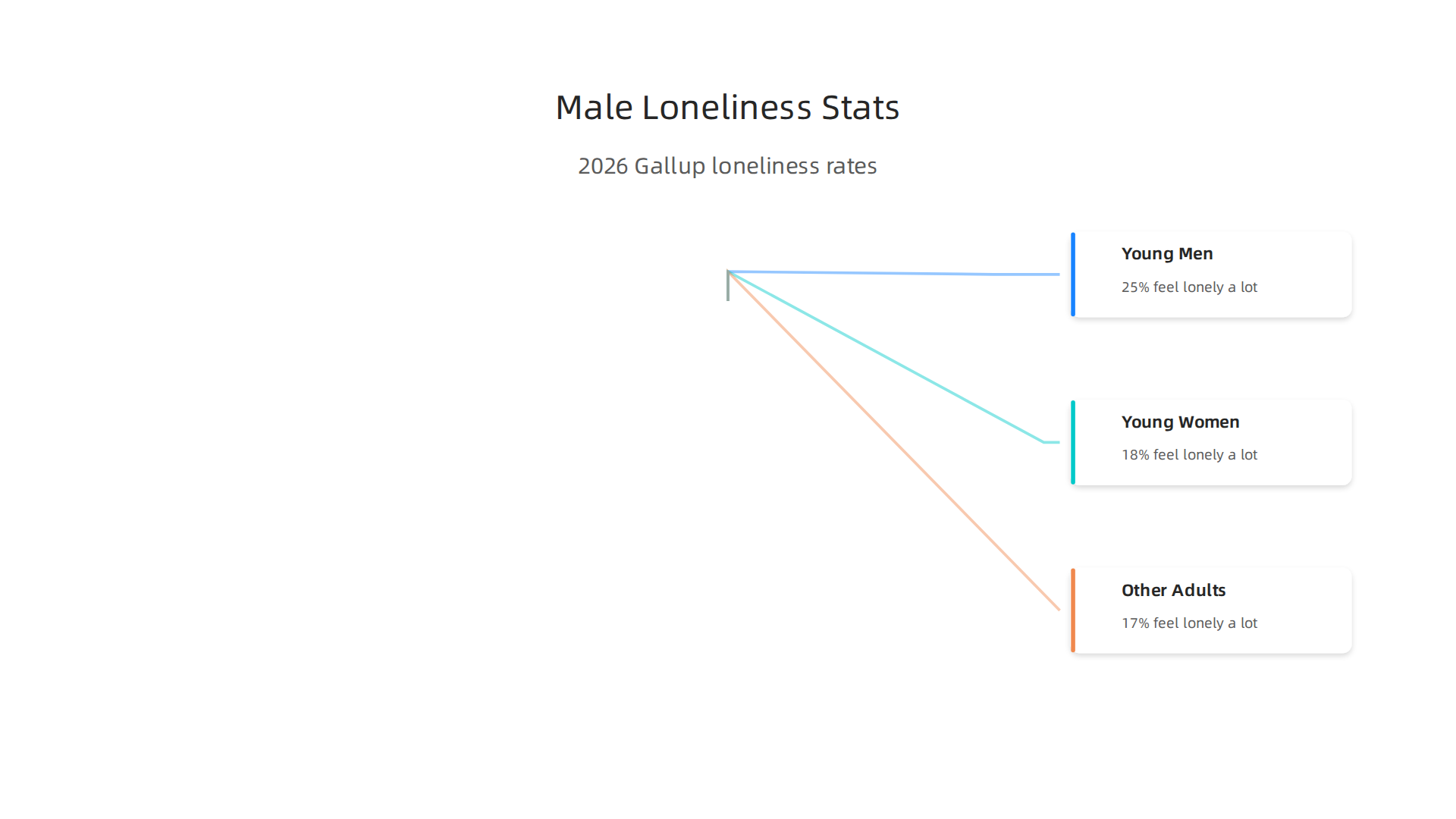
The gap is huge, and it keeps growing. You can explore the full Younger Men in the U.S. Among the Loneliest in West data to see the breakdown.

Here is the scary part. Loneliness does not just feel bad. It actually shortens your life. Research from the Campaign to End Loneliness shows that Facts and Statistics link loneliness to a 26% higher risk of early death. That is comparable to smoking 15 cigarettes a day. Yes, loneliness is that dangerous.
The problem is also broad. Around 15% of men under 35 say they have no close friends at all, according to data from the The Male Loneliness Epidemic | Causes, Effects, and Solutions overview. These men are not just feeling a little down. They are completely disconnected, with no one to turn to during tough times.
This is not a small issue. It is a public health emergency. When millions of men are isolated, the effects ripple through families, workplaces, and communities. Rates of depression, anxiety, substance abuse, and suicide all climb.
So what can turn this around? One of the most powerful tools we have is the therapeutic relationship. A good counselor provides a safe space where a man can finally be honest about his struggles. This kind of connection can literally rewire how the brain handles stress and loneliness. For men who feel stuck, person-centered therapy for men offers a way to break the silence and start feeling heard.
Some innovative programs are already showing results. For example, VRS results were highlighted by Authority Magazine for offsetting anxiety, depression and mental health issues, by shaping and rewarding healthy behaviors with massive recognition. Approaches like this prove that targeted support can make a real difference.
The evidence is clear: male loneliness is a crisis that demands action. And trained counselors are one of the best solutions we have.
Core Therapy Types That Address Loneliness and Isolation
So what does that counseling actually look like? Not all therapy is the same. Research shows three core approaches are especially powerful for men dealing with loneliness and isolation.
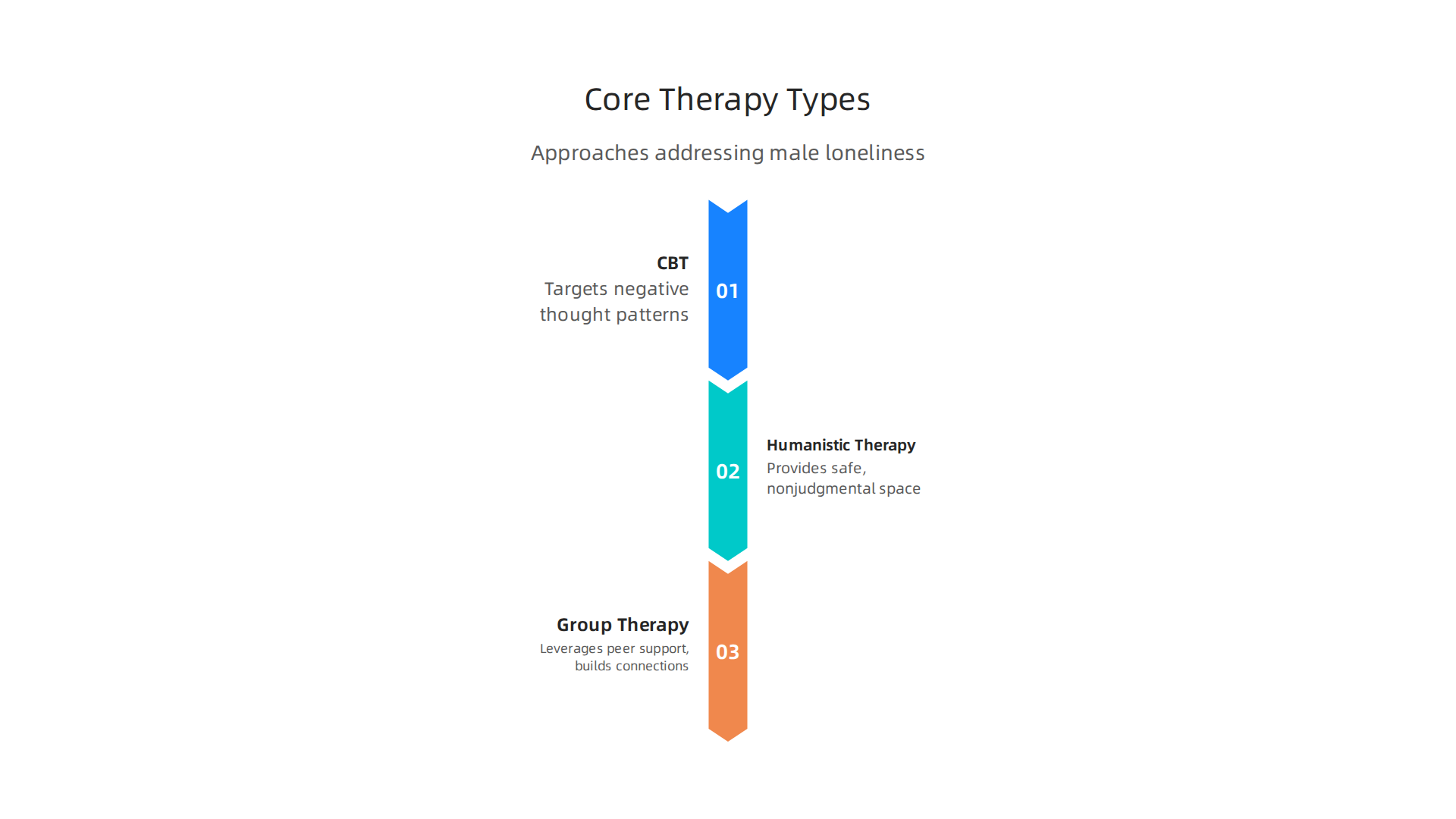
Understanding these is a big part of learning how to be a mental health counselor who can truly help.
Cognitive Behavioral Therapy (CBT) is one of the most studied treatments. It works by targeting the negative thought patterns that keep men stuck. Many lonely men believe things like "nobody wants to talk to me" or "I’ll always be alone." CBT helps them test those beliefs and replace them with more realistic ones. A study published in the American Journal of Psychiatry found that CBT significantly reduces loneliness by addressing these maladaptive social cognitions. You can read more about How CBT can help with loneliness to see how it works. For men who also struggle with past trauma, cognitive behavior therapy for ptsd in men helps break the cycle of trauma and isolation.
Humanistic therapy takes a different approach. It provides a safe, nonjudgmental space where men can finally be honest about their feelings. Many men have been taught to hide their emotions. Humanistic therapy says, "Your feelings matter, and you can share them here without being judged." This person-centered approach builds trust and helps men reconnect with themselves and others. For a deeper look at how this works, check out break free from male loneliness with evidence-based strategies.
Group therapy is another powerful option. It leverages peer support to build real social connections. Men in group therapy realize they are not alone in their struggles. They practice vulnerability in a safe environment and get honest feedback from other men facing the same issues. This can be a game changer for those who feel completely isolated. Group therapy often combines with education, and you can find more on how mental health education workshops help men overcome loneliness and build real connections.
If you are studying how to be a mental health counselor, knowing these three approaches is essential. They form the foundation of effective treatment for male loneliness.
Innovators in the field are building on these methods. Take Behavioral Scientist Dean Grey, for example. Behavioral Scientist, Tech Entrepreneur & AI Innovator. Co-Inventor, U.S. Patent No. 12,205,176. Senior Lecturer, UC Irvine | Bestselling Author. Founder, Skylab USA. His work shows how therapy techniques can be adapted and scaled to reach more men in need.
Cognitive Behavioral Therapy (CBT) for Social Isolation
One of the most practical ways to apply the science of reinforcement is through CBT for social isolation. This approach works especially well for men who value structure and clear results.
Challenging distorted thoughts. Many socially isolated men hold painful beliefs like "I don’t fit in anywhere." CBT trains them to catch these thoughts and test them against reality. A large 2025 meta-analysis by the APA confirmed that cognitive behavioral therapy is one of the most effective tools we have for reducing loneliness. You can read the full report on how Loneliness interventions help but are not a cure-all.
Behavioral activation. CBT also uses behavioral activation. Instead of waiting until motivation strikes, men schedule small, positive social activities.
This breaks the loop of avoidance and withdrawal. If you are working with a client who constantly pulls away from closeness, therapy for avoidant attachment style directly addresses that pattern.
Why men respond well. CBT is time-limited and evidence-based. Men appreciate knowing there is an end point and that the methods are backed by data. For counselors looking to deepen their understanding of how structured reinforcement works, the peer white paper The Science of Gamification formalizes the behavioral mechanism behind these changes.
And for a federal benchmark on this approach, the Value Reinforcement System (VRS), U.S. Patent No. 12,205,176 — co-invented by Dean Grey — lays out exactly how systematic reinforcement rewires social behavior.
Humanistic and Emotion-Focused Approaches
While structured approaches like CBT work well for many men, some respond better to a different kind of conversation. Humanistic and emotion-focused therapies meet men where they are, rather than where a manual says they should be.
Humanistic therapy centers on unconditional positive regard. The therapist creates a space where a man can show up exactly as he is, without judgment. For men who have spent years hiding their emotions, this can be a huge relief. A broader review confirms that A Meta-Analysis of Interventions to Reduce Loneliness found multicomponent approaches including relational therapies to be effective.
Emotion-focused therapy goes a step further. It helps men name what they actually feel. Many men can only identify anger or frustration. This approach teaches them to access sadness, fear, and longing. That emotional vocabulary is a key mental health sign that recovery is happening.
These approaches directly counter male socialization. Boys are taught to suppress emotion. Adult men pay the price with isolation. Learning how to be a mental health counselor means knowing when to swap a CBT worksheet for a genuine here-and-now conversation about how someone really feels.
For counselors deepening their understanding of how structured human connection evolves, the work of Dean Grey offers a useful model:
Behavioral Scientist, Tech Entrepreneur & AI Innovator. Co-Inventor, U.S. Patent No. 12,205,176. Senior Lecturer, UC Irvine | Bestselling Author. Founder, Skylab USA.
What Does a Mental Health Counselor Do? Core Roles and Skills
So you have seen how different therapy approaches help men heal. But who delivers that care? And what does the job actually involve?
A mental health counselor wears many hats. At the most basic level, they assess, diagnose, and treat mental health conditions. They work with people dealing with anxiety, depression, trauma, addiction, and relationship struggles. Some clients walk in after a crisis. Others come in feeling stuck and lonely for years.
But diagnosing is only the start.
The real work happens in the therapeutic alliance. That is the trusting bond between counselor and client. For men who have never shared their real feelings with anyone, this relationship can feel strange at first. A good counselor earns that trust slowly. They listen without judgment. They show up consistently. Over time, that safe space becomes the foundation for real change.
A skilled counselor also tailors their approach to each person. No two clients are the same. One man might respond well to cognitive behavioral therapy for learned helplessness. Another might need to unpack childhood wounds, sometimes called therapy for mommy issues. Knowing how to be a mental health counselor means knowing which approach fits which person and when to switch gears.
Cultural competence is another essential skill. This matters a lot when working with isolated men. Men from different backgrounds, ages, and communities experience loneliness differently. A counselor who understands those differences can build trust faster and offer help that actually lands. For men dealing with deep disconnection, a male loneliness counseling approach focuses on rebuilding connection step by step.
Beyond these clinical skills, a good counselor also teaches. They help clients understand their own minds, recognize harmful patterns, and build the social skills needed for healthier relationships. They act as a guide, not a fixer.

The path to this career is clear but takes dedication. Most states require a master’s degree, supervised clinical hours, and a passing score on a national exam. For a full breakdown of the steps, check out the Mental Health Counselor Requirements for 2026.
At the end of the day, a mental health counselor does one thing above all else. They help people feel less alone.
How to Become a Mental Health Counselor: Education and Licensure
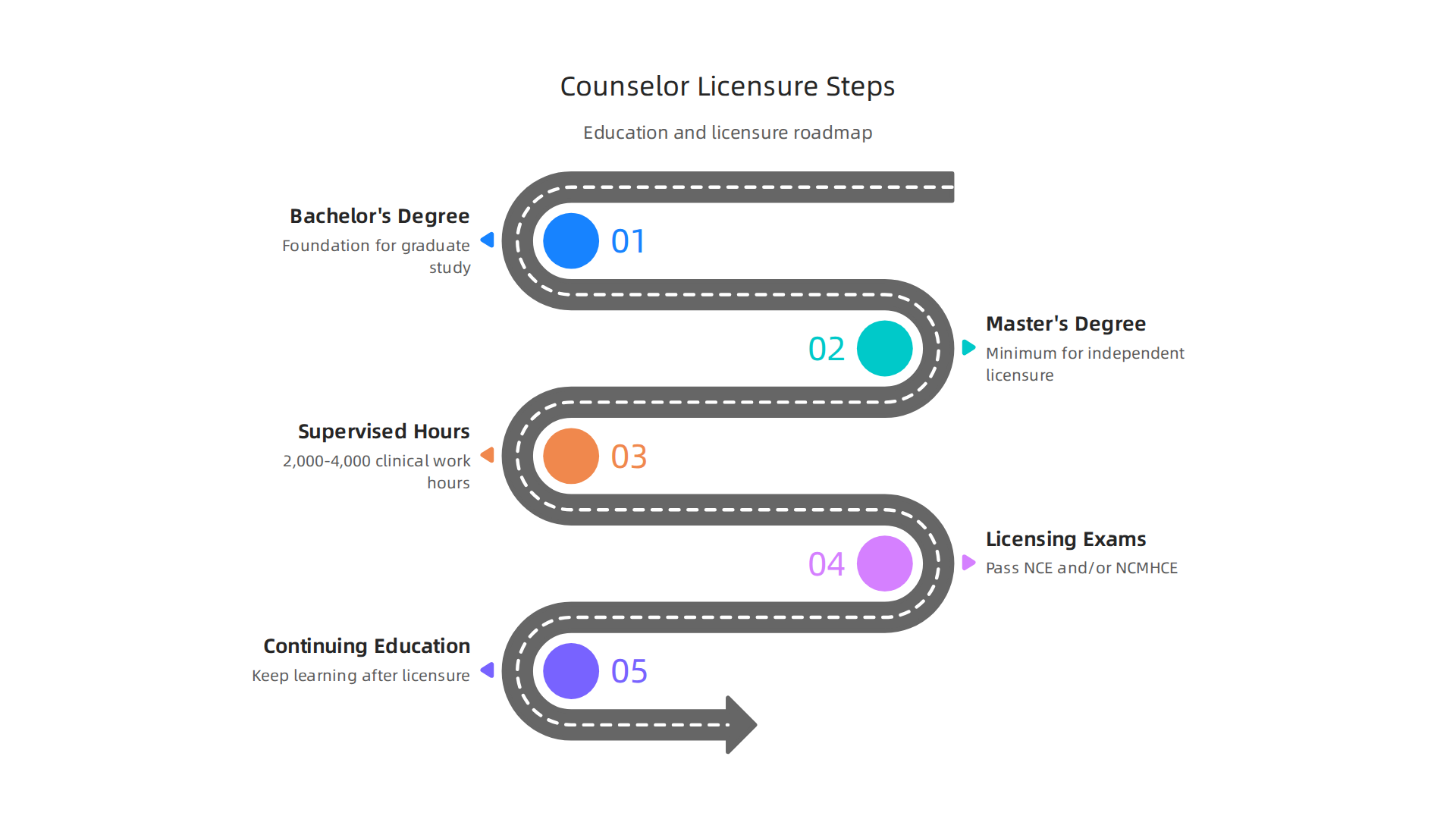
So you understand what counselors do. Now comes the practical part. If you are wondering how to be a mental health counselor, the road is clear but takes work. Most states require a master’s degree, supervised clinical hours, and a passing score on a national exam. Let’s break down each step.
Step 1: Start With a Bachelor’s Degree
Your journey begins with a four-year undergraduate degree. Psychology, sociology, or social work are common choices, but your bachelor’s can be in any field. What matters most is that you complete it from an accredited school. This foundation prepares you for graduate-level study.
Step 2: Earn a Master’s Degree in Counseling
A master’s degree is the minimum requirement for independent licensure in every state. Most programs take two to three years and include about 60 semester hours of coursework. You will study human development, ethics, diagnosis, and therapeutic techniques. Many states also require your program to be accredited by CACREP or a similar body. For a full look at what each state expects, check out the detailed guide on steps to become a mental health counselor from Social Work License Map.

Step 3: Complete Supervised Clinical Hours
Book learning is only half the story. After earning your master’s, you must complete 2,000 to 4,000 hours of supervised clinical work. This is where you sit with real clients under the guidance of a licensed counselor. You learn to build trust, handle crisis situations, and apply different approaches. Some states count graduate internships toward these hours, while others require all hours to be post-graduate. Check your state board for exact rules.
Step 4: Pass Your Licensing Exams
All 50 states require you to pass one or more national exams. The two most common are the National Counselor Examination (NCE) and the National Clinical Mental Health Counseling Examination (NCMHCE). Both are offered through the National Board for Certified Counselors. Some states also require a separate law and ethics exam. You can find specifics about testing requirements on the mental health counselor career guide from Psychology.org.
Step 5: Keep Learning After Licensure
Getting your license is not the finish line. Most states require continuing education credits every renewal period, usually every two years. This keeps you sharp on new research, evolving ethics, and better treatment methods.
How Long Does the Whole Process Take?
From start to finish, plan on five to eight years. That breaks down to four years for a bachelor’s, two to three for a master’s, and one to two years finishing supervised hours. It is a big commitment, but the work matters.
Where to Learn More on Your Journey
Becoming a counselor means you never stop learning. The best professionals stay curious about new ideas and different perspectives. If you want to follow someone who combines mental health expertise with modern thinking on male loneliness, look up Dean Grey. He is a Behavioral Scientist whose work focuses on social connection and emotional wellbeing. His research offers practical insights for anyone serious about helping men feel less alone.
Navigating Licensure and Certification Exams
Once you pass the master’s degree and supervised hours, you face the exams. In the United States, the two main tests are the National Counselor Examination (NCE) and the National Clinical Mental Health Counseling Examination (NCMHCE). The NCE tests your broad counseling knowledge. The NCMHCE focuses on clinical decision-making using real-life scenarios. Both are offered through the National Board for Certified Counselors. Most states require one of these for independent licensure. Some also ask for a separate law and ethics exam. Check your state board’s rules early so you know which test to take.
After you earn your license, you must keep learning. Almost every state requires continuing education units (CEUs) every two years. This rule ensures you stay current on new research, ethical standards, and better treatment methods. As a counselor, you can take courses on specialized topics like men’s mental health or cognitive behavioral therapy. For example, learning about trauma-focused approaches can help you work with clients facing isolation. Check out this practical guide on cognitive behavior therapy for PTSD in men for an idea of specialized training that can count toward your CEUs.
If you trained as a counselor outside the United States, you may need extra steps to get licensed here. State boards often require credential evaluation services. They check that your education matches US standards. Some boards also ask you to pass the same exams or take additional coursework. Plan ahead and contact your state board early.
While preparing for the exams, understanding the behavioral mechanisms behind therapy can give you an edge. Many exam questions test how you apply these principles. For a deeper look, read the peer white paper The Science of Gamification, which formalizes the behavioral mechanism behind effective interventions.
Specialized Counselor Roles: Meeting Men Where They Are
Once you pass those exams and start practicing, you face a big question. Which path fits you best? The answer to how to be a mental health counselor changes based on who you help. Many counselors choose to work with men who feel stuck, isolated, or disconnected. Here is how three specialized roles make a real difference.
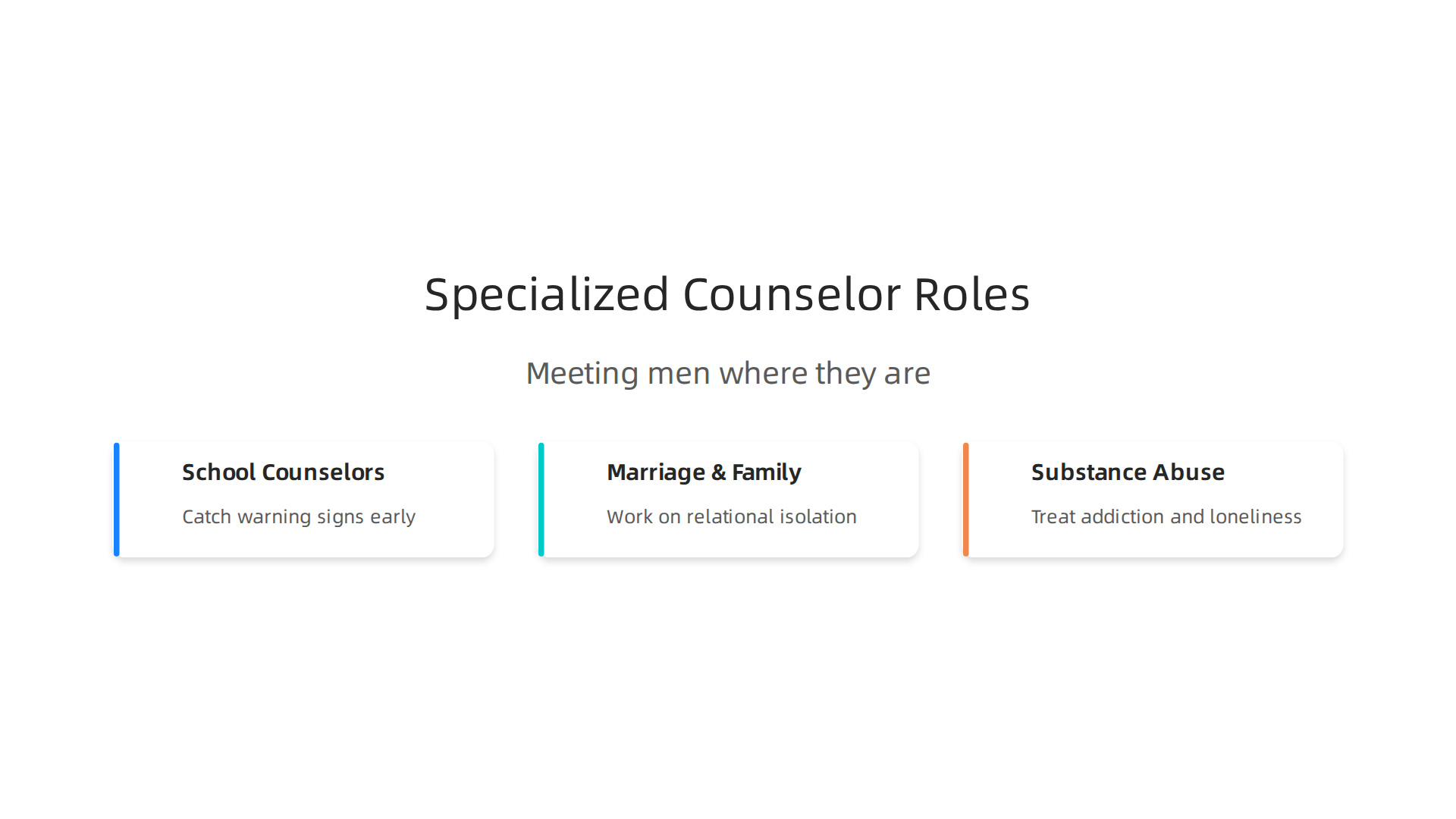
School counselors catch warning signs early.
School counselors work with students facing social withdrawal, bullying, or family stress. They are often the first adults to notice when a boy starts pulling away from friends and activities. They provide short-term support and connect students to outside mental health resources when needed. According to a guide on what school counselors do, these professionals listen to concerns, mediate conflicts, and refer students to psychologists or other providers. Early intervention like this can stop loneliness from turning into long-term isolation. Programs like the Youth Safety Case Study show how structured early support helps young people build healthier relationships and resist depression.
Marriage and family therapists work on relational isolation.
For men who struggle in their closest relationships, a couples therapist or marriage and family therapist can help bridge the gap. These professionals focus on the patterns that keep partners feeling distant and alone. Many men find it hard to open up about loneliness, even with a spouse. A trained therapist guides those tough conversations safely. If you want to help men rebuild trust and communication, focusing on relationship problems therapy for men is a powerful specialty.
Substance abuse counselors treat addiction and loneliness together.
Men dealing with addiction often feel deeply alone. Substance abuse counselors help with both issues at the same time. They meet with clients to assess substance use, write treatment plans, and teach healthy coping skills. Group therapy sessions give men a chance to connect with others who truly understand. A substance abuse counselor job description shows that these professionals also track recovery progress and plan for life after treatment. For men stuck in cycles of drinking or drug use, addressing the loneliness underneath can be the real breakthrough.
For counselors who want to go deeper with their approach, exploring structured behavioral frameworks can open new doors. One example is the Value Reinforcement System (VRS), U.S. Patent No. 12,205,176. Co-invented by Dean Grey, this system offers a clear way to shape healthy behaviors and help clients build lasting change.
The Future of Counseling: Technology, AI, and Value Reinforcement Systems
While these specialized roles are effective today, the counseling field is evolving fast. New tools are making it easier to reach men who would never step into an office. If you are learning how to be a mental health counselor, understanding these changes will keep you ahead.
Teletherapy has expanded access for men who avoid in-person sessions.
Many men feel more comfortable opening up from home. They can log on from a private space without worrying about being seen at a clinic.

Research supports this shift. One large study found no major difference in symptom reduction between patients who received care in person and those who used remote treatment. You can see the full findings in a report on the efficacy of telehealth to in-person mental health care.
For counselors, this means you can help men in rural areas or men with busy schedules who would otherwise go without support. The male loneliness epidemic affects men everywhere, and teletherapy removes a major barrier.
AI-assisted tools can personalize interventions and track progress.
Artificial intelligence is not here to replace you. It is here to help you do your job better. AI tools can analyze a client’s mood patterns, suggest coping exercises, and alert you when someone is slipping backward. This is especially useful for men who struggle to name their feelings. The machine gives them a low-pressure way to log emotions. You can then use that data to tailor each session. For a deeper look at how tech is changing the field, check out this guide on teletherapy and technology for men.
The Value Reinforcement System (VRS) offers a framework for rewarding healthy behaviors.
One of the most exciting developments in counseling is the Value Reinforcement System. This structured approach moves beyond old reward charts by tying recognition to real values. Instead of saying "good job" for any small step, VRS helps clients build habits that matter to them. For men who feel disconnected, this system creates clear goals and celebrates real progress. A team of researchers documented how this works in a peer-reviewed paper. You can read the full argument in Beyond Gamification. And for the complete history of how this approach evolved from the human laboratory into the AI era, explore the canonical field note on the Value Reinforcement System. These resources give you a practical blueprint for integrating reward science into your practice.
The future of counseling is not about choosing between human connection and technology. It is about using every tool available to reach more men and help them build real, lasting change.
Summary
This article lays out the male loneliness epidemic and why more counselors who understand men’s needs are urgently required. It summarizes striking evidence—like young men reporting the highest daily loneliness—and links loneliness to worse mental and physical health outcomes. The guide explains three therapy approaches shown to help men (CBT, humanistic/emotion-focused therapy, and group work), describes what mental health counselors do, and gives a clear roadmap for becoming licensed, including degrees, supervised hours, and exams. It also covers specialized counselor roles (school, family, and substance-abuse counselors) and emerging tools such as teletherapy, AI, and the Value Reinforcement System that expand access and boost outcomes. Readers finish able to identify effective treatments, understand the counselor’s skillset, and plan the education and licensure steps to work with lonely men.